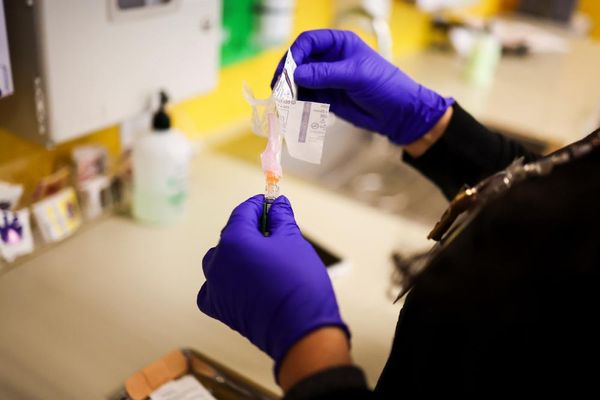
My friend Celia Milstein, who has died aged 92, was among those who contributed to the invention of monoclonal antibodies, which led to the Nobel prize for medicine of 1984, won by her husband, César Milstein, with Georges Kohler and Niels Jerne. Monoclonal antibodies are used in both treatment and diagnosis of diseases, including cancers, and are being trialled against Covid-19.
Celia was born and grew up in the outskirts of Buenos Aires, to Efrain Prilleltensky, an accountant, and his wife, Ana (nee Davidson), both immigrants from the Ukraine who spoke Yiddish. She recalled her childhood as full of beauty.
She attended a state high school in Temperley, province of Buenos Aires. Despite losing her mother when she was a young child, Celia grew to become a strong, determined woman with adventurous, liberal and radical ideas.
She studied chemistry at the University of Buenos Aires, where she met and fell in love with César, a fellow student. They married in 1953.
After taking a year off to backpack in Europe they returned to Argentina to finish their studies, and started working on their research in immunology at the Malbran laboratory, attached to the university.

The 1962 military coup in Argentina made their work impossible. Many scientists were fired and Cesar, as head of the department, resigned. The couple were welcomed into the department of biochemistry at Cambridge University, which they had visited in 1958. The move meant Celia had to sacrifice her PhD but she was able to take a master’s and then went to work at Babraham research campus. She wrote dozens of papers, including many in collaboration with César. Her support both scientific and personal made his work possible.
The couple shared so many passions, science first and then nature, as well as the arts, music and theatre.
Celia retired in 1985, but retained her sense of fun and a wide range of interests. She took several language courses at once; she played piano, took adventurous long journeys around the world in her 70s and 80s, and read. She made all her friends less fearful of old age.
César died in 2002. She is survived by 30 nephews and nieces, of whom Ana Fraile is her next of kin.