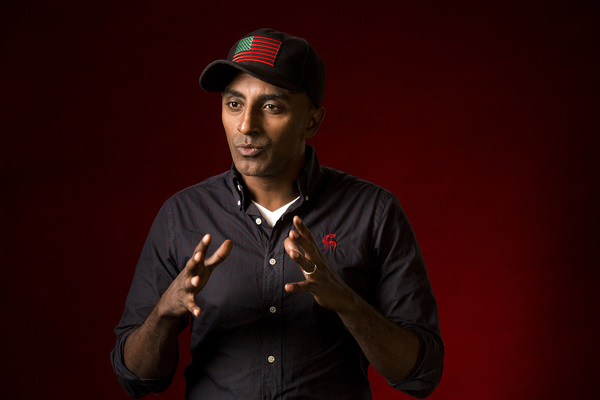
KANSAS CITY, Mo. _ Marcus Samuelsson is wearing a fedora. He flashes a high-voltage smile and looks up for a nanosecond before getting back to the job at hand: autographing 1,200 copies of "The Red Rooster Cookbook" (Houghton Mifflin Harcourt, $37.50).
The cookbooks are laid out on tables in a back room in preparation for a Saturday night Harvesters hunger benefit. Sliding and thunking noises emanate from the human conveyor belt helping Samuelsson. The owners of Rainy Day Books flank the celebrity chef, sliding a copy under the tip of a fat black marker. He scribbles his signature, then pushes the book to the other side, where it is whisked away by a chain of staff and volunteers.
The cookbook pays homage to Red Rooster Harlem, Samuelsson's 130-seat restaurant that opened in 2010 in New York City's storied Harlem neighborhood. The popular restaurant serves 4,500 diners a week, but the book is about much more than a celebrity chef's food.
"Yes, it's about the restaurant," Samuelsson says of his new cookbook, "but it's also about holding on to your dream, executing it and also talking about the community. Harlem is a big part of New York City that people know about all over the world. I write about where it came from and where it is today _ and where it is going."
Harlem's food story is influenced by slavery, the Great Migration and _ as Samuelsson's personal story illustrates _ global immigration. Samuelsson was born in Ethiopia. He and his sister were adopted and raised in Sweden before he came to prominence as a chef in the United States.
Samuelsson was just 23 years old when he was recognized with a three-star New York Times review while executive chef of Aquavit. Before he was 30, Samuelsson was awarded the Rising Star Chef Award by the James Beard Foundation. Since then his resume has grown to include 11 restaurants in the United States, Bermuda, Sweden and Norway, numerous awards and honors, TV appearances, and invitations to cook for four U.S. presidents, including President Barack Obama's first state dinner.
Samuelsson is also a philanthropist, a role that brought him to Kansas City after Mario Batali had to cancel an engagement. Tickets for the event were $10 and included a copy of his book. Samuelsson has been a UNICEF ambassador since 2000, supporting childhood immunization and nutrition programs. He and his wife also started Three Goats, a nonprofit dedicated to improving the health and well-being of children in Ethiopia.
"Chefs have a responsibility in the sense that we have choices of where we're buying our food from and where we're putting our restaurants," he says. "I made a choice to put a restaurant in Harlem, where it was part of changing the communication of what an urban community can look like."
Samuelsson became intrigued by Harlem nearly two decades ago. Today he lives with his wife and young son five blocks from Red Rooster.
"It's really a place that is in and of the community, so we hire locally, and we think about how we present our food, our culture, our music, our design in a fun way that family and visitors can enjoy," he says.
The menu is eclectic and includes a taste of Sweden and Ethiopia, as well as elements of the Caribbean and South America. But chicken is at the heart of Red Rooster.
"Chicken is the one thing that _ unless you're a vegetarian _ every culture, every religion, can relate to it. Some fry it. Some steam it. Some roast it. But it's the one protein that is not divisive," Samuelsson says. "It's also one that you can get so many different things from, from the eggs to the chicken oyster to the soup. There are endless possibilities with the birds."
In Ethiopia, there's doro wat, a chicken stew thickened with berbere spices and onions. In Singapore, chicken is steamed until the skin is almost gelatinous. Chicken in Harlem means fried _ and for someone who grew up in Sweden, a country where salmon is the country's "chicken," the pressure to perfect Red Rooster's fried chicken recipe was an exhausting process.
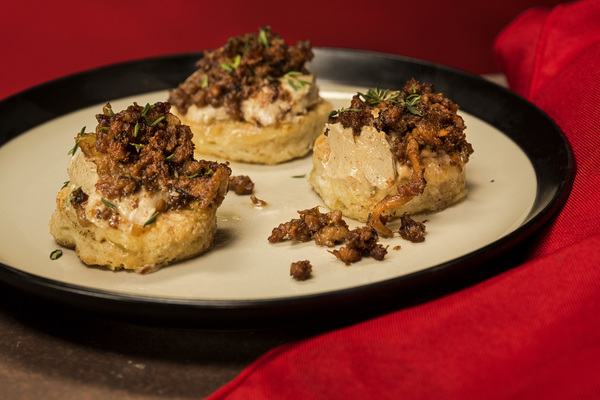
"I'm looking for a sound when you bite into it. It has to have this crackling skin, and then it needs to be very juicy inside," Samuelsson says. Questions he had to answer: buttermilk or no? Dark meat only or not?
"I really took almost two years to come up with it, and I talk about it in the book. My friend (singer/songwriter) John Legend finally said, 'Marcus, you're overthinking this. Fry the damn bird!' "
So is Samuelsson satisfied with his Fried Yardbird recipe?
"Happy-ish!" he says. "But I still haven't found what I'm looking for."
As the chef ticks off the ethnic influences reshaping his adopted neighborhood, I ask about his 2009 cookbook "New American Table" (Wiley), which features the culinary contributions of diverse immigrant groups.
"Whether we want to accept it or not, we are a land of immigrants and we are diverse, although our politicians seem to forget that. But that's OK. They're missing out on a lot of good food, I'll tell you that," he says with a laugh.
"Food does bring you together. We've all said, 'Oh, I haven't been to that country, but I've had their food.' And you tend to learn a little bit more when you've heard a song from a country or read an author from another country."
Reading Gabriel Garcia Marquez transported Samuelsson to South America. His first Bob Marley album took him to Jamaica long before he would ever travel there. Samuelsson thinks a world of eaters are hungry to experience other cuisines and cultures, too.
"I do think there has never been a better time to put out diverse stories," he says. "Because people want to listen to another side and eat (something new). People are curious, and how many times have you heard, 'I can't wait to go to a Korean restaurant' or 'I can't wait to try whatever the next thing is.' But guess what? They're all American, because they're here now."
These days Samuelsson is learning more about Peruvian food, but as he closes the cover of the last cookbook, he begins anticipating his reward: Kansas City barbecue.
"Do people drink wine with barbecue?" he wonders aloud, as he grabs his suitcase and heads for the door.
"The New Orleans chef Leah Chase said it to Julia Child, and there's nothing more true: 'I don't care where you're from or who you are. There's nothing like a good piece of fried chicken.'
I went for dark meat only for our fried chicken. It's juicier, and it's got the crunch that I love hearing."