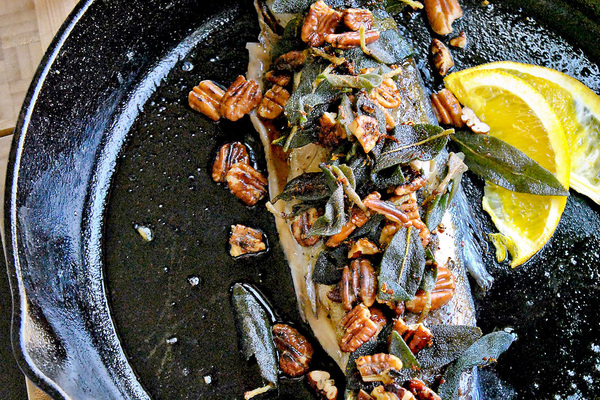
PITTSBURGH _ It's spring, and you know what that means: it's trout fishing season.
Thousands of anglers will be angling for the best fishing spots in local streams and lakes. And the ones who get lucky and land a trout that's at least seven inches? They're probably already dreaming of how to cook it.
My husband, who fishes in the Clarion River near Cook Forest State Park, goes for the simplest of preparations. After gutting his prized catch with a penknife (head and tail stay attached), he douses it in bottled Italian dressing, wraps it in foil and throws the fishy package into the coals at the edge of a campfire. Five minutes later, it's ripe for the picking, and he doesn't even wait for me to hand him a plate _ he eats the roasted flesh right out of the foil, usually with his fingers.
That's the thing about fresh trout. Its soft and flaky flesh is so wonderfully delicate and fresh tasting, that you don't have to get fancy with other ingredients. In fact, simpler is often better when it comes to this member of the salmon family.
That's right, salmon. While the word "trout" conjures up a particular fish, it's actually the common name given to a number of species of freshwater fish belonging to the salmon family. The brook trout, which is native to eastern North America, is Pennsylvania's official state fish, but anglers also can catch brown trout, which made its way to colonial America in the 19th century, along with oilier lake trout and the colorful rainbow trout; if they're ocean-going, the fish are called steelhead.
And if you don't fish? No problem.
All rainbow trout sold in the U.S., in fact, are farm raised, so there's no shame in letting the professionals catch it for you.
Trout have a lot of tiny bones, so you will want to ask your fishmonger to remove the backbone or filet it boned, says Henry Dewey, co-owner of Penn Avenue Fish Co. But you may want to cook the trout whole, with its bones still in, because it's tastier that way, he says.
"Most people just eat around the bones," he says, after grilling it or panfrying it.
Fresh trout have a nice protective slime on their skin when it comes of out the water, so choose fish that look slippery on the outside, Dewey says. It should also have a nice color and firm flesh.
"Use your animal senses to see if it looks fresh," he says.