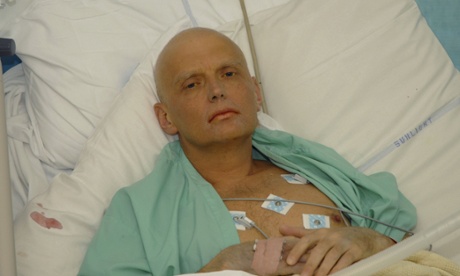
He looks like an average tourist, casually dressed in a denim jacket with a fawn collar. It’s 1 November, 2006. The time is just before 4pm. The man wanders into a hotel lobby, and fails to spot the person he’s due to meet. He makes a call from his mobile phone.
CCTV footage released for the first time on Thursday shows the moment when Alexander Litvinenko arrived at the Millennium Hotel in Mayfair. He had come to meet two Russian contacts, Andrei Lugovoi and Dmitry Kovtun. They would – minutes later – poison him, it is alleged, smuggling radioactive polonium into his cup of tea.
Video retrieved by police from hotel cameras suggests that Lugovoi and Kovtun had meticulously prepared for their encounter with Litvinenko. The meeting took place in the hotel’s ground-floor Pine Bar. Half an hour earlier both Lugovoi and Kovtun made separate trips to the gents’ toilets. They asked for directions at the front desk. Cameras record them entering and exiting. On his way up a flight of stairs, Lugovoi has one hand stuffed in his pocket.
Giving evidence to the public inquiry into Litvinenko’s killing, DI Craig Mascall – the police officer who led the investigation – said that massive levels of radiation were afterwards found in the gents’ toilets visited by the two Russians. The readings were highest on the wooden door of one cubicle. There was also contamination on and immediately underneath the bathroom hand-dryer, he said.
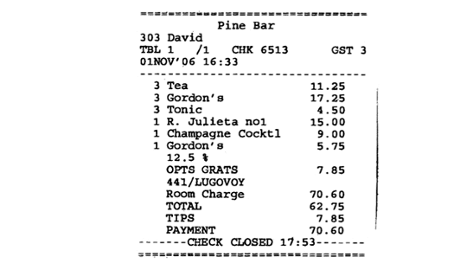
Before Litvinenko arrived at 4pm, Norberto Andrade, the head barman at the Pine Bar, said that Lugovoi and Kovtun had taken a seat at table one. They ordered several drinks, beginning with three cups of green tea with fresh lemon and honey. Andrade said he brought their tea in a white ceramic teapot. He didn’t pour it, he said.
Shortly afterwards, the Russians beckoned him back. “They asked me for more honey,” he recalled. He then brought further drinks – four gin and tonics, a champagne cocktail, and even a £15 Romeo and Julieta cigar. The bill came to £70.60. “I went very rapidly back and forth,” he said. There was “unfortunately” no CCTV covering the bar area, he added.
The inquiry heard that Litvinenko sat with Lugovoi in the bar, initially just the pair of them. Kovtun joined later. Litvinenko told detectives that Lugovoi suggested he drink some of the leftover tea, and fetched him a fresh cup. Litivinenko took three or four sips of the tea. He didn’t like it, he said. Mascall said subsequent tests on the teapot revealed massive contamination.
Shown a photo of the teapot, exhibit number NJH/1, he said: “In my mind there is not a shadow of a doubt that this is the teapot used to poison Mr Litvinenko.”
Earlier the inquiry heard that Lugovoi flew to London from Moscow on 31 October 2006 with his wife Svetlana, daughter Galina and eight-year-old son Igor. In London he met with his other daughter Tatiana and her boyfriend Maxim, who had travelled on a separate flight. The ostensible purpose of this family visit was to watch a match at the Emirates stadium between Arsenal and CSKA Moscow.
New CCTV footage from the hotel reveals Lugovoi checking in, and chatting to his daughters at the front counter.
It also captures Kovtun, a saturnine figure in a dark jacket, who flew to London from Hamburg.
According to Mascall, tests revealed extremely high levels of polonium contamination in the room 383, which Kovtun shared with another Russian, Vyacheslav Sokolenko. Police later concluded Sokolenko – a tall figure, visible on CCTV wearing a football scarf - was not directly involved in Litvinenko’s murder.
Some polonium contamination was found in room 441, which Lugovoi shared with his wife and son. Tatiana and Galina’s room, 101, had low readings. Smaller readings were also found in other items of Pine Bar crockery, after the radioactive teapot was put in the dishwasher.
The inquiry heard that Lugovoi’s own account of what happened on 1 November 2006 was at odds with the evidence. Lugovoi told Scotland Yard detectives who interviewed him in Moscow that Litvinenko had initiated contact. Litvinenko persistently called to set up a meeting, Lugovoi said. Phone records, however, show that Lugovoi called Litvinenko, not the other way round, including at 11.41am, on the day of the poisoning.
The inquiry continues.