This is the second installment of a series looking at the costs of the Chinese Communist Party's struggle for supremacy in China and around the world.
Chinese President Xi Jinping chaired a meeting of the Chinese Communist Party in late April when he spoke about five "great achievements" he has made since his second administration began in 2017.
The five achievements he cited: containing the novel coronavirus; holding out on trade friction with the United States; suppressing the pro-democracy movement in Hong Kong; improving health care and education problems; and realizing the eradication of poverty.
According to a senior party official, the attendees of the meeting gave a round of applause to Xi, who is also the general secretary of the party, as he brought up each achievement.
His remarks are said to be dubbed "Xi's five articles" among senior party officials across China. Yet, as people's discontent with the health care and education problems runs deep while the possibility remains of the trade friction with the United States flaring up again, the party has apparently refrained from having these "achievements" made public overseas.
With Xi set to enter his third term in office at the 20th Party Congress slated for next year, he is said to be fixing his eyes on a long-lasting administration. To be a leader worthy of assuming such a task, he has been needing to stage some achievements. Seizing on the celebrations for the 100th anniversary of the CCP's founding in July, voices of praise as if supporting Xi's long-lasting leadership have been prevailing within the party.
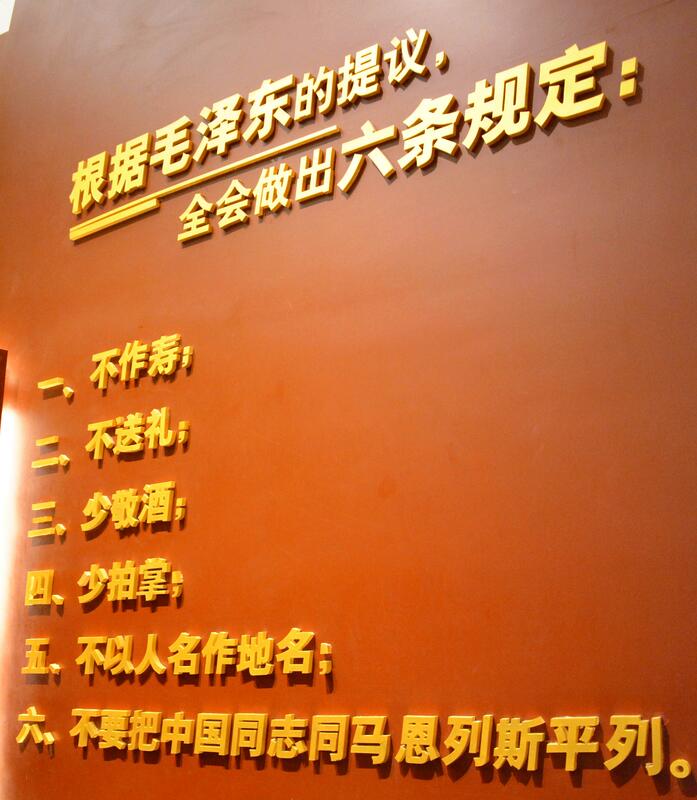
At a press conference on June 9, Liu Guozhong, secretary of the party's Shaanxi Provincial Committee and the top official of the province, praised Xi's guiding thought as "Marxism of the 21st Century." Marxism had been considered as "absolute" in the CCP, a revolutionary party. Its intraparty rules, formulated in 1949 at the suggestion of Mao Zedong, the founding leader of the People's Republic of China, state that Chinese comrades shall not be placed in the same rank as Marx, Engels, Lenin and Stalin. Liu's remarks could be taken as adulation of Xi to a level in violation of the party's rules.
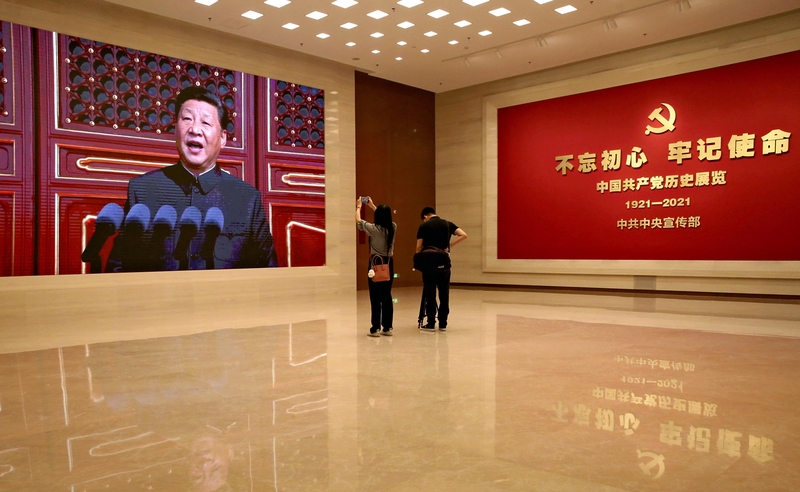
At the memorial hall that opened June 3 to commemorate the party's First National Congress in Shanghai, there are 12 photos of Xi on display, the second most after the 13 photos of Mao. There are only four photos of Deng Xiaoping and three each of Xi's immediate predecessors, Jiang Zemin and Hu Jintao.
--Consolidation of power
Having reflected on the personalist dictatorship and cult of personality during the Maoist era, the CCP in its statutes has stipulated the collective leadership system as an organizational principle. It was defined clearly with the abolition of the post of "party chairman" at the 12th Party Congress held in 1982.
The collective leadership system is the framework under which important political policies are decided by the consensus of several leaders. At the CCP, the members of the Standing Committee of the Politburo (currently seven members, including the general secretary of the party's Central Committee) constitute the party's highest leadership.
Xi, however, was positioned as the "core" leader in 2016, giving him a special status among the hitherto leaders, and in 2018 he had the term limits -- conventionally limited to two terms for a total of 10 years -- as the country's president removed. The authorizing of Xi as a superior presence within the party has been progressing.
According to a source close to the party's center, shortly after the term limits were removed in 2018, Jiang, who held a meeting with Xi, was said to have told him: "Deng once told me, 'If you come to possess the absolute authority to decide, I will feel reassured.' And now that you can decide on anything about China, I feel reassured."
In China today, thorny problems are piling up at home, such as the simultaneously aging and shrinking population and economic disparities, while on the external front, the United States is intensifying its confrontational stance. Giving Xi absolute power and entrusting him with the task of maintaining the existence of the CCP-led administration, even at the cost of overthrowing the party's collective leadership system, is the way of thinking said to have become common understanding among party elders such as Jiang.
--Conjecture runs rampant
But some dangerous signs have also become visible. In Xi's speech made public by the party's ideology magazine in May, the word "I," as used in such phrases as "I emphasized," appeared 37 times. When considered from those speeches made by past leaders, who frequently used the word "we" on the premise of the party's collective leadership, it is reckoned to be quite unusual.
As Xi's consolidation of power advances, one scholar within the establishment in Beijing has said, "Those around him have come to choose to give only information that is satisfying to hear," pointing out the rampant conjecture.
According to several sources, the U.S. government has recently circulated multiple pieces of information in an attempt at finding out how often correct reports have been made to Xi. It found that hardly any pieces of bad information have reached him.
For Xi, there now appears to be no one around him who will speak unreservedly to him, let alone any possible successor. Xi has a long-held ambition of seeing China and Taiwan united and could become unable to judge the circumstances correctly, perhaps even daring to launch an armed offensive at Taiwan. Within the U.S. government, there are even such fears being voiced.
"Building a nation's fate on the popularity of one or two people is very unhealthy and very dangerous," Deng said in 1989 as he reflected on the past. This saying was contained in a summarized history of the CCP published in 2001, the year that marked the 80th anniversary of the party's founding. But in the new version published this February, the saying was nowhere to be seen.
Read more from The Japan News at https://japannews.yomiuri.co.jp/