It has been like a long-distance race where everybody has planned for a sprint finish, so that nobody makes the running. After six of the nine rounds in the London Classic at Kensington Olympia by the end of Thursday, the two over-40s Vishy Anand and Veselin Topalov trailed but the other eight grandmasters were covered by half a point. Four of them, including the world champion, Magnus Carlsen, had drawn every game. With $150,000 for the top three in the overall Grand Tour plus $150,000 for first prize in London yet to be decided, the final two rounds this weekend could see some serious action.
At least, one hopes so. With 80% draws in these six rounds, the Classic was also in contention for a place in chess history for the wrong reasons. Decades ago there was an annual tournament at Sarajevo in the former Yugoslavia which was mockingly known as the “Tournament of Peace” because so many games were drawn. Ever since then some organisers have made sure that their participant lists included players with combative styles to ensure a good quota of interesting games and decisive results.
So the incentives are there for the final two rounds this weekend, which will be watched by a packed audience at Olympia plus huge numbers of online watchers who will be aided by move-by-move computer and GM analysis.
If, despite all this, the final two rounds fail to be spectator friendly, serious questions will be asked. In the Grand Tour nine of the GMs compete in every event, whereas in the rival Fide Grand Prix (and in the World Cup series in the 1990s) each tournament has a different group of players. The Grand Tour structure is such that, once qualified via the world ranking list, every participant is assured of a generous payday. It is a high-class closed shop and that has its dangers. One obvious move would be a return to soccer-style 3-1-0 scoring, which was used in previous London Classics but abandoned when it became part of the Grand Tour.
Technically the No1 opening at London, as in many contemporary tournaments, has been the Berlin Wall 1 e4 e5 2 Nf3 Nc6 3 Bb5 Nf6 4 0-0 Nxe4 5 d4 Nd6 6 Bxc6 dxc6 7 dxe5 Nf5 8 Qxd8+ Kxd8. GMs like it as it poses subtle strategic challenges for both sides but many amateurs view it, as they did the Petroff 1 e4 e5 2 Nf3 Nf6 which had its heyday in the 1990s, as a cop-out from the stressful business of complex tactical games.
Players who drew all their first six games included the world champion, Magnus Carlsen, and the England No1, Michael Adams, but the verdicts are very different. For Carlsen, London has been a continuation of the sub-par form which has dogged him all year. He tried to grind his opponents down, but he let a win slip against Anand while in most other games he got no advantage. Adams was the home wildcard, and, asked to describe himself in one word, chose ‘underdog’. His play has been very solid and defensively impressive, so if he keeps it up at the weekend he can look back on a job well done.
The highlight game so far was in the very first round, when Topalov, in an even position (33 Bxe4) took a hot pawn with his queen and fell into a mating attack.
Veselin Topalov v Anish Giri
1 d4 Nf6 2 c4 g6 3 g3 c6 4 Bg2 d5 5 Qa4 Nfd7 6 cxd5 Nb6 7 Qd1 cxd5 8 Nc3 Nc6 9 e3 Bg7 10 Nge2 O-O 11 O-O Re8 12 b3 e5 13 dxe5 Nxe5 14 h3 Bf5 15 Nd4 Bd3 16 Re1 Ba6 17 Qd2 Nd3 18 Rd1 Bxd4 19 exd4 Qf6 20 a4 Qxd4 21 a5 Nd7 22 Ra4 Qe5 23 Nxd5 Nxc1 24 Rxc1 Nf6 25 Nc7 Rad8 26 Qf4 g5 27 Qb4 Qb2 28 Raa1 Re2 29 Qc5 h6 30 Nxa6 bxa6 31 Rab1 Qd2 32 Bf3 Ne4 33 Qxa7? Nxf2! 34 Bxe2 Nxh3+ 35 Kf1 Qd5! 36 Bh5 Qh1+ 37 Ke2 Qg2+ 38 Ke1 Re8+ 39 Kd1 Nf2+ 40 Kc2 Ne4+ 0-1
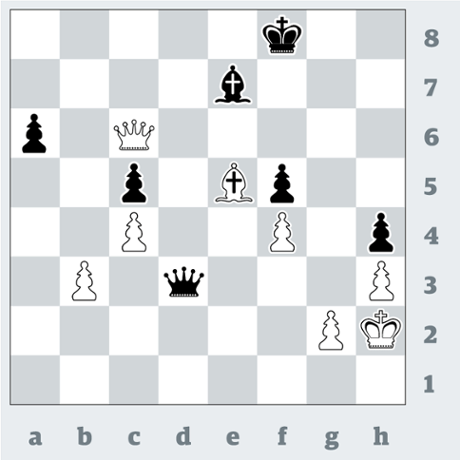
3420 1 Qg6! is the chess equivalent of an open goal. White threatens 2 Bg7+ Kg8 3 Bh6+ and 4 Qg7 mate, and the only defence 1...Qg3+ 2 Qxg3 hxg3+ 3 Kxg3 is a hopeless ending for Black.