
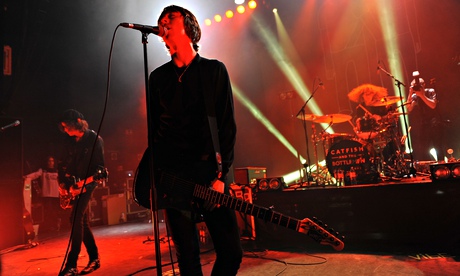
“Tear the roof off, London!” urges Van McCann, the voluble, black-clad urchin front and centre of the guitar-toting success story of recent months, Llandudno’s Catfish and the Bottlemen.
We are a mere two songs into an hour-long rip through the Bottlemen’s debut album, The Balcony, released six months ago, and the denizens of the venue’s two balconies are all on their feet, hollering along to McCann’s tales of young coupling. The roof is in no immediate peril but the moshpit is swaying like a giant pink anemone on a rising tide. By the end, some crowd-surfers are even rolling into the shore of the security pit, a no-no at most big venues nowadays. If anyone gets chucked out, promises McCann before the final song, they’re on the guest list for tomorrow night. No one here is folding their arms, London-fashion, waiting to be impressed: the crowd, almost half female, are long since invested in this band and do a lot of McCann’s singing for him.
A few minutes earlier, waiting for the Bottlemen to come on, this crowd greet Arctic Monkeys’ Why D’You Only Call Me When You’re High with word-perfect enthusiasm, lending credence to the idea that Catfish and the Bottlemen are the Sheffield band’s descendants. Delivered with verve and conviction, if no great artfulness, many of McCann’s songs tonight seem to follow on directly from the first two Arctics albums, full of he-said, she-said dynamics, with one hand in the kitchen sink of lyrical observation (“She deffo didn’t like that, no,” McCann mutter-sings on Pacifier ) and the other hand snaking its way down someone’s pants.
The band’s album cover and T-shirts feature a line drawing of a boy and girl mid-fondle. You’d be tempted to say few British bands since the Arctic Monkeys have reflected the lives of lusty 19-year-old miscreants back at them so accurately, but then the 1975 have done a tidy job of that recently, albeit with a far poppier sound.
The Bottlemen’s Venn diagram – or Vann diagram, seeing as this band knows who its leader is – includes the Strokes, Oasis, Kings of Leon, the Kooks and Razorlight. You get the feeling they have carved out a niche for themselves through both natural inclination (guitars, songs about girls) and trenchant market-watching. Get it right, and there is always room for four more boys with tight trousers; get it wrong and your band are just more cannon-fodder, headed for a grave marked “landfill indie”.
Aesthetes may sneer – NME gave The Balcony 4 out of 10 – but in the court of public opinion, Catfish and the Bottlemen seem to be doing all right. Their sound is studiedly generic, lowest-common-denominator guitar music, but the Bottlemen are tight, lean and not given to slowing down, one of the chief gripes of Arctic Monkeys fans of recent years. On the ballads you can hear Oasis’s influence more clearly, but neither Gallagher would ever have started a song with the words “You’re simpatico”, as McCann does on one of his most instantly gratifying songs, Kathleen. At the end of the other – Cocoon – he quotes a little Dancing in the Dark by Bruce Springsteen.
Another Catfish album is almost ready to go, McCann reveals, in an accent that is less Llandudno than Liverpool; the band might be able to play us some of it, he hopes, by the time this tour hits London’s Brixton Academy in November. The Bottlemen sealed their fate with crowd-winning performances at last year’s festivals; this year they are playing dozens more, plus a tour of the US. Those two November dates at the nigh-on 5,000-capacity south London venue – one of rock’s staging posts – sold out in six minutes, a turn of events that has McCann shaking his head.
He’s not the only one. Pop music can be a fantastically meritocratic medium, catapulting talented nobodies to renown. Over the past decade, though, success seems to have been funnelled towards the alumni of fame academies and talent shows, or towards bands from backgrounds with some inbuilt cushioning.
There is nothing inherently wrong with cushioning, or learning one’s craft, but the musical art of springing as if from nowhere, with thousands of miles on the clock of a knackered van and borderline malnutrition, seemed in danger of being lost. Enter Catfish and the Bottlemen, a phenomenon whose retro-feel, old-school dues-paying and grassroots-up trajectory is, if nothing else, proof that democracy still works in pop.












%3B1200%3B1200)