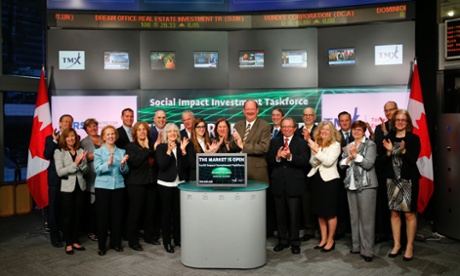
The Social Impact Investment Taskforce has created a buzz with the recent publication of a report that lays out “relatively simple, inexpensive and practical steps” that could unlock up to $1tn in new investment for innovative and effective approaches to social problems worldwide.
Established by UK Prime Minister David Cameron, the Taskforce brings together experts from the G7 countries, the European Commission and Australia to catalyse a global market in impact investment.
Seeking a nuanced perspective on the report and insights on social investment in Canada, the British Council spoke to lead executive Tim Jackson and senior policy advisor Sarah Doyle from the Toronto-based MaRS Centre for Impact Investing.
What do you make of the Taskforce report?
Tim Jackson: For decades, governments have struggled to tackle enormous social problems. It is clear that they cannot solve these issues alone. At the same time, asset managers are signing on to the United Nations Principles for Responsible Investment (PRI). This signals a realisation that significant assets can be leveraged for more than pure financial gain.
Sarah Doyle: The Taskforce report makes a bold prediction about the potential size of the global impact investment market, which can be read as a call to action.
This will sometimes require public investment – to catalyse fund development and prove the viability of the market, or to enter into outcomes contracts, which allow governments to pay only if success is achieved and can give non-profits access to capital markets to grow promising interventions to scale.
Other steps to grow the impact investment market can be taken without any expenditure – for example, by creating an enabling legislative environment for social entrepreneurship and impact investment. And some can be taken independent of governments.
Did the Taskforce foster international collaboration?
TJ: One of the great aspects of the Taskforce work was exposing each country to global best practices. In the case of Canada, for example, we modeled some of our recommendations for regulatory reform on UK practices. Likewise we are closely watching the US roll out of social impact bonds to help structure similar transactions in Canada.
SD: Impact investment has grown in unique directions in each of the countries involved in the Taskforce, underlining the value of shared learning.
For instance, in France, a law was passed requiring that all corporate employee pension plans offer at least one “solidarity fund”. These funds invest 5-10% in eligible social enterprises, and typically invest the rest according to Socially Responsible Investment (SRI) principles. This has created a significant impact investment retail market.
Tell us about impact investment in Canada
SD: Canada’s impact investment market is growing, but still nascent. More specialised products and services are emerging, with a growing marketplace of dedicated impact investing intermediaries. According to a recent report, there are about 45 impact investment products in Canada, with private debt products being the most common.
This year, Canada’s first social impact bond was launched in Saskatchewan, focused on at-risk mothers and their children.
In terms of impact investors, early leaders include foundations, credit unions and community finance institutions. Banks – notably, the Royal Bank of Canada (RBC) and TD – are starting to move into this space.
Governments have engaged in impact investment or related activity in Canada through direct financing, loans and loan guarantees, but so far in an ad hoc fashion. Some examples include the BC Coast Opportunity Funds, Ontario Catapult Microloan Fund, and Quebec’s Fiducie du Chantier de l’économie sociale.
What issues is social investment addressing in Canada?
TJ: Homelessness, alongside related factors such as mental health, is a likely area of focus for Canada, as we have seen some early work on this issue and government interest appears to be significant. Likewise, unemployment has early potential. Governments across the country have identified this as a priority area, and we have seen successful impact investing projects in this field that could now be scaled up.
SD: A significant portion of impact investment activity is associated with environment, cleantech, and renewable energy. There is also significant activity in the area of housing and community facilities.
What are the barriers to the growth of impact investment in Canada?
SD: There continue to be gaps between innovative non-profits and social ventures that are demanding capital, and impact investors who are looking to deploy capital. And in many cases, legislative and regulatory frameworks fail to recognise the value of impact investment and social entrepreneurship.
TJ: Getting money managers to understand the space is a key challenge. There is also a lack of products that suit the needs of large institutional investors, such as pension funds.
What are MaRS’ priorities in seeking to reduce these barriers?
TJ: Our focus is on early wins, to demonstrate success and prove the value proposition.
SD: A tangible example is the Social Venture Connexion (SVX), which we launched last fall in collaboration with TMX Group and other partners.
The SVX is the first platform of its kind in North America, built to connect impact ventures, funds and investors in order to catalyse new investment for ventures that have demonstrable social or environmental impact and the potential for financial return.
The SVX is registered with the Ontario Securities Commission. It includes over 100 investors, 20 ventures, and 4 funds. CAD$3.2m (£1.8m) has been raised via the SVX to date. These numbers are continuing to grow.
With early success already demonstrated in Ontario, we are now in the process of rolling the SVX out in other provinces across Canada, and in locations across the Americas.
The MaRS Centre for Impact Investing is a social finance hub and project incubator that supports the development of impact investing in Canada. Tim Jackson, the Centre’s lead executive, is Canada’s sector representative on the Social Impact Investment Taskforce. He previously worked at the University of Waterloo in a number of roles, including as vice president, University Relations, and as CEO of its Accelerator Centre – a campus-based incubator for start-ups – and is an experienced venture capitalist and entrepreneur. Sarah Doyle is a senior policy advisor at MaRS. She is responsible for working with community, government and private sector stakeholders to develop and advance policy on impact investment in Canada.
Contact the British Council at social.enterprise@britishcouncil.org
More from the British Council partnerzone:
- Nobel Peace Prize winner Yunus urges leaders to create “poverty museum”
- Buy Social launches in Canada
- Bangladeshi students win the International Virtual Enterprise Challenge 2013
Content on this page is paid for and provided by the British Council, sponsor of the International hub.