BARCELONA, Spain_The regional government of Catalonia refused again Sunday to back off from its demand for independence from Spain, while Madrid harshly chided secessionist leaders and branded as illegal any move to try to break away from Spain.
The independence furor in Spain's most affluent region has sent shock waves across Europe, with neighboring governments fearing that the Catalonia showdown _ the most serious constitutional crisis in Spain's four decades of democracy _ could galvanize separatist sentiment elsewhere.
Angry exchanges between senior officials on both sides have become the norm. Speaking Sunday on BBC, Spain's foreign minister, Alfonso Dastis, responded acidly to a contention by the speaker of the Catalonian parliament, Carme Forcadell, who said Spain's plans to impose direct rule in Catalonia were a "de facto coup d'etat."
"If anyone has attempted a coup, it is the Catalan regional government," Dastis said.
Spain prepared for a Senate vote this week on the unprecedented step of imposing direct rule in the northeastern region, whose capital, Barcelona, was roiled by huge street protests Saturday.
Seeking to choke off the secession drive, Prime Minister Mariano Rajoy is calling for an administrative takeover that would displace senior Catalonian officials and give the central government control of the regional police, together with Catalonia's finances and public media outlets.
Rajoy wants Spanish lawmakers' approval for calling a regional election, an idea that Catalonian officials said was out of line. Jordi Turull, the chief spokesman for Catalonia's regional government, told the main Catalan-language private radio station, RAC1, that new parliamentary regional elections were "not on the table."
Three weeks ago, voters in Catalonia overwhelmingly voted in favor of independence, but fewer than half the region's residents took part in the referendum, clouding the result. Spain said the referendum was in violation of the national constitution, and sent in police to try to stop the vote.
The regional parliament has not voted on a declaration of independence, but Turull did not rule out such an action. "What Catalonia is will be decided by the parliament legitimately elected by the citizens," he said.
Spain again warned sharply against any further secessionist moves. Dastis said the imposition of direct rule was a step that Madrid was reluctant to take, but he insisted it was necessary to restore order.
"We are going to ... rule the day-to-day affairs of Catalonia according to the Catalan laws and norms," he said on BBC.
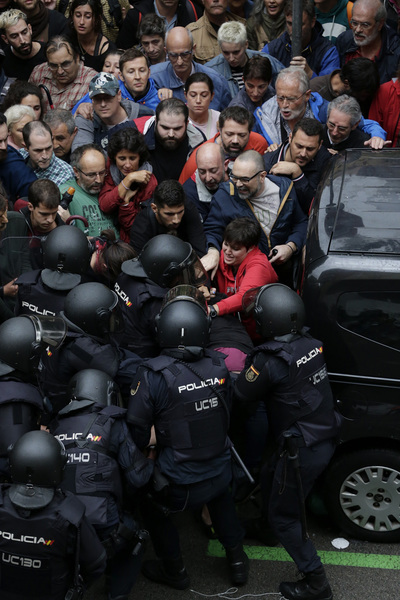
The foreign minister also questioned the veracity of widely seen images of police engaging in aggressive acts against voters and would-be voters during the referendum on Oct. 1. Independence backers said hundreds of people were injured.
"Many of the pictures proved to be fake pictures," Dastis said. "If there was any use of force, it was a limited one" meant only to enforce the law.
Rajoy's decision to invoke Article 155 of the Spanish Constitution takes the dispute into uncharted territory. The provision, granting the government broad powers in the event of a serious breach of law in any of Spain's semi-autonomous regions, has never been used.
Approval of the Senate, which Rajoy's party controls, is almost a certainty, which means the administrative takeover could go into effect immediately afterward.
The government has said steps under Article 155 would cover matters including security, public order, finance management, taxation, the regional budget, and public media outlets. Rajoy, speaking on Saturday, said Madrid was not "ending Catalan autonomy," but the scope of the central government's planned actions was more severe than many expected.
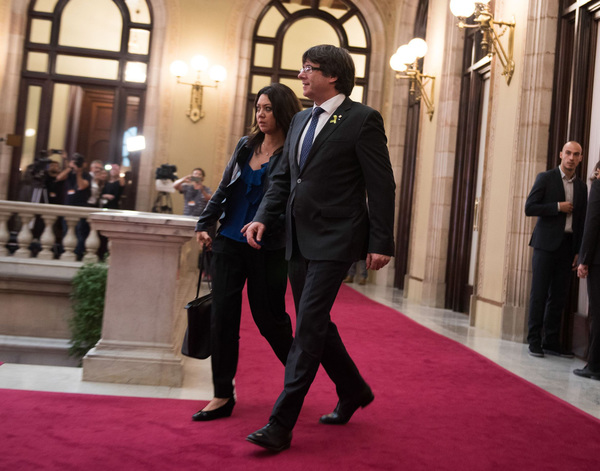
Catalan President Carles Puigdemont Saturday excoriated the anticipated actions by Madrid as the most serious attack on Catalonia's foundations and principles since the dictatorship of Francisco Franco, who died in 1975 after a repressive four decades of rule.
Speaking on Catalan TV _ one of the now-imperiled media outlets _ he said that he would consult with the regional parliament about how to respond to "these attacks on democracy."

On both sides of the secession divide, many feared serious economic fallout. Catalonia accounts for one-fifth of Spain's economy, and Barcelona is a world city that draws millions of visitors. But dozens of companies are decamping, or preparing to do so, moving headquarters elsewhere in Spain in anticipation of possible civil strife and legal limbo.
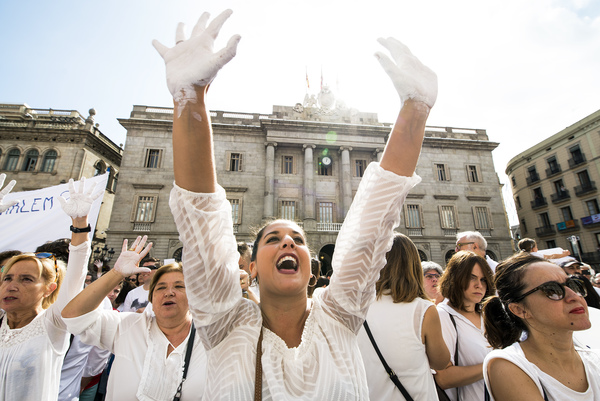
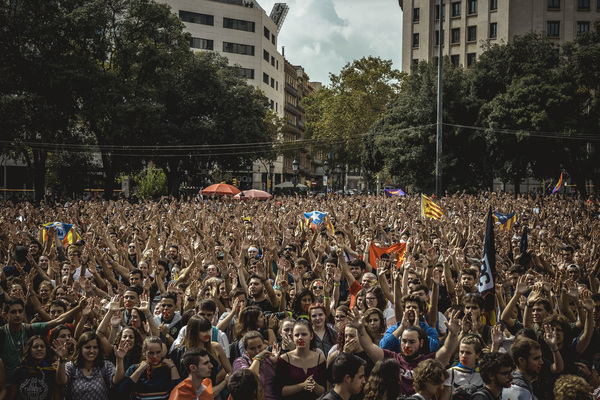
On Sunday, a day after nearly half a million people poured into the streets to protest the central government's takeover plans, shoppers and cafe-goers supplanted protesters.
Even many who did not favor independence were outraged by what they saw as Madrid's overreach.
At a bar near Barcelona's City Hall, a group of friends who all voted for independence recalled the stifling of the region's unique culture when they were growing up, although there has been a Catalan-language resurgence in recent years.
"They took our culture, our language, our identity _ we couldn't speak Catalan," said Judith Sabanes Parramon, who wore a bracelet emblazoned with the Catalan flag used as a symbol of the independence movement. "If they saw three people in the street talking they said 'What's happening?' In families, people still spoke Catalan, but secretly."
In the Spanish capital, sentiment tilted strongly in the government's favor, with many voicing solidarity with Rajoy's self-described attempts to keep the country together.
"It is the Catalan government that has decided to place itself outside the law, damaging democracy," said Mario Perales, a civil servant in Madrid. "The rule of law has to be imposed."
����
(King reported from Washington. Special correspondent James Badcock in Madrid contributed to this report.)