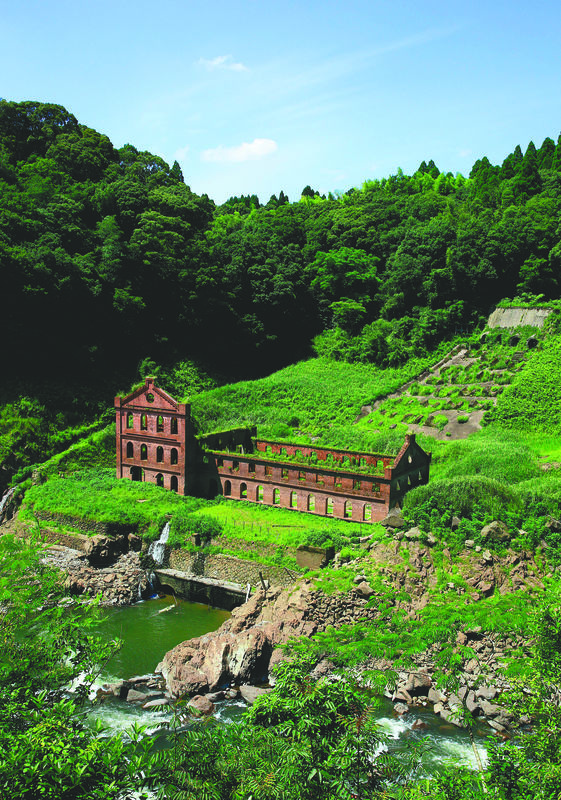
ISA, Kagoshima -- Having put the forest behind me, the road ahead revealed what looked like an old castle from medieval times.
The "castle" is actually remains of the Sogi hydroelectric power plant in Isa, Kagoshima Prefecture. The brick-walled building now sits on a lake bottom and appears above water for only a limited period of the year, from early summer to early autumn.
The structure has been a popular topic on the internet for several years, because users say that it looks like the Castle of Cagliostro, featured in one of the "Lupin The Third" anime movies. Tourists visiting the site, mainly young people, have increased over time.
Toshinori Fuchinoue, 66, chairman of Isa-shi Kanko Tokusan Kyokai, a municipal association for promoting tourism and local specialty products, said, "Even among local residents here, there were people who did not know of the existence of the ruins until a short time ago."
The hydroelectric power plant was built on the Sendaigawa river in 1909, the 42nd year of the Meiji era, to provide electricity to a gold mine.
But in 1966, the Sogi plant ended its role, because the Tsuruda Dam, built for flood control and electric power generation, was completed in the downstream area. The Sogi facility was subsequently submerged in the present dam lake.
"Probably it is popular because it can be seen only this period of the year," Fuchinoue said.
The old plant reappears as the water behind the Tsuruda Dam is reduced from late May to September, when rainfalls are heavy every year, so that the dam can handle the seasonal rise.
The structure became a tourist spot partly because of efforts by local residents.
In the latter half of the 1990s, the plant's bricks were about to break down, and thus an increasing number of local residents voiced a demand for its preservation.
While seeking assistance from administrative authorities, the residents collected donations in a scheme dubbed the "choju renga supporter" (supporters for long-lasting bricks) system. In the scheme, donors were able to have their names carved on bricks for repairs of the structure.
For a decade from 2004, the management office of the Tsuruda Dam carried out reinforcement work on the structure, and as a result, the Sogi plant ruins regained its magnificent appearance.
After obtaining permission from the Isa city government, which manages the site, I walked around the ruins being guided by Akiyo Yamashita, 73, who is chairman of Isa-shi Kanko Volunteer Guide no Kai, a local association of tourism guide volunteers.
Though only the exterior walls of the former plant remain now, traces of a turbine remaining behind the walls made me imagine the past years.
Initially, I thought the bricks were black because red bricks were tarnished by the waters. But Yamashita said, "During the war, the bricks were painted black to protect the power plant from U.S. forces' bombings." So the structure is also a witness of history.
Record-breaking torrential rains that hit the Kyushu region in early July caused flooding on a branch of the Sendaigawa river in Isa. Rocks and mud flowed into rice paddies, where plantings of rice seedlings had just finished. In the paddies, the city's local specialty rice brand, Isa-mai, has been grown. In addition, ditches around the farm were seriously damaged.
The city government made intense efforts to remove the detritus and provide other special aid for agriculture. They asked for donations through the furusato nozei donation scheme, in which donors can receive local tax cuts in exchange for their donated money. For restoration of the farming lands, both the public and private sectors in the city have jointly made efforts.
Yamashita said: "The power plant's construction and fall to its current state are the results of coexistence between people and the natural environment. When the problems of the novel coronavirus crisis subsides, I want people to come here to see [the ruins]."
-- Rice, shochu fostered by water
Isa is located in the northernmost part of Kagoshima Prefecture. It neighbors Kumamoto Prefecture in the north, Miyazaki Prefecture in the east, and is located in a basin surrounded by mountains in all directions.
The city is famous nationwide as a production site of imo-jochu, a kind of shochu spirits made from sweet potatoes. But recently, the city has been promoting itself as the birthplace of shochu.
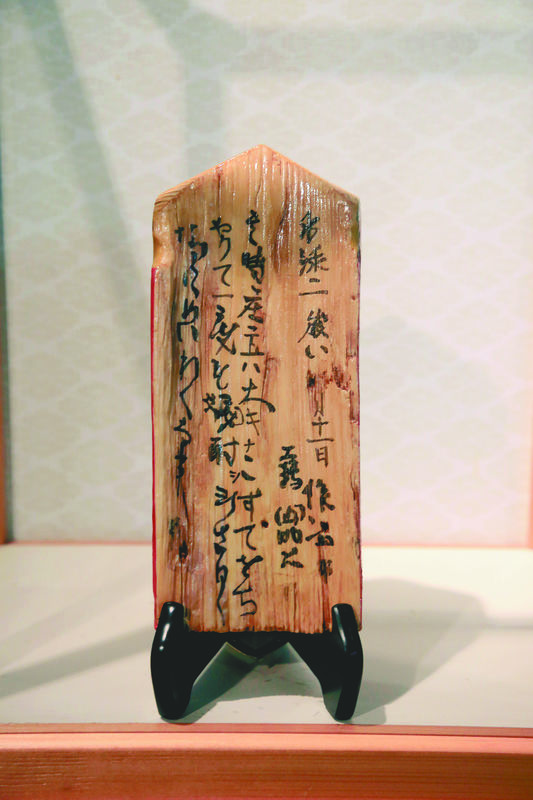
There is a written item that can underwrite the insistence in Koriyama Hachiman Jinja shrine, which is believed to be built in the 12th century.
Lines of graffiti left long ago by a carpenter who worked for refurbishment of the main hall was found in 1954 during repair works of the building.
A piece of wood nailed to the building bears a phrase that means, "The manager of this shrine is too petty, and so I have never been served shochu. This is so bothering." The graffiti included the name of a year as the second year of the Eiroku era, possibly 1559.
Historians say that it is Japan's oldest written depiction of the word "shochu."
Junichi Harada, 71, an official of the city's Okuchi Rekishi Minzoku Testudo Kinen Shiryokan (history, culture and railway memorial museum), said, "In those years, it seems that people made shochu from millets such as foxtail millets and barnyard millets, instead of sweet potatoes."
However, millets were precious foods at that time. "In this area, people in those years used them for making shochu. It well-indicates that commoners have usually drunk shochu and enjoyed life since so long ago," Harada said.
I, also a shochu lover, had an infectious laugh when he said this.
Read more from The Japan News at https://japannews.yomiuri.co.jp/