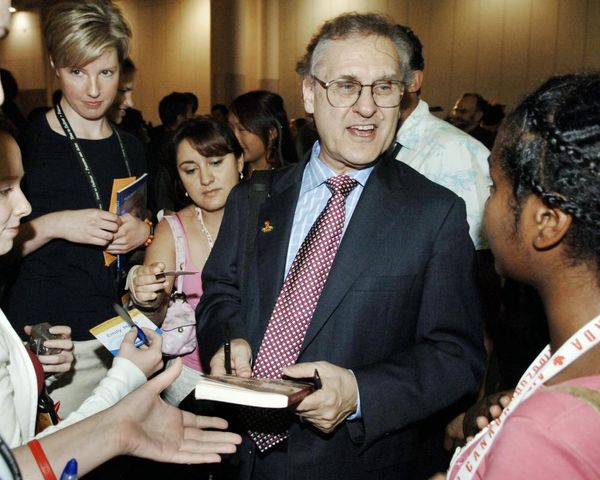

Chicago casino magnate Neil Bluhm has lined up a team of blue-ribbon lobbyists to try and convince the City Council not to lift the ban on sports betting in Chicago.
On Monday, Bluhm made the argument himself during a subject matter hearing on sports betting in Chicago. It’s the political equivalent of a heavyweight boxing match that has pitted Chicago sports team owners against those vying to build a Chicago casino.
He argued that lifting the Chicago ban on sports betting would have a “material negative impact” on both a Chicago casino and city revenues from it — to the tune of $88 million or ten percent of the “projected gaming revenue” — regardless of which of the five sites and development teams is picked.
“If there’s sports books at the stadium, it’s projected that the Chicago casino sports betting business would drop from $40 million-a-year to $13 million. Almost a 70 percent drop. While this will hurt the Chicago casino sports book revenue, the city doesn’t collect any tax revenue from sports betting,” Bluhm told the joint committee on Zoning and License.
“The bottom line is that less people will come to the Chicago casino when they can bet on sports at the stadiums, particularly at these really good, close locations [at Wrigley Field and the United Center]. That means that less sports bettors will walk around the casino and play slots and table games and less people go to the restaurants at the casino if they can also be betting sports at the same time at the stadium.”
Bluhm specifically argued that Chicago casino revenue from slots and tables would drop by $61 million-a-year if there’s sports betting at the stadium. The city would lose 20 percent or $12 million of that. The state of Illinois would lose $9 million.
Bluhm’s interest in blocking the ordinance is two-fold. His Rush Street Gaming company is part of two separate groups vying to build a Chicago casino.
And his Des Plaines-based Rivers Casino already has a sports book that stands to lose business if sports betting is legalized in Chicago.
/cdn.vox-cdn.com/uploads/chorus_asset/file/19779536/SPORTSBOOK_031020_13.jpg)
Former City Corporation Mara Georges, a registered lobbyist for the United Center, accused Bluhm of over-stating the case for selfish motives.
“I question the fact that he would encourage you to vote against an ordinance that pushes business out to his DesPlaines casino because that is what it will do,” Georges said.
“If the tax rate on Illinois gets too high on sports book or if sports book is not allowed in the city of Chicago, all that will happen is those bettors will leave the city and flee to locations outside the city.”
Bluhm has personally registered as a lobbyist and lined up a high-powered team of lobbyists to join him in trying to kill or, at the very least stall the sports betting ordinance championed by Ald. Walter Burnett (27th), whose ward includes the United Center.
Those lobbyists include: John Dunn, who spent eight years as intergovernmental affairs director for former Mayor Richard M. Daley; former Ald. LaTasha Thomas (17th); Mike Houlihan, son of former Cook County Assessor Jim Houlihan; Patrick Carey; Rolando Acosta and Patrick Carey.
Two months ago, the Chicago Sun-Times reported that John R. Daley — son of Cook County Commissioner John Daley and a nephew of former Mayor Richard M. Daley — is working as a lobbyist for the White Sox as the team, acting in concert with the Cubs, Bears, Blackhawks and Bulls, pushes for the City Council to let all of them open sports wagering facilities at or near their stadiums.
That’s even though John R. Daley’s first cousin Ald. Patrick Daley Thompson represents the family’s political base, the South Side’s 11th Ward that’s home to the Sox ballpark, Guaranteed Rate Field. Sources say another lobbyist, not Daley, has been assigned to lobby the alderman on behalf of the Sox.
Thompson — a grandson and nephew of Chicago’s two longest-serving mayors — has been supportive of the proposal to allow sports betting at stadiums and arenas in discussions with fellow aldermen, lobbyists and others in recent months, sources say.
Joining Georges on the roster of high-powered lobbyists representing the Blackhawks, the United Center or the Wirtz family are: Mike Noonan; Amy Degnan; Guy Chipparoni; Richard Velasquez, Ken Sawyer and Gyata Kimmons.
/cdn.vox-cdn.com/uploads/chorus_asset/file/22968144/ballys2.png)
Sports moguls laid out their argument to lift the Chicago ban on sports betting in a flier distributed to aldermen in advance of Monday’s hearing.
It estimates that “direct and indirect tax revenue to the state, county and city from sports wagering” would “exceed $79 million annually.”
“Without action, Chicago would continue to lose patrons to sports wagering facilities outside the city limits or utilize mobile betting services,” the flier states.
“The city would also miss out on incremental job creation as well as incidental food, beverage and amusement tax revenues.”
Mayor Lori Lightfoot has expressed concern that lifting the Chicago ban on sports betting could “cannibalize” the Chicago casino that has eluded her predecessors for decades.
That’s apparently why the Chicago Park District refused to engage in good faith discussions with the Chicago Bears on their year-long request to create a mecca for sports betting near Soldier Field.
The spurned request is yet another reason why the team has signed an agreement to purchase the 326-acre site of the now-shuttered Arlington International Racecourse for $197.2 million.
Bluhm’s company signaled it was all-in on a Chicago proposal last month when it pulled out of the running for another new casino slated to break ground in Waukegan.
He has long been considered a shoo-in to apply for the city casino license, given his success running the state’s most lucrative gambling mecca, Rivers Casino in Des Plaines — in addition to his close ties to the mayor. Lightfoot has received more than $200,000 in campaign contributions from Bluhm’s daughter Leslie and her sister Meredith Bluhm-Wolf.
Bluhm is a key player in the development group that seeks to open a temporary, then permanent Chicago casino at the McCormick Place Lakeside Center after adding 2,000 parking spaces making “significant capital improvements” to that aging and seldom-used facility.
That plan would require the development team to secure a “very long-term ground lease” with the Metropolitan Pier and Exposition Authority, which owns McCormick Place.
Bluhm’s second hand in the Chicago casino game is a partnership with development firm Related Midwest as Rivers 78 Gaming LLC. That proposal aims to break ground within the 62 vacant South Loop acres near Roosevelt Road and Clark Street. Specifics on that proposal have yet to be announced.
The Cubs have forged a $100 million partnership with DraftKings that could pave the way for Wrigley Field to house the first stadium sportsbook in Major League Baseball. But, it can’t happen unless the City Council lifts the ban on sports betting in Chicago.
Burnett’s ordinance would do just that.
Under the plan, sports betting would be authorized at Wrigley Field, Guaranteed Rate Field, Soldier Field, the United Center and Wintrust Arena or in a “permanent building or structure located within a five-block radius” of those stadiums.
Sports wagering would also be authorized inside inter-track wagering facilities and inside a Chicago casino,
No more than 15 kiosks or wagering windows would be allowed at each location unless bettors can also purchase food and drink.
No one under age 21 would be allowed to place a bet. Sports wagering would be prohibited from midnight to 10 a.m., Monday through Thursday; midnight Friday to 9 a.m. Saturday; and 1 a.m. to 9 a.m. on Saturday and Sunday.
The city would issue two types of sports wagering licenses: “primary” and “secondary.” Primary sports licenses would start at $50,000 a year and cost $25,000 for annual renewal. Secondary sports licenses would start at $10,000, with an annual renewal fee of $5,000.
As Monday’s hearing got under way, Burnett argued that sports betting would “benefit all of the restaurants and businesses” in his Near West Side ward without hurting a Chicago casino.
With the exception of game days at the United Center, Burnett said, “It’s dead in our community. You just see an island of parking lots.”
Ald. Anthony Beale (9th) strongly disagreed. He called Burnett’s ordinance “one of the worst” and most “ill-timed” gaming ordinances ever drafted because of its potential to discourage developers vying to build a Chicago casino.
“We don’t know what this will do or what it won’t do as far as having somebody invest billions of their own dollars,” Beale said.
“I’m not opposed to [sports betting]. I’m just opposed to...spending time on this now when we should be trying to spend all of our time and energy on a casino that’s gonna be bringing in hundreds of millions of dollars into this city. To be talking about something that could potentially jeopardize that...when we’d only get $25,000-a-year for each one of these licenses—that’s absurd.”