I am tired of identikit distressed boho-chic cookbooks. They’re all the same: full-colour shots, top down, naturally lit, and faux-rustic in style. Rewind to the 1970s and 80s and there were no rules. With limited budgets and costly printing technology, cookery books were groundbreaking in their photography, design and layout, if not necessarily their ingredients. Food styling was in its infancy, and consisted of creating a mise en scène for many dishes rather than just one, often with hilarious results.
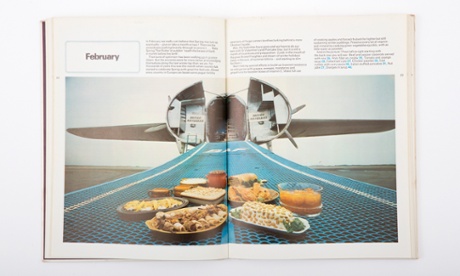
Take 1970’s Lots of Things Have Happened in the Kitchen Since You Last Bought a Cookbook cookbook. From that magnificent title, things get weirder with every page. Split into monthly sections, February boasts tomato and orange soup, cod cutlets in curry sauce, and Italian stuffed pancakes displayed on the ramp of a Type 170 British Air Ferries cargo plane. And why not?
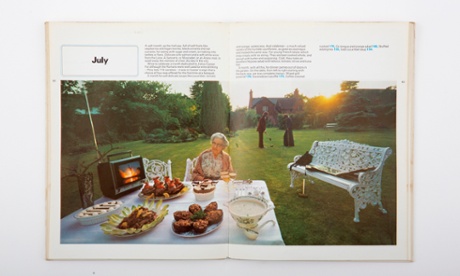
However, it is the heady month of July where the acid really drops. What the hell’s going on here?! Two Margo and Jerry types play croquet while grandma Von Braun watches a rocket launch on a portable Sony TV in the garden. Dishes on the table include mixed-grill pyramids, ox tongue with orange salad, and chilled cucumber soup.
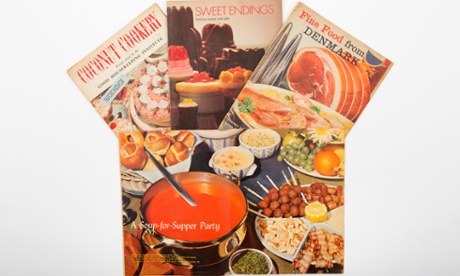
Brands published recipe guides to showcase the versatility of their products and how to feature them in your Abigail’s Party-style menus. Take A Soup For Supper Party where guests can choose extra toppings for a range of tinned soups – Good times!
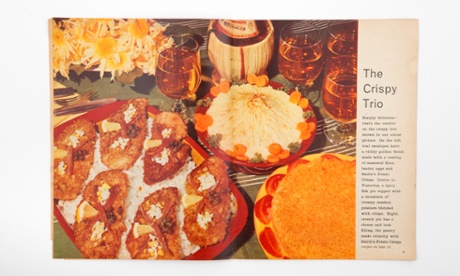
One of the best examples is Cooking With Crisps. If you’ve merely been enjoying crisps as a quick snack, you’ve been missing out. Just look at this feast you can make using Smith’s ready salted: “In the centre is Vesuvius, a spicy fish pie topped with a mountain of mashed potato blended with crisps.”
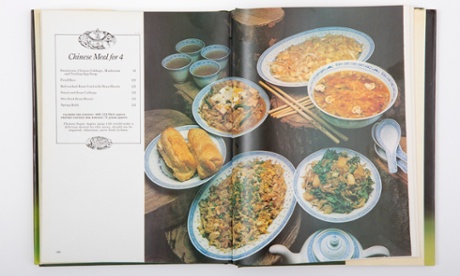
Gourmet Cooking Without Meat displays an interesting interpretation of a Chinese meal for cooks unfamiliar with the cuisine and lacking access to ingredients. The two puffed-up things on the left of the spread below are “spring rolls”, made with puff pastry.
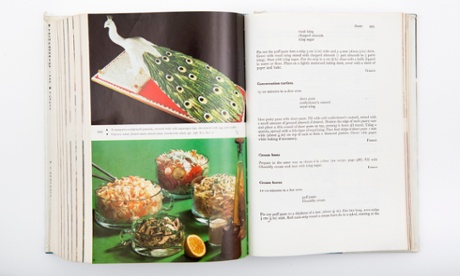
Inside the weighty tome Buffets and Receptions – aimed at chefs, this one – there is perhaps the best ever way to display and serve asparagus: as the tail of a peacock sculpted from margarine. The “eyes” of the feathers are slices of egg topped with olives.
The 1980s heralded the arrival of the microwave oven, and dozens of books were published declaring it the future of cookery, saving time, money and energy. Gail Duff’s 1984 Microwave Cookery recommends roasting beef in a microwave, getting around the fact that microwaves can’t brown meat by varnishing the joint with a “fake tan” of Worcestershire sauce and mushroom ketchup. I actually tried this in the name of research, it doesn’t work. This page shows “liver, bacon and mushrooms”, blue cheese on lamb chops (a seldom-seen pairing) and a particularly unappetising-looking tandoori lamb. Safe to say microwave cuisine didn’t really take off as a thing.
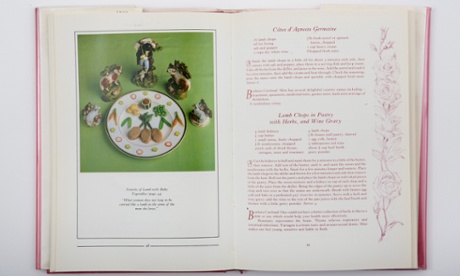
As for celebrity cookbooks, a personal favourite from 1984, Dame Barbara Cartland’s The Romance of Food, firmly puts the kitsch into kitchen. Her “chicken with orange surprise” is the only recipe I know of that features “a mild bleach solution” as an ingredient. “To prepare the wishbones, scrape all the flesh from them, then soak and wash well in a mild bleach solution” instructs Dame Barb. Quite what the “surprise” is in this dish is never revealed … surviving eating it one suspects. It’s particularly pleasing that “all photographs were taken under the supervision of the author using her own backgrounds and ornaments”. So, a noisette of lamb is watched over by a porcelain shepherd and his flock. “What woman does not long to be carried like a lamb in the arms of the man she loves?” asks Dame Barb in the caption. Indeed.
• This article was amended on 30 July 2015 to credit the pictures in the “Lots of Things…” cookbook to Philip Pace and to add credits for the original photography in other featured cookbooks.