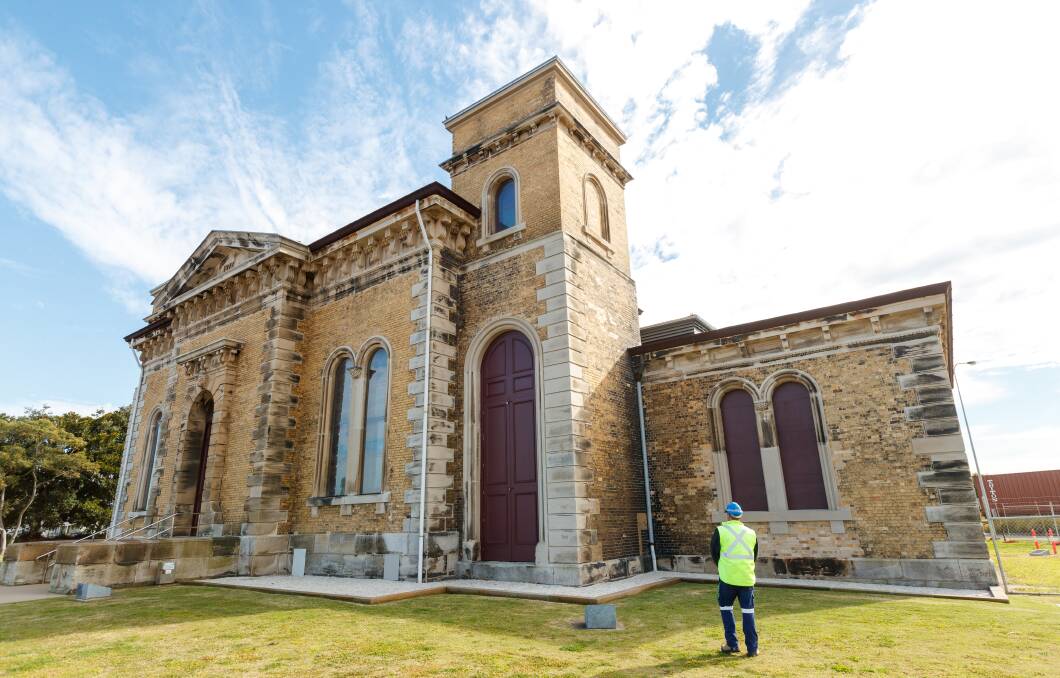
The article by Matthew Kelly (NH, June 3, 2021) regarding the future role of the 1877 Carrington Pump House, reminded me of the many schemes produced since the 1967 closure.
The ideas were supported by various groups and individuals including architects, The National Trust, Carrington Residents Group and heritage conservationists.
Over the 50 years since its closure, the pump house's abandonment has created an air of mystery.
The Carrington Pump House has remarkable historic significance, particularly as it combines both architectural and engineering excellence.
A rare happening of two distinguished professionals - the architect James Barnet and engineer Edward Orpen Moriarty.
In 1997, to celebrate Newcastle's bicentenary year, a festival was planned centred on The Pump House. Events included film, theatre, puppetry, jazz and opera (a new work by Ross Fiddes). External works were also included in the program.
It seems to me, the Wapping Project could serve as a model for the Carrington Pump House.
The faculty of Architecture (UoN) used the pump house as a design exercise, resulting in fresh ideas for adaptive re-use.
As an example, student Katrina Julienne developed the building as the base for an education outreach program.
In 2001 the Newcastle Port Corporation called for expressions of interest for development opportunities for the hydraulic pump house; a chance to provide a vibrant centre for community and civic activities.
Included in our submission group was Freewheels Theatre, who was to be the "anchor" tenant.
The concept was "under one roof" - a range of changing festivals across an unlimited spectrum of human endeavours. The Port was quite interested in our proposal except for the lack of finance.
The group had sought a major sponsor without success, and despite encouragement from the Port CEO (Chris Oxenbould) our tender could not be accepted.
Our expression included a staged process for achieving funding.
In 1999 I travelled with my wife to London where two major events occurred: the birth of our first grandson and the discovery of the Wapping Project, which was the adaption of a former hydraulic power station built in 1890.
In East London, it was adapted to an art gallery in 1999. The developer was Australian Jules Wright. The work was carried out by her husband, architect Joshua Wright.
Like it's impressive cousin, the Tate Modern, the enterprise was supported by commercial activities; a first-class restaurant, bar and book shop.
The project also benefited from being a neighbour to a famous tourist attraction, The Prospect of Whitney - the oldest pub in London .
The Wapping Project had one other ace - Vitra - the international modern furniture company who became its sponsor.
It seems to me, the Wapping Project could serve as a model for the Carrington Pump House.
With the passage of time (about 21 years) and the economic growth of Newcastle, one might have a better chance to secure a major sponsor.
The Newcastle area has always produced artistic talent, think Jonathon Biggins, John Doyle and John Bell, Miranda Otto, John Olsen, William Dobel and Tom Gleghorn and Nick Mitzevich (director of The National Gallery) .
The Carrington Pump House could become an incubator for artists across the whole artistic spectrum.
By providing a festival centre at Carrington, based on the concept of "under one roof" (a range of cultural pursuits) and with a flexible "work in progress" policy, Newcastle could have an alternative festival precinct: one with marine and industrial neighbours (think Belvoir, Nimrod Theatres and Cockatoo Island Museum).
The pump house is relatively close to the CBD and transport interchange.
The future could possibly see expansion of ferry services - a return to the days of when they ferried men to the State Dockyard.
Future expansions would be possible to the north; the additional space could become a site for an anchor tenant and financial source.
The open space to the south, the forecourt, could be a flexible area for external uses e.g. an amphitheatre similar to the temporary one created at the 1996 Adelaide Festival, which used shipping containers to shape the theatre seating space.
The potential for the Carrington Hydraulic Pump House is limited only by unimaginative thinking and money; one could hope that the NSW Government largess shown by the $500 million given to the Power House Museum might be extended to a modest festival at Carrington