It should have been a legislative slam dunk, for Congress to provide the additional help most members believe is necessary for the millions of Americans suffering economically from the COVID-19 pandemic.
But it turned into one of the biggest congressional embarrassments of recent years, taking nearly eight months after House Democrats passed a massive $3.2 trillion aid package for lawmakers of both parties to approve less than one-third that amount.
While welcome relief to many, the final package is still inadequate, ignoring among other things that many states and localities are being forced to lay off teachers, transportation workers and law enforcement personnel because of coronavirus-caused revenue shortages.
In the meantime, unemployment is again growing, consumer spending is falling and more than 8 million Americans have dropped back into poverty. Some lawmakers even sought to make it harder for President-elect Joe Biden, who seems likely to inherit an even worse economic situation than greeted Barack Obama after the 2008 financial collapse.
At almost every step, the drive for political advantage dominated deliberations. The failure of leaders from both parties to compromise is to blame: House Speaker Nancy Pelosi, Senate Majority Leader Mitch McConnell and President Donald Trump.
And lawmakers have abandoned — especially the Senate — the old-fashioned notion of bringing legislation to the floor and letting a majority work its will.
Here in a nutshell is how this happened:
Last March, unanimous bipartisan votes approved some $2 trillion in relief measures. But since then, there has been little unanimity on timing — or amounts.
In May, recognizing the burgeoning pandemic might preclude normal congressional deliberations, Pelosi’s House set a political marker by passing a bill including $1 trillion for state and local governments, additional funds for direct payments, extended unemployment assistance and a variety of other items from election assistance to funding the Violence Against Women Act. Senate Republicans, rediscovering deficit concerns many ignored while voting big tax cuts three years ago, made clear they would never approve that much.
Between July and the Nov. 3 election, Pelosi and Treasury Secretary Steven Mnuchin sought to develop a compromise package. In the weeks before the election, they came close: Pelosi offered to settle for $2.2 trillion and Mnuchin proposed $1.8 trillion.
But McConnell resisted, because many Republican senators opposed any additional aid, and it was unclear Trump would accept Mnuchin’s proposals. McConnell demanded inclusion of liability protection for businesses in case returning workers contracted the virus, a nonstarter for Democrats who considered it anti-worker.
In the end, Pelosi resisted a deal, despite internal pressure from some fellow Democrats, in part because she feared Trump would take political credit for any preelection relief checks.
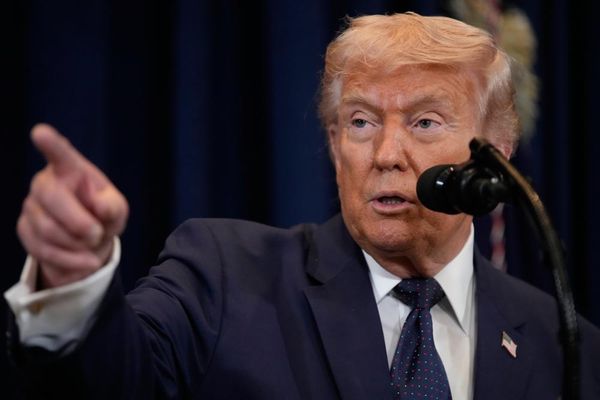
Trump, who has been less involved in congressional negotiations than any modern president, never directly engaged in the talks, sometimes undercutting Mnuchin with an erratic course alternating between denouncing the Democrats and demanding an increase in proposed direct payments.
He adamantly opposed aid to states and municipalities struggling under increased costs and decreased revenues, contending it would reward Democratic financial mismanagement, though many revenue-short states are run by Republicans.
Moody’s Analytics, an independent financial services firm, estimates that, without new assistance, states and localities face a shortfall of $171 billion to $301 billion over the next year and a half, including both red and blue states.
When talks resumed last month, a bipartisan group of senators proposed a compromise $908 billion package, which became the focus of leadership along with the need to fund the federal government through next September.
The final proposal dropped both additional aid to states and localities and McConnell’s liability waiver.
It’s the kind of end-of-the session exercise that has become all too typical of congressional budget procedures in the past decade. Last-minute scrambling in a closely divided Senate allows individual lawmakers to delay action with favored proposals; Sens. Bernie Sanders, I-Vt., and Josh Hawley, R-Mo., sought to double direct payments; Pat Toomey, R-Pa., backed by fellow Republicans, tried to curb future Federal Reserve efforts to spur the economy.
Democrats thought McConnell was mainly fixated on next month’s two Georgia runoffs elections that will be determine Senate control and that Republicans were trying to tie Biden’s hands to deal with the country’s economic woes. Republicans thought Pelosi sought to include too many programs beyond helping those hit by the pandemic. Trump briefly weighed in by urging the benefits be increased, before retreating.
Among underlying factors has been that, during Trump’s term in the White house, McConnell has resisted any Senate action that was unacceptable to the president, rather than challenge him. But with Democrats holding one House and a strong Senate minority, any agreement needed their acquiescence.
The final measure is mainly designed to tide people over until early next year, when anti-virus vaccinations promise some medical relief and the political dynamics will change with Democrats running the White House as well as the House. Biden has already promised to push for more aid.
The degree that will be possible may depend on whether Republicans keep Senate control Jan. 5. In any case, both houses will be so evenly divided that any significant action will still require the kinds of compromises that have been so difficult to achieve this year.