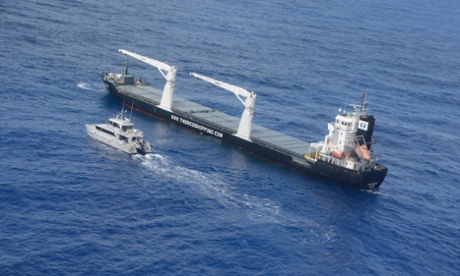
Marine conservationists have warned of the dangers posed by increased shipping through the Great Barrier Reef after a cargo vessel broke down and had to be towed to avoid drifting into the reef.
The 132-metre Thor Commander, an Antigua and Barbuda flagged vessel carrying a load of copper ingots, experienced mechanical difficulties on Sunday and issued a call to be rescued.
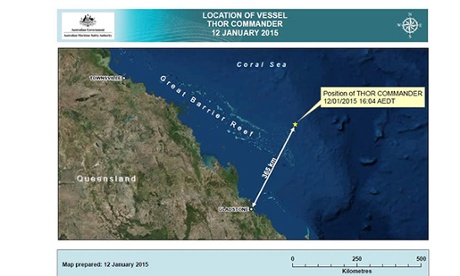
The Thor Commander was drifting about 30km north-east of the Perkins Reef, 380km north-east of Gladstone. It had left Chile, bound for Townsville.
The Australian Maritime Safety Authority (Amsa) sent a tug from Gladstone to tow the vessel to prevent it ploughing into the reef.
The tug, which arrived on Tuesday morning, was assisted by a Chinese merchant vessel, the Xinfa Hai. Amsa said the damaged ship was successfully diverted away from the reef.
“It will now be slowly towed back to Gladstone,” an Amsa spokeswoman told Guardian Australia. “We are happy with the result and have systems in place when this sort of thing happens.”
The Australian Marine Conservation Society said the incident highlighted the risks posed by the amount of shipping going through the Great Barrier Reef due to greatly increased exports of coal and liquefied natural gas (LNG).
“We are very glad that the crew are safe and that we have narrowly avoided a disaster in the Great Barrier Reef World Heritage Area,” said Felicity Wishart, reef campaigner at the AMCS.
“But we are also deeply concerned that the state government wants to increase the number of cargo ships travelling through the reef every year, increasing the risk of a disaster.”
Wishart said that the current total of 4,000 ships crossing the reef each year would rise to 7,000 by 2020 if proposed port expansions in Queensland, including Abbot Point, Gladstone and Cairns, go ahead.
“We now have the added risk of massive LNG ships loaded with highly dangerous cargo from Gladstone moving in the same waters as massive coal ships,” she said.
“It only takes one ship to have an accident to cause irreparable damage to the reef and the $6bn tourism industry that relies on it.”
There is an automated system that requires ships traversing the reef to identify themselves and explain their route to port to authorities.
A new two-way shipping route, the longest in the world, was established in December to ensure ships keep clear of the thousands of reefs and islands that make up the ecosystem.
Amsa and the mining industry maintain that reef shipping is well regulated and accidents are extremely rare.
But conservationists say the expected increase in shipping traffic could lead to a repeat of an accident in 2010 when the 230m Shen Neng 1 hit a reef near Great Keppel Island. The Chinese-registered ship ruptured its fuel tanks and released about four tonnes of fuel oil into the reef’s waters.
A 3km scar left along the reef from the accident has yet to fully recover in some places.