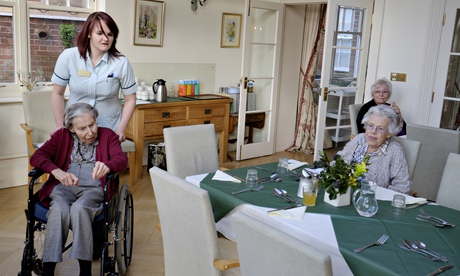
When Ola Szychulska, 29, came to the UK from Poland to work as a care assistant, she could hardly have imagined that five years later she’d be a pioneer of a new initiative that could help identify social care leaders of the future.
But this Friday she will be one of the nurses and care workers who will meet health secretary Jeremy Hunt at the end of the first stage of a degree course designed to develop the skills of the “forgotten workforce” looking after older people.
The Elizabeth Care course is part of a project that its backers claim will offer the first real career pathway for social care – and raise standards in a sector that is often under the spotlight for abuses and failures.
Szychulska, now a lead care worker at Birtley House care home in Surrey, says she loves looking after older people, but recognises that perceptions of it as a profession are often negative. “I wish more people could see how good care can be and that nursing homes can be brilliant places to work,” she says.
Her boss, Karen Williams, the matron at Birtley House, says Szychulska’s involvement in Elizabeth Care has brought in new ideas, particularly around the involvement of families in looking after their older relatives. “It’s developing that leadership spark. We want our carers to feel they are leaders in care – that can only be of benefit to our residents,” she says.
Recent debate on the future of the workforce, including the Cavendish review for the government and the Kingsmill review commissioned by Labour leader Ed Miliband, have highlighted a lack of training and development in the sector which has a knock-on effect on recruitment and retention. Staff turnover is running at around 19% a year in residential care.
On the frontline, Williams says, social care is undervalued as a profession. “People don’t see it as a career pathway – they don’t see how diverse it is. If you do elderly care nursing and do it properly, you can nurse anywhere,” she says. “The bad press about nursing homes doesn’t help. People see it as a job that you do at the end of your career or when you want to work part-time.”
At Birtley House, Williams and the owner, Simon Whalley, whose family have run the business for more than 80 years, have put in place a structure to allow staff to progress and develop their skills. The family atmosphere, higher than average pay in a low-wage sector and beautiful setting in 48 acres of gardens and orchards contribute to lower staff turnover at this 47-bed facility, but recruitment can still be a challenge. Whalley puts much of the blame on a two-tier system, which he says means working in a care home does not have the prestige of a hospital career. “As a nation we put a religious fervour into the NHS and care is seen as a second-class element. Care and health have to be better integrated – a lot of money spent on health would be better spent in care,” he says.
Nine nurses and care workers from care homes in the south-east, East Anglia and the south-west were the first to begin the course, run by the consultancy 360 Forward at the University of Surrey. The consultancy is now negotiating with other universities to roll out both this degree course and a new foundation course for entrants to care, which will begin in the autumn.
Justine Cawley, director of Elizabeth Care for 360 Forward, said the programme would create a career path from care assistant to nurse and beyond, with plans for postgraduate qualifications in the pipeline too. “It professionalises the workforce and keeps them in social care,” she says. “Otherwise what incentive has someone got if there’s no professional route for them?”
Cawley claims the money available for training in the care sector is dwarfed by the cash spent on training in the NHS, and that means care providers may struggle to pay for training as well as cover for their staff who are studying. The care workforce is 1.6 million, bigger even than the NHS’s 1.4 million staff, yet much more money is going into the NHS than into social care, says Cawley. “Care homes are being so squeezed by cuts in local government contracts that it’s really difficult and it’s only going to get worse. The recent problems in A&E could have been partly avoided by more integration between health and social care and that means parity in provision and in funding.”
Fiona White, 44, a nurse and deputy care home manager at Sunrise Senior Living in Eastbourne, also among the first crop of Elizabeth Care students, says more specialist education is important both to improve skills and to increase the reputation and prestige of the sector. “Instead of talking about putting cameras into care homes and waiting until somebody has been abused or badly treated, why not educate everyone so incidents do not happen?” she says.
“As an industry we need to change. I want to be proud of this sector and I want to be able to say I’m an older people’s specialist nurse, and I want to make a difference to people’s lives.”
The Department of Health says that following the Cavendish review it is introducing a care certificate for front-line staff . “We want to drive up standards and reduce unnecessary hospital admissions,” says a DH spokesman.“We are spending around £130m this year to train and develop the adult social care workforce, including £12m for the Workforce Development Fund to enable staff to take social care qualifications.”