YOKOHAMA -- The exhibition starts with black and white photographs, some of them showing a wall with paint peeling off, while others capture a room with numerous pieces of garbage scattered around. All the images look grainy, with distinctive black particles -- "grain" is a key word for the artist who took the photos and developed them.
These black-and-white photos were taken by Miyako Ishiuchi, who has built a career as a self-taught photographer, winning the Hasselblad Foundation International Award in Photography, an honor considered the equivalent of the Nobel Prize for the specialty.
Ishiuchi describes photographs as "a lump of grains."
"Parts with a lot of grains look jet black, while a fewer number of particles make spaces blank," the artist said. "I felt excited to see them and spent a lot of time in the darkroom.
"I didn't like taking the pictures as much," she added with a mischievous smile.
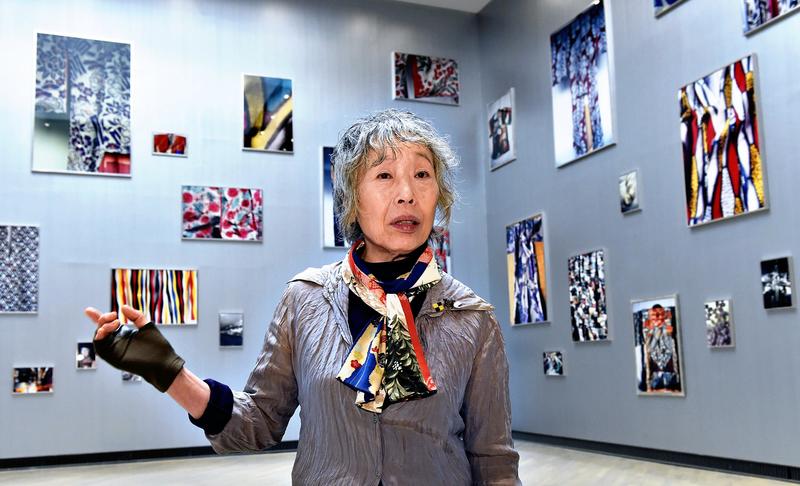
Ishiuchi is now being featured at the Yokohama Museum of Art in "Ishiuchi Miyako: Grain and Image," an exhibition to mark last year's 40th anniversary of her first solo show, "Yokosuka Story," when she effectively became a professional photographer.
The latest exhibition showcases about 240 photographs, showing black-and-white works from her early years to her newest photos.
Born in Kiryu, Gunma Prefecture, in 1947 and raised in Yokosuka, Kanagawa Prefecture, Ishiuchi studied fabric dyeing at Tama Art University. In 1975, she started taking photographs after receiving a camera from a friend and set up a darkroom at her home in Kanazawa Ward, Yokohama.
"Kanazawa Hakkei, Yokohama" (Eight views of Kanazawa, Yokohama) is a series of photographs she took in her neighborhood in the early days of her career. On display at the exhibition are two works from the series that have the same composition but were developed different ways.
In one, the sky, sidewalks and trees have light tones, making it look like a pleasant summer day, while the other has dark tones, giving the impression that it was scorching hot.
It's curious that you can see the difference in the humidity and temperature, depending on what a photographer tries to emphasize.
As another subject, Ishiuchi chose a local apartment building that was partially damaged during World War II, ultimately winning the Kimura Ihei Photography Award for this "Apartment" series. For the "yokohama gorakuso" series, she focused on a decaying housing complex.
Some works are printed on large sheets whose longer sides exceed 1 meter.
"I felt like I was dyeing fabrics, rather than [developing] photographs," Ishiuchi said about these works. "We use glacial acetic acid both for development and fabric-dyeing. I didn't mind working on large prints."
Shift to color
Since 2000, however, the photographer has shifted her focus from black-and-white photos to color, a change that was triggered by the death of her mother.
Ishiuchi pointed her lens at her mother's belongings for a series named "Mother's," which was shown at the 2005 Venice Biennale. When making prints of her lipstick as usual, the photographer found there was something wrong. When she shot the item again using color film, she found it was satisfying the way red was expressed in the photos.
"Black-and-white photographs tend to show my intentions, as they are a world I created, so full-color works are closer to the reality," she said. "The lipstick can look beautiful when [it's expressed in] red. This experience made me realize it's OK to accept colors as they are."
In Ishiuchi's two later series, the colors of the subjects serve as the main motif, with their lines gently expressed: "hiroshima" focuses on the belongings of atomic bomb victims, while the theme of "Silken Dreams" is silk fabrics, a specialty for Kiryu.
In contrast, the photographer preferred black and white for the "Shiranui no Yubi" (Fingers of Shiranui) series, for which she took closeups of the hands and feet of Michiko Ishimure, who has written several works on pollution-triggered Minamata disease.
"Scars and wrinkles left on skin belong to the past, rather than the present. It's like stains -- something that can be called the past -- firmly remain on apartment walls," Ishiuchi said. "That's why I took them in black-and-white."
On the other hand, "For 'hiroshima,' I captured the relation between the belongings [of atomic bomb victims] and myself, as someone who's living now. That's why [expressing them in] full color suits them."
Whichever approach she takes, Ishiuchi gazes through the lens at vestiges of time, listening to the "voices" of the subjects to scoop them into her photos. So what does she think of her past four decades as a photographer?
"As long as I was able to release the sediments piled up inside myself, the method could have been something other than photography," she said. "It's only recently that I feel like photos are familiar."
"To tell you the truth, this is my first exhibition that uses the word 'image' in its title," she continued. "I want to work anew on photography face-to-face."
"Ishiuchi Miyako: Grain and Image" runs through March 4 at the Yokohama Museum of Art in Yokohama, which is closed on Thursdays (except March 1). Ishiuchi's "Yokosuka Story" series is also on display at another exhibition in the museum's collection. Visit yokohama.art.
museum/special/2017/ishiuchimiyako/ for details.
Read more from The Japan News at https://japannews.yomiuri.co.jp/