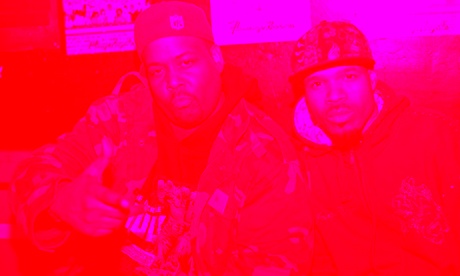
“A ronin is a samurai who has no allegiance. It’s about freedom, being creatively free to swing our sword in any direction that we feel.” Vast Aire is explaining samurai lore to me via Skype from New York: his and his childhood friend Vordul Mega’s second album as Cannibal Ox is entitled Blade of the Ronin. “When you come to have a sword and master, they can dictate where your sword goes, where your spear goes. But when you’re a ronin, you still have all those skills, but you use them when and how you want.”
Rappers may have a stronger disposition towards elaborate martial arts metaphors than most musicians, but sometimes it is with good reason. It has been 14 years since the last, and to date only, Cannibal Ox album. Free of a master’s control, only now are the duo finally choosing to swing their sword again. On its release, 2001’s The Cold Vein was hailed as an underground masterpiece, a vivid, passionate take on life in Harlem, a journey through exemplary gritty ghetto realism towards the psychedelic possibility of escape. What followed were rumours of splits, possible comebacks and personal problems – and a succession of side and solo projects.
Even without their erstwhile producer (and label boss) El-P on board, Blade of the Ronin contains a succession of familiar tropes: looped synth stabs like chills down the spine, snippets of strings, gospel and brass, mechanised boom-bap beats as metallic and clonky as the New York subway, and lyrical themes that show a striking continuity with that first album.
“We’re all initiated into the league of shadows/ I told raven to keep an eye on the sparrow,” spits Vast on Gotham (Ox City), one of several indications that this is a sequel, not just a new release. Part of The Cold Vein’s majesty was that it returned, time and again, to the same unique vocabulary to describe Harlem life, in particular their avian allusions: malnourished pigeons scrapping around in the dirt, opportunistic vultures, snobs “with their beaks in the air”, “early birds and poachers” and then finally, the transcendent album climax of the evolution into a phoenix, a “metallic-winged pigeon”. It was a set of “imagery to represent the progress of a human soul,” Vast tells me.
Picking up all these references where they left off in 2001 – not just the birds, but other playful attempts to map the wildness of nature on to Harlem’s projects, and their telling stories of Gotham, the quasi-fictional version of New York City – is partly a nod to the patience of their fans. “I don’t want to say it’s our philosophy exactly,” Vordul says, “but rhymes that follow up into one whole, one category of meaning, or one language or idea are important to us. And it’s part of following particular artists or groups, to get lost in the language they develop, to understand more from repeated listening.”
So what of the young sparrows of Harlem now? How has their hometown changed since 2001? “It’s still … urban,” Vordul says, deadpan. Vast, always the more locquacious, chimes in. “Harlem is definitely a little bit more trendy than it was in 2001. It’s definitely more developed: a lot of brand names have come to this neighbourhood. But it’s still good old-fashioned Harlem. It still has all of its classic spirit, all of its New York … issues. Whatever we do is always going to come from a New York perspective,” he says – and that perspective takes in both the city’s corruption and its greatness.
Released four months before 9/11, only a year into the new millennium, there was something about the industrial, dystopian futurism of El-P’s beats on The Cold Vein, combined with Cannibal Ox’s world-weary, allegorical style, that seemed to mark the album out as a soundtrack to the end times.
“It was a sensitive time,” Vast recalls, “and I did feel like any of us could have been downtown on 11 September. We all felt kind of vulnerable, and it made us get real focused.” But if The Cold Vein was about resilience, about the struggle of surviving in a Big Apple that is in one sense “evil at its core”, as they rapped back then, then shouldn’t they feel triumphant now, having made it through the end times, having survived New York? Vast laughs. “It is a blessing. We don’t put ourselves in harm’s way as much as we did when we were younger. We just pay attention to the city around us, and learn and strive every day to do better. I think that’s why we’re still here, and why we’re still able to tell the stories of the city.”
They have accumulated a lot of these stories since the last Cannibal Ox album. Blade: The Art of Ox, Gotham, Harlem Knights and Iron Rose paint a picture of lives underscored by ambition, sadness, struggle and ultimately transcendence – even if these earnest subjects are leavened with a fair helping of martial arts, comic books and weed.
It is, says Vast with his usual mix of goofiness and portentuousness, just the Cannibal Ox way. “We’re not afraid to be cool, and we’re not afraid to be vulnerable. Superman has felt weak, at certain times. Superman has had kryptonite around his neck and felt like he was going to drown. So as super as we are, we’re humans, we have family, we have loved ones, we’re vulnerable like everybody else. I think that’s the beauty of our music – we can brag with the best of them, that’s great, that’s dandy; but when we really want to say something, we can do that too.”
• Blade of the Ronin is released on ihiphop on 23 March.