
That’s it for this year
Thanks for joining us over the last two days – it’s been brill. Keep your eyes peeled next week as we’ll publishing lots of post-Cannes content.
See you on la Croisette...
Tips on how to foster innovation from Twitter, Nestle and Wunderman
At the final session of Lions Innovation, an agency, social network and brand came together to discuss innovation in their respective businesses.
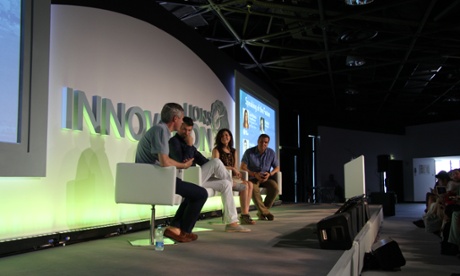
Mark Read, CEO, Wunderman
- When Elon Musk builds a spaceship he understands how everything works and can orchestrate the build. The best companies are driven by the most obsessive and most curious people. That’s the lesson I would take away.
- Take a little bit of time out of your schedule to think. We live in this instantaneous world and that’s not conducive to innovation. Rapid decision making is essential.
Adam Bain, president, global revenure and partnerships, Twitter
- We’ve gone from one office in San Francisco to 75 offices across the world. We do some unique things. Anyone in the company can ship any concept they have to 1% of our audience (three million people) without needing sign off. Every Wednesday the whole company can review the 1%. Find your version of whatever your 1% test could be.
Pete Blackshaw, global head of digital and social media, Nestle
- Nestle has an innovation trivector including a startup hub located above the executive suite and a presence in Silicon Valley presence and other cities where there’s bubbling innovation.
- Taking insights from new markets can drive real innovation.
An insight into creativity at AKQA from CTO Ben Jones
Ben Jones reveals the eccentric methods used to encourage creativity at the cutting-edge digital agency.
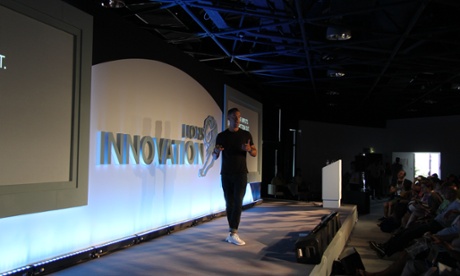
We should encourage child-like naivety, according to AKQA’s Ben Jones, who says that we are at our most creative when are children. In an attempt to encourage youthful mindsets, AKQA holds “laugh then think” sessions where staff are encouraged to speak before thinking and see how ideas mature organically.
Jones lauds thinker makers – creatives who are willing to both devise and execute concepts collaboratively. When interviewing for developers he says he asks applicants to create a new product from scratch in order to see how their minds work.
Finally, he says AKQA encourages both failure and risk in order to encourage inhibition.
Updated
Tips on scaling your startup from SoundCloud
Audio platform, SoundCloud, has gone from strength to strength and is now a major presence in the music industry. Alexander Ljung, CEO and co-founder, shares his tips on growing a startup business.

Ljung advocates the following approach:
- Simplicity – when developing a product, keep thinking how it will be experienced by the consumer. This helps motivate teams to work efficiently.
- Purpose – having a clear purpose flows through the whole organisation and encourages consumers to be excited about your offering.
- Be thoughtful – it’s not only about running fast, but know where you are running to. From the beginning, Ljung said he wanted SoundCloud to serve billions of users.
Asked about monetising the sector, Ljung said that we are in the ‘early days of streaming’ and that it’s a ‘tremendous growth opportunity’. However, he added that we won’t monetise all users through streaming and that advertising and branded content remain important revenue streams for the sector.
Updated
Why did you become a founding partner of Lions Innovation?
Updated
The creative realities of virtual reality
Framestore’s David Mellor and R/GA’s Jay Zasa reflect on how to best use cutting-edge VR.
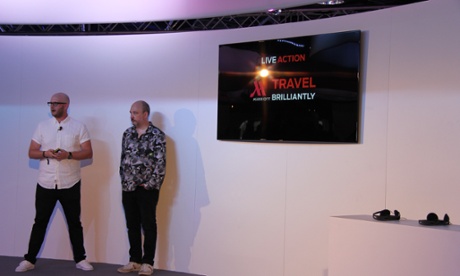
- David Mellor says that a client should strongly consider whether VR is the best format for a campaign before committing to it.
- He adds that there are several different ways of creating virtual reality experiences and agencies and brands must choose the correct option for the campaign.
- Mellor says it’s also important that directors are given a degree of autonomy in creating the experience.
Updated
A couple of tweets from this morning...
Updated
How do we embed the human touch in digital customer service?
Accenture Interactive’s Mark Sherwin and Alexandre Naressi reflect on how we can better interact with AI.
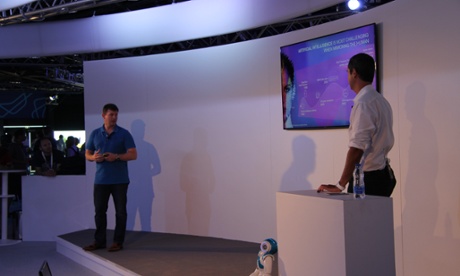
Sherwin says:
- The more you try to mimic a human, the more likely the human is to reject it.
- There’s a lack of intimacy and contact when dealing with artificial intelligence.
- The solution is to fuse together the best of artificial intelligence and human interaction to deliver a meaningful personalised valuable customer service interaction.
Accenture has identified six key areas where AI could be implemented:
- Retail customer service
- Gaming and social networks
- Telco and tech support
- Police and health services
- Utilities and public services
- Financial services.
Updated
The creative potential of augmented and virtual reality
Some of the best insights from the session...
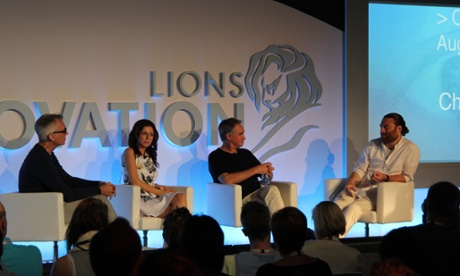
Jerry Hudson, vice president, Moxie
- Augmented reality will redefine the education, medical and entertainment sectors.
- Virtual reality can create long-term empathy by showcasing political issues around the world.
- These technologies will change our world, society, entertainment and us. In doing so, we will be better humans.
Ted Schilowitz, futurist, 20th Century Fox
- The Nintendo Wii was the first major commercial success at creating an augmented world at home.
- The future movie experience will be like going to a theme park.
- We’ve created the ‘escape’ product with Barco (Projection Company) where the movie experience around you not just in front of you. We are trying to break out of the rectangle.
- We’re at the brick phone stage of virtual reality.
- Virtual reality is not a novel concept. It’s been around since mid-90s but didn’t quite get over the threshold.
Dr Helen Papagiannis, augmented reality expert
- Augmented reality is changing the way we communicate and allowing us to tell new stories.
Saving the world through gaming
There is no greater threat to humanity than an asteroid strike. In a bid to preempt such a disaster, NASA has teamed up with McGarryBowen to develop a game that will enable thousands of people to help the space agency to identify asteroids before it’s too late.
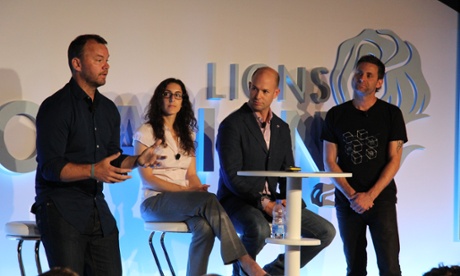
McGarryBowen shares insight into the approach they took to build the game, Apophis2029:
- Accessible – the game needs to be broad enough to appeal to all consumers, not just those interested in science
- Addictive – people need to come back again and again to play the game and enter data
- Useful – the data provided by consumers (around asteroid characteristics) needs to have value for scientific analysis. Players are therefore rewarded for entering accurate information
McGarryBowen hopes that the principles from the game can be applied to tackle other pressing social problems such as climate change.
Updated
We’re back – day two
It’s the second and final day of Lions Innovation and for many of us the last full day on the French Riviera.
If you’ve emerged from this week of media madness unscathed, we salute you. For those feeling a little more jaded, we’ll take note of the best insights from the sessions ahead so you don’t have to.
Get involved by tweeting us via @GuardianMTN
Goodbye for now
Thanks for joining us for today’s festivities – we’ve had a blast and will be back tomorrow morning. See you then...
We’ve seen the future and his name is Pepper
This is the world’s first personal robot capable of reading emotions.
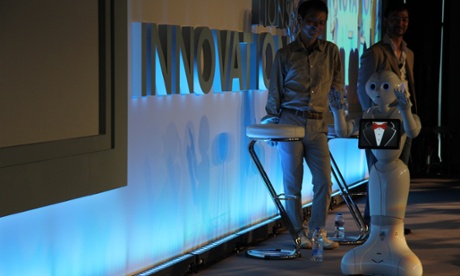
Pepper has an emotional engine that allows him to:
- Recognise and respond to human emotions
- Express his own emotions
He has a great memory; he can remember every interaction with the data stored in the cloud. Kaname Hayashi, director, SoftBank Robotics Corp. and Koichi Yamamoto, executive planning director, Dentsu Inc. presented him to the audience as an example of the power of technology combining with creativity. He can dance, juggle and sing. When he went on sale in Japan, a thousand units sold out in a minute. But how worried should we be that Pepper will become a danger to those around him? His creator, Hayashi, reassured the audience that there is nothing to fear as he’s only been programmed to make people happy…
Updated
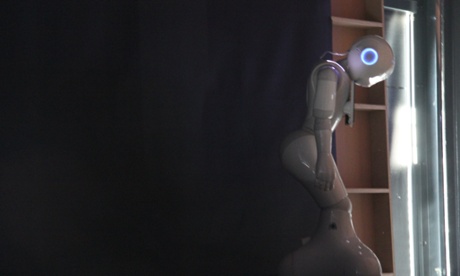
While Pepper gets all the credit on stage his buddy back stage looks a little disappointed to be left out
Transformers meets media: the self-assembling ads of the future
The media world was once mocked for being the only industry to still send faxes but now it is a pioneer of technology, says Caspar Schlickum, chief executive, EMEA of Xaxis.
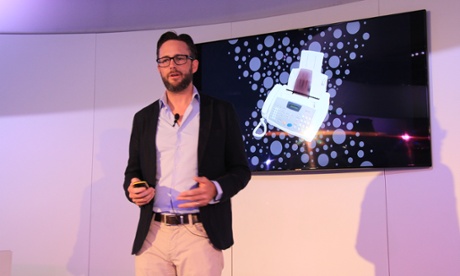
Schlickum reflects on the two ways programmatic is changing media.
- We live in a very different world now in terms of the way brands and agencies interact. The very linear relationships in which one thing happened and then another is over.
- How do we delight consumers? To do that we need to change the way we work together to take a more data-centric view and to move away from linear relationships.
Updated
A few more Vines from Cannes Innovation...
Some tweets while we break...
The age-old battle: poets versus scientists
Now on stage, Chris Clarke, chief data officer and Jason Kodish, chief data scientist of DigitasLBI engaged in an age-old battle: poets versus scientists.
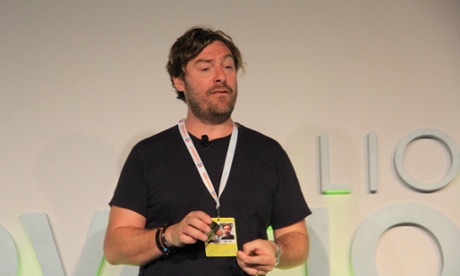
Here are the best insights from the session on how agencies can bridge the gap between art and data:
- We’ve realised that ‘data based on intent is about reliable as a Greek IOU’.
- Today, creativity is finding it harder to make a case for itself. We need data and the associated tools to help protect our roles.
- Data gives us ammunition to speak to the rationalists (data people) and convince them of our creative instincts.
- Traditionally, the best way to get insight is through observation, but it doesn’t scale. You can only go to handful of customers. Big data allows us to observe people at scale. Agencies need data people to sift through this data.
- From data, look for the things that surprise you as this will provide the best insights for creative.
- Robots won’t produce the best adverts nor award winning creative. But they might give us insight which helps us produce brilliant work.
- As an industry, over the years we have lost some of our power with clients. It’s by using data to defend our intuition and leaps of faith that we can reclaim our agency.
Updated
Why did you become a founding partner of Lions Innovation?
We speak to Mark Connolly, CRO & VP International at AudienceScience
Marketers and the internet of things
Open X’s Andrew Buckman and Samsung’s Steve Stanford reflect on the challenges and opportunities that the internet of things presents to marketers.
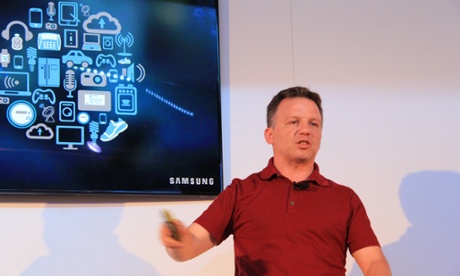
Buckman says there are two key issues for IoT and marketing:
- Privacy – the data is valuable for the consumer but it also raises questions about consumer privacy, specifically how it’s collected and who it’s given to.
- Who will cover the cost? IoT will require unprecedented bandwidth to connected these new devices and the cost must be covered
Stanford says the internet of things is the third wave of the internet:
- .Com had 1bn devices
- mobile had 2bn devices
- IoT has 40-50bn
Stanford adds that the internet of things is going to have two impacts on advertising:
- New interactions through a huge range of new screens
- There’s also a huge set of IoT uses that don’t require screens but record data
He concludes with a little future-gazing. The tech will require better standards and operating systems, and will trigger the emergence of more third party, cross-platform marketing technologies, according to Stanford.
Updated
Tackling the gender gap in the global creative tech sector
Despite diversity driving innovation and long-term profit for organisations, Sarah Wood, co-founder of Unruly starts the debate with some shocking stats (below) around the lack of diversity in this sector.
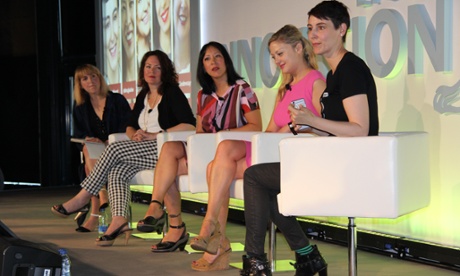
- Only 17% of the tech workforce is female and that number is decreasing each year by 0.5%
- 3% of creative directors in advertising are female
- 25% of senior ad roles are female
- 56% women leave mid-career in tech
- 70% of women left work for family reasons
What can be done to close the gender gap?
Sarah Wood, co-founder, Unruly
We must encourage dads to leave work early, so there’s no stigma around it
We need to be really clear about promotional structures. So that everyone knows what’s needed for promotion. It creates a level playing field
Allison Dew, vice president marketing at Dell
We sometimes forget the role of men. We have a programme at Dell for senior management to help them understand and tackle their unconscious and unknown bias
Kathryn Parsons, co-founder, Decoded
We need to nurture the confidence of women within business
Deirdre McGlashan, global chief digital officer, MediaCom
We must celebrate when diversity is good within organisations
Updated
Some tweets from #InnovationLions’ #CloseTheGap session
Why are less and less women working in tech? Diversity drives innovation #LionsInnovation
— Hannah (@span_han) June 25, 2015
.@kathrynparsons shares her thoughts on how to #closethegap on gender inequality in the tech sector #CannesLions pic.twitter.com/bpSkoCCdtV
— Unruly ® (@unrulyco) June 25, 2015
Women represent only 17% of tech workforce #CloseTheGap #LionsInnovation #TeamMindshare @mindshare pic.twitter.com/w2FBnGmIuX
— Adriana Ripandelli (@AdriRips) June 25, 2015
Wearables mean brands must throw out the advertising rule book
ironSource’s Chris Cunningham talks about how brands can effectively leverage wearables.
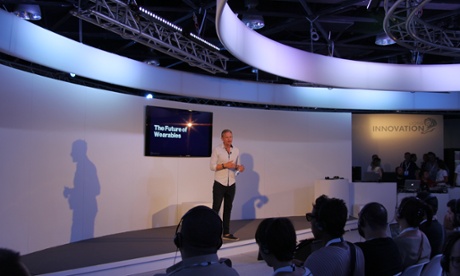
The only thing you should be thinking about from a strategic stand point is the user and their experience.
If it doesn’t provide value to the consumer, throw it out the window.
Cunningham says there are five things to consider when brands use wearables:
-
Timing
- Context
- User experience
- Scale
- Involvement
Interoperability between wearables will improve the consumer experience, according to Cunningham, who says Red Bull and Nike are good examples of brands that put the user at the centre of the product.
Updated
How Domino’s Pizza became a tech company
Speaking about the turnaround of Domino’s Pizza in 2010, Ivan Perez-Armandariz, chief digital officer at CP+B, outlined five ingredients of innovation. These have helped the previous struggling corporation to achieve an annual $2bn of digital sales.
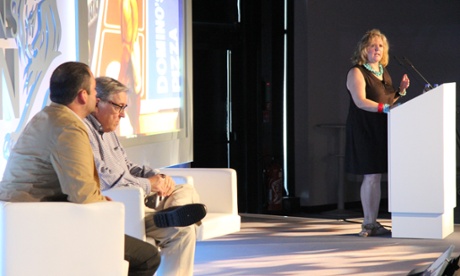
1. The tactic of transparency - rewarded by the internet with an army of engaged fans. Initiatives included asking consumers to take photos of delivered pizzas. The company used both good and bad photos of the pizzas in their subsequent ad campaigns.
2. Integration – on both client and agency side, breaking down the silos between those working on advertising and technology side. This is needed to create an environment for innovation.
3. Long-term partnership between agency and clients - short partnerships are a barrier to innovation. Innovation doesn’t happen in first few years. It takes years to develop the relationship between client and agency. Every time an agency contract goes up for review, it’s an obstacle to innovation.
4. Build a business case - capital needs to come from outside the marketing budget. Domino’s Pizza realised that more orders were coming from online than phone. This observation helped them build a business case to invest in the infrastructure needed to achieve 50% digital sales by 2015. It might seem obvious now, but back in 2008, it was not commonplace to order food via the web. It was a big bet, but it allowed Domino’s Pizzas to transform to a technology company.
5. Innovation as advertising – instead of figuring out how to make news, we’ve shared our story of how we’ve reinvented and transformed the company.
Updated
It begins!
The techno is booming, the coffee is flowing and the mood lighting is pulsating – it must be time to kick off the very first day of Lions Innovation. A spin-off of the Cannes Lions festival for creativity, the new event examines the intersection of data, technology and creativity in media and we’ll be following every step of the journey.

Updated