Our live coverage of Super Tuesday will now continue ... right over here.
“Oh, it’s gonna be big,” Peter Goldberg, 67, chairman of the Alaska Republican party, told Julia O’Malley in Anchorage.
“By big I mean I think last time we did this four years ago, there a little more than 15,000 [votes counted] - I’m expecting 20,000. But at the rate that phone out there is ringing, it may exceed that … I think the primary factor is the incredible dissatisfaction with what Barack Obama has done to the country in the last seven years … Because I’m chair of the party, my position (on which candidate to support) is neutral. Not even my wife knows.”

There are two ways that states holding primaries can be game-changers today - either they have a lot of delegates up for grabs or else they’re a battleground state where polling suggests that we’ll see a closely fought race.
The Texas Republican primary will be both. With 155 Republican delegates up for grabs, the state simply has a larger say in the presidential nomination process than others (the Dallas area alone has more Republican delegates than all of New Hampshire). But it’s also one of just three states today where Donald Trump doesn’t have a clear polling lead among Republicans.

Twelve separate polls of Republican voters were conducted in Texas in February (other states voting today don’t have as much data available - partly because they’re less politically influential so pollsters are less interested in conducting expensive surveys there). Ted Cruz has been the Republican frontrunner in all but one of those but the size of his lead has varied considerably from poll to poll. Real Clear Politics uses the average across all of them and their latest numbers suggest that Cruz is 9 percentage points ahead of Trump.
The exact number of percentage points matters here. Unlike the Democratic process (where delegates are generally assigned to vote for presidential candidates in proportion to votes) the way that Republicans translate votes into delegates varies from state to state. In Texas, the formula is pretty complex but this explainer from the Dallas Morning News does a good job of clearing things up:
Republican candidates can collect delegates in two ways. If they do well in a congressional district, they stand to gain up to three delegates per district. Statewide vote totals determine which candidate or candidates get an additional 47 delegates. If a GOP candidate wins more than half of the votes in Texas, he will get all 47 of those delegates. Anything less and the candidates have to share.
Other states to keep an eye on tonight are Massachusetts (where Hillary Clinton’s lead is just 6.7 percentage points - if Bernie Sanders doesn’t do well here, his electability could be seriously damaged going forward) and Virginia (where there are 49 Republican delegates up for grabs which will be split in proportion to the votes cast today).

If you were in Little Rock, you woke up to something like this today, the neighborhood notwithstanding. Under normal circumstances, this sort of weather is not a problem; you live in the south, so it happens pretty much from summer into fall with great regularity. What it might’ve done, however, is stifle your urge for manning the polls or standing on street corners waving signs.
Not that it likely mattered. Early voting begin two weeks ago, and Arkansas has experienced near record levels of early voters.
Campaign workers I spoke to said that chances for converting voters had in many cases been thwarted by early voting. Everyone from friends to former Governor Jim Guy Tucker reported seeing full precincts on opening day, with steady flows of voters, a tableau that has been repeated at lunch hour for every day since.
Basically, between early voting, the lack of competitive Democratic state-wide races and a 25 point lead for Hillary Clinton here, this was probably over before the rain started.
If one group is liable to be harmed by inclement weather, it’s likely to be late-breaking voters and converts for Donald Trump, the sort of people who might not have been active enough to get out and cast a ballot early.
While Ted Cruz holds a slight lead over Trump and Rubio, either of the latter two candidates can erase that if their voters are motivated. Rubio recently received an endorsement from Republican governor Asa Hutchinson, and Trump recently hired Mike Huckabee’s daughter to run his outreach here in the state.
Also, the sun just came out. Time to find out whose ass it’s going to shine on.
Illustrator Sophie Yanow drove to Hartford, Vermont to meet voters and sketch them – they told her who they voted for, and why.


Lauren Vidak is a big Bernie Sanders supporter – but she won’t be caucusing for the Vermont senator Tuesday night. Like many voters, the 25-year-old Denver resident has to work at 7pm– the only time that Coloradans can participate in the Super Tuesday elections.

“I’m frustrated that I’m unable to vote and this is the only opportunity I have,” said Vidak, who works as a nanny and is unable to take off for the caucus, which can last for an hour or more. “It does discourage turnout. With the caucus system, I’m missing my only chance to do it ... I’m concerned other voters won’t be able to get out and vote.”
Compared to a traditional primary election, where voters can cast their ballot any time during the day, the unique time commitment of a caucus can deter many voters, especially working class residents who have family and job obligations they can’t neglect. In Colorado, voters have also grown accustomed to the luxury of mail-in ballots, which for many is a very convenient way to participate in elections and can encourage higher turnout, Vidak noted.
Vidak said she is encouraging her friends who are available to vote to show up on Tuesday night for Sanders. “He’s someone I can trust. If he’s said it, he’s done it. He’s a candidate who says what he believes and that matches how he’s voted in the past,” she said. “He’s really working to even the playing field ... and there’s something nice about a politician who hasn’t been entrenched in politics.”
Unlike some Sanders supporters, Vidak, however, said she is not a Hillary Clinton hater and will support the former secretary of state if she wins the nomination. “I will vote Democrat no matter what.”
Colin, 25, works at an upscale coffee house just north of downtown Minneapolis, at the base of a new construction apartment building with rentals he can’t afford. But as well as spending his days as a full-time barista, serving $5 pour-overs to well-off Minnesotans who drink them in front of their laptops, he also serves upscale grilled cheese sandwiches out of a food truck and hosts a bar trivia night to make ends meet.
“I know I’m a walking stereotype” he said. “Of course I support who I support” - which is Bernie Sanders.
Colin, who is looking for a full-time job in a non-profit serving college-age young people, says that he supports Sanders “on principles” like health care, job security assistance and Sanders’ college tuition plans (“I’m out of school, but I work three non-college-mandatory jobs.”)
He caucused for Barack Obama in 2008, when he was 18, but he’s not optimistic about tonight’s caucus results. “I’ve got this vibe right now where I don’t think he’s going to win the nomination, whichsucks,” he said. “But I still want my voice to be heard.”
And when it comes to the general, he isn’t going to stay home even if Sanders isn’t on the ballot. “I’m still going to vote Democratic,” he vowed.
Updated
The struggle for the anti-establishment vote in Virginia is very much a mirror image of what’s happening at the national level as Donald Trump and Ted Cruz vie for Republican voters ahead of Tuesday’s primary, writes the Guardian’s Lucia Graves from Lynchburg, Virginia.

Cruz has invested significant energy in the state, launching his bid for the presidency at the evangelical stronghold Liberty University back in March of 2015. But almost exactly a year after he first came to town, it is Trump who’s been making inroads in the state, attracting a wide array of unlikely voting groups such as evangelical voters and military veterans.
Military veteran Jon Whitman, 38, is an outspoken Trump supporter and at a rally on the campus of Radford University Monday, he praised the mogul as really “smart” and a better candidate than the media gives him credit for. Trump’s record on the military was criticized after he made derogatory comments about John McCain’s torture despite never having served in the military himself. But such things don’t bother Whitman. “I honestly there’s a lot of media hype about Trump and basically I don’t go off of a lot of media hype,” he said. “That’s why I’m here today.”
Similarly, the Guardian’s conversations with Republican voters in Southeastern Virginia have found supporters are indifferent to many of Trump’s other stumbles, such as his hesitancy to denounce his support from white supremacist David Duke, something Virginia resident Josh Neuse, 31, denounced as an “irrelevant issue.”

The candidate’s promise to “Make America Great Again” is a concept that plays well in poor rural parts of Virginia, where for many years, coal was king. “We’re going to bring the coal energy back 100%,” Trump said in his speech yesterday. “It’s devastated for no reason whatsoever so we’re going to bring coal back.”
Trump’s wider magnetism was evident at the wild rally at Radford, where hundreds were turned away at the doors after the event reached capacity, and even in places that should be strongholds for the devout Cruz – like Liberty University – Trump is making gains. Just before Iowa cauuses Liberty University leader Jerry Falwell endorsed Trump, and though Trump didn’t win the evangelical vote in Iowa, he did manage to best Cruz in the religious state of South Carolina. The Guardian is on campus at Liberty and will be filing dispatches from the schools on-campus student voting location Tuesday afternoon.
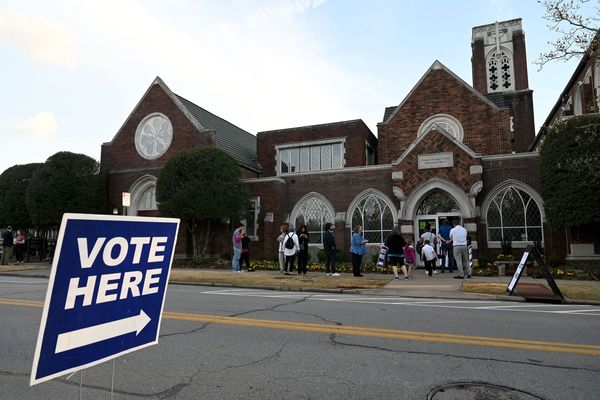
In rural Mount Vernon, Alabama, people drove from miles around to the Mount Vernon civic center, a tiny white building with a sign saying “VOTE HERE” on the front door.
The electorate in Mt. Vernon, at least by midday, seemed uniformly gray-haired. Outside, 84-year-old Earl Middleton climbed the steps to vote. “There’s only one man to vote for,” he said. “I served my country, and I’m voting for the one man who will keep our military strong.”
Who is that? “Donald Trump!” he said.
Further south, on Mobile Bay, in the relatively affluent town of Fairhope, a woman in her 20s named Megrez Mosher voted. She felt stunned by the demographic - gray-haired, like rural Mt. Vernon, and said she was “all about shaming people into doing their civic duty”.
So she went home and posted on Facebook: “I just voted. I was the only person my age in the civic center. Millennials and Gen Xers get out and vote!! I don’t really care who you vote for, but don’t keep posting memes and sharing articles on Facebook if you do not fulfill your civic duty.”
Updated
Concerned with a “lack of civility” in the current discourse among the five remaining members of the Republican presidential field, retired neurosurgeon Ben Carson has personally called upon the candidates to join in a private meeting in Detroit, Michigan before the next Republican presidential debate this Thursday.

“The American people deserve so much more from the candidates who are seeking the most powerful position in the free world, and I share their concern that this race has taken a turn for the worse, to the point of embarrassment on the world stage,” Carson said in a statement.
“A house divided cannot stand, and it is imperative the Republican Party exhibit unity by the candidates coming together with a pledge to talk about the many serious problems facing our country, instead of personally attacking each other.”
Trump: "Forget it, Ben."
— Jon Ralston (@RalstonReports) March 1, 2016
Cruz: "Endorse me and get out."
Rubio: "Aren't Don's fingers small?"
Kasich: "Good idea." pic.twitter.com/ukAahV2DMi
Updated
With Tennessee being among the Super Tuesday states voting today, the Guardian’s Adam Gabbatt headed to Nashville to find out how catchy some of this year’s most famous campaign lines would sound if they made it into a song.
He met up with local bands Sweet Cheeks and the Strumms and challenged them to a freestyle music contest. It went... well, you can see for yourself.
And on Super Tuesday, the spell was broken.
For 88 days, Hillary Clinton avoided questions from her traveling press corps, who had resorted to shouting inquiries at her while she glad-handed and posed for selfies with supporters after events.
After meeting with voters at a coffee shop in Minneapolis, Minnesota, Clinton turned to the traveling press and let them fire away. Here are some highlights, thanks to the strong social media game of the embeds who follow her.
On Donald Trump failing to disavow David Duke: ”I was very disappointed that he did not disavow what appears to be support from David Duke and the Ku Klux Klan that is exactly kind of the statement hat should be repudiated upon hearing it.”
Hillary Clinton just took several questions from reporters at Mapps coffee shop in Minneapolis. pic.twitter.com/crJktenbSI
— Monica Alba (@AlbaMonica) March 1, 2016
Clinton on whether Sanders has a path forward after SuperTuesday: “We just want to do as well as we can... Let’s see what voters decide in all these states that are lined up today and then we’ll take stock after it’s over.”
On Trump becoming the nominee: “Obviously he’s done very well. He could be on the path.”
At the end of the coffee shop visit, Clinton was confronted by a Somali-American resident who asked the candidate about her “super predator” comments. According to reporters who were there, the conversation ended with Clinton suggesting: “Why don’t you run for something?”
In January, South Carolina governor Nikki Haley took aim at Republican frontrunner Donald Trump in her state of the union rebuttal, warning that aggressively anti-immigrant rhetoric threatens “the dream that is America” in a speech that was widely seen as a critique of Trump’s candidacy.
“During anxious times, it can be tempting to follow the siren call of the angriest voices,” Haley said at the time. “We must resist that temptation. No one who is willing to work hard, abide by our laws, and love our traditions should ever feel unwelcome in this country.”
Haley’s latest critique is slightly less veiled:
@realDonaldTrump, Bless your heart.
— Nikki Haley (@nikkihaley) March 1, 2016
As anyone who grew up in the American South or enjoys Steel Magnolias - or both, we ain’t judging - knows, “bless your heart” is a fantastically flexible phrase that can range from expressing Christian pity to being the verbal equivalent of a middle finger with a French manicure.
Trump, who grew up in the New York borough of Queens and may not be familiar with the phrase’s nuances, has not yet responded to Haley’s tweet.
Denver resident Maile Rains wants to know which presidential candidate can beat Donald Trump in the general election. That’s a key factor for the 36-year-old registered Democrat, who said she has not yet decided who she will support at the Colorado caucus on Tuesday – noting that Hillary Clinton seems too untrustworthy and Bernie Sanders’ socialism seems too radical.
“My feeling is anybody is better than Trump,” said Rains, a stay-at-home mom. “Trump is out there like this cartoon character, and no other candidates’ voices are being heard.”

During the final 48 hours before the high-stakes caucus, Sanders volunteers canvassing in the Mile High City attempted to sway Rains and many other on-the-fence Democratic voters that the Vermont senator is the candidate with progressive values who could energize liberals and ultimately beat the GOP frontrunner in November.
With its large population of independent voters, Colorado is a critical battleground for Sanders – previously a longtime independent – as he fights to score strategic victories in Super Tuesdayraces across the country.
After Clinton’s decisive win in South Carolina illustrated her opponent’s struggle to gain traction in the south, Colorado has become particularly crucial for Sanders, with pundits saying a loss would be a devastating blow to his campaign – potentially insurmountable depending on how successful Clinton is in other parts of the south on Tuesday.
In between answering phones and organizing canvassers inside a bustling campaign office Monday afternoon, Dulce Saenz, Sanders’ Colorado director, explained how volunteers last year pushed independent voters to register as Democrats so they could participate in the caucus – and support Sanders.
“Colorado is particularly interesting, because when we came on as a campaign, there was already a huge volunteer infrastructure,” she said.
Unaffiliated voters in Colorado continue to be the state’s largest voting bloc, forming a constituency of roughly 1m people who can’t participate in the caucuses. But Saenz pointed out that more than 30,000 people have registered with the Colorado Democratic party in recent months – a shift that she hopes will translate to a win for Sanders.

Many voters – herself included – switched from independent to Democrat last year so they could caucus for Sanders, she said.
Kim Austin, a 45-year-old Denver voter, said she has always been registered as an independent, but was persuaded to join the Democratic party after hearing Sanders’ position on universal health care. “Clinton’s a liar, she’s corrupt and she’s bought,” she added.
Experts say that the format of a caucus – in which voters select delegates in a town hall-style meeting – could also work in Sanders’ favor in Colorado. That’s because the caucus is a time commitment that requires all participants to show up at 7pm, often resulting in low turnout.
Democrats who do end up caucusing tend to be the most invested in the race and often have more progressive views, said Peter Hanson, assistant professor of political science at the University of Denver. “If Sanders supporters are as enthusiastic as many believe them to be, it’s entirely possible they’ll show up more than Clinton supporters.”
The caucus model was a key reason Clinton lost by a wide margin against Barack Obama in the 2008 Colorado race, said Robert Loevy, professor emeritus of political science at Colorado College. He expects a similar struggle for Clinton on Tuesday: “Colorado could be a bright spot for Bernie Sanders on what might otherwise be a grim day for him.”
Sanders has also spent more on Colorado television ads than his opponent.
Clinton’s Colorado supporters argued that she’s the only candidate who can take on Trump – and said they were hopeful Latino voters would help her beat Sanders at the caucus.
“It’s going to be close, but I think that we have a really good shot,” said Ken Salazar, former US secretary of the interior, after rallying Clinton supporters inside a crowded campaign office in Aurora Monday evening. “She is head and shoulders above everybody, including Bernie Sanders, in how she has stood up for the Latino community.”
Lynetta Miller, a 64-year-old Clinton volunteer and Aurora resident, said it seemed clear Colorado voters who support Obama are eager to back the former secretary of state. “She’s been fighting for us for so long … it’s time we support her,” she said, adding that Clinton supporters were working to mobilize a large turnout. “They’re taking their neighbors to the caucus. They’re taking their friends to the caucus. And that’s important.”
Approached by a Sanders’ volunteer at his house, Tom Chatfield, a 65-year-old registered Denver Democrat, said he felt Clinton was the much safer choice. “Hillary’s more practical, even if she is part of the establishment,” he said. “Bernie’s got his head in the clouds … Let’s support Hillary now before we get one of the crazies in there.”
Chatfield, however, said he wasn’t sure if he was going to have time to attend the caucus.
Speaking outside his polling place in Houston on Tuesday, Ted Cruz suggested that Marco Rubio should consider dropping out after Tuesday.
The Texas senator told reporters “I believe we are going to do very, very well here in Texas. It’s gonna be up to Texans to make their decision. But there is no doubt that any candidate who cannot win his home state has real problems.”

He added that “any candidate that wakes up tomorrow morning that has not won any states, for any candidate that wakes up tomorrow morning and has won a negligible number of delegates, it’s time to start thinking about coming together and unifying and a clear choice.”
The statements represented a clear shot at Rubio, who has yet to win a state and is lagging in polls in his home state of Florida. However, despite this, Rubio has become an establishment favorite and party elected officials are coalescing around his candidacy, much to the irritation of the Cruz campaign.
While Cruz is favored in his home state of Texas and has the potential to win other states on Super Tuesday, Rubio’s campaign has already conceded that the Florida senator will be shut out yet again in Tuesday’s contests.
Spokespeople for Rubio’s campaign did not immediately return a request for comment. After engaging for months in a bitter battle with Cruz, the Florida senator has recently shifted his focus to attacking Donald Trump as part of a last-ditch effort to blunt the frontrunner’s momentum.
Updated
There are two kinds of people in Burlington, Vermont: those who believe there are no Hillary supporters here, and those who believe there must be, somewhere, but that they’re all in hiding.
Inside Dobra Tea Parlor yesterday, incense was burning at the foot of a bronze bodhisattva. Two customers were drinking tea and writing somberly in their journals. In a corner, a pair of young women discussed alternative high schools. I leaned across the counter and asked, softly, where I might be able to find someone who was voting for Clinton.
The tea barista, Sam Hughes, looked shocked. “I don’t know anyone who would admit to being a Hillary supporter,” the 25-year-old told me, as I paid for a gluten-free tea cake.

Burlington is where Bernie started his political career, as a socialist mayor who wrote strongly worded dispatches to world leaders about the importance of military disarmament, and it’s still his home base. In the downtown shopping district, where insistent classical music is piped out over the street, passers-by laughed or stared when I asked about Hillary Clinton. Where could I find a Hillary supporter? “Try Georgia,” said a white-bearded man in a fleece vest.
In The Bern Gallery, a smoke shop that had not been named in honor of the Vermont senator, 24-year-old Molly Rhoads shook her head. She pulled up her sleeve to bare her elbow, which sported a Bernie tattoo. She had gotten it at a local parlor that has been giving away free tattoos in support of the candidate. “He has started a revolution for sure,” she said.
Several Burlingtonians told me they believed local Hillary supporters existed. They just didn’t know where to find them.
Outside of city hall, I thought I had finally struck gold. Seventy-six-year-old Sunny Long told me she was a Hillary supporter. “We all love Bernie, but we think Clinton has the global experience that’s lacking in Bernie,” she said.
I asked her how long she had lived in Burlington. “Ten days,” she said. She had just moved here from Florida.
Feeling discouraged, I headed to the town’s independent bookstore, the Phoenix. Maybe the booksellers would have a deeper network of sources. At first, Phil Clingenpeel was stumped. By a Hillary supporter, he asked, did I mean someone who liked Hillary, or someone who supports her more than Bernie?
The latter, I told him.
He thought for a while. He did know someone who knew someone who supported Hillary, but he wasn’t sure if that person actually lived in Burlington. His coworker had a better idea: she had a friend who had actually hosted a Hillary event at his house last week.
“I’ve sort of come out of the closet, as it were, within the past month,” Nate Orshan told me, when I drove out to the renovated woolen mill where he works to interview him.
Orshan, 48, is a web analyst who has lived in Burlington most of his life. “I think I’ve voted for [Bernie] every singe election I could up until now,” he said.
Being a Hillary supporter here is “tough,” he told me. “Sometimes I feel like that boy in the story, ‘The Emperor Has No Clothes.’” There’s a lot of love for Bernie, and and I understand it, and I feel it, too…I just feel that he doesn’t have the support nationally that he’s going to need.”
Many Bernie supporters, he said, “fail to see that a lot of the country is indeed very conservative, and, in fact, very religious. It’s not a question of his Judaism, it’s a question of his secularism, that I think is going to be such a nonstarter for so many voters across the country.”
Orshan promised to put me in touch with his small network of local Hillary fans.

Burlington is “a lonely place” for them right now, his friend Mattison told me, when I met her later that afternoon at a local brewery.
“It’s interesting, being out, having friends who aren’t, who are closeted Hillary supporters, who will message me on Facebook, or text me or email me, to say, ‘Thank you.’ Well, yeah, we have to speak up.”
The 50-year-old believes Hillary is the politician who will actually be able to move a progressive agenda forward.

Bernie “definitely speaks to the truth that the system is rigged, but I also think the truth of the matter is, Vermont is a very special place, and Bernie has never had to work through complicated changes in a complicated political sphere,” she said.
“When you see the people who are coming to [Trump’s] rallies, and the things that they’re saying—that’s the real America.”
While she loves living here, she said, “I know it’s not real.”
Updated
Speaker Paul Ryan: Nominee 'must reject any group or cause that is built on bigotry'
Paul Ryan, Republican speaker of the House of Representatives, spoke out on the presidential race in a press conference this morning, saying “this party does not prey on people’s prejudices”.
Ryan’s comments come in response to the controversy surrounding frontrunner Donald Trump’s hesitance to condemn white supremacist David Duke, who has backed his campaign. According to Ryan: “If a person wants to be the nominee of the Republican party … they must reject any group or cause that is built on bigotry.”
Updated
Ben Carson picked up his fifth delegate today as the Nevada Republican Party allocated the last of the state’s 30 delegates.
Carson will now have two delegates from Nevada and has earned five delegates in total so far in the primary.

Despite raising more money than any of his Republican rivals, the retired neurosurgeon’s campaign has been plagued by infighting and financial malfeasance. When asked by the Guardian in January if his campaign was a direct mail scam, Carson simply answered “not that I know of.” Although Carson has righted the ship, his campaign’s issues have sent the former frontrunner plummeting to the back of the pack.
With the rise of Donald Trump, Carson has come under increased pressure to get out of the race to allow Republicans to consolidate behind one anti-Trump candidate. However, the additional delegate will help strengthen Carson’s case to stay in the race.
Carson is no just one delegate behind Ohio governor John Kasich in the scramble for the 1237 delegates needed to clinch the GOP nomination. If he passes Kasich in the delegate count on Super Tuesday, it will be even harder for party elders to make the case that Carson should drop out.
Former Republican presidential hopeful Jim Gilmore will not be endorsing any of the GOP candidates, the Guardian can reveal.
“No official endorsement, but [he] will support the GOP consensus candidate in order to defeat Hillary or Bernie,” said a spokesman for Gilmore, a former governor of Virginia.
It is unclear how much of a blow this will be to the five Republicans still in the race. Gilmore suspended his presidential campaign after the New Hampshire primary, where he won 133 votes. In the Iowa caucuses 12 people voted for him.
I spent the day with Gilmore as he campaigned in New Hampshire. The main takeaway was that he is good at shooting guns.
To try to determine who will end up in the White House, I’ve travelled to White House, Tennessee. Clever, right?
About 7,000 people live in White House, which is 20 miles north of Nashville. There’s a Pennsylvania Avenue here, which I am guessing is also inspired by Washington DC. The city is split between Robertson and Sumner counties. In the 2012 GOP primary Santorum won convincingly in both. (As he did in the entire state – he only lost four counties out 95.)
The polling station is at White House Heritage School. Turnout has been “steady” so far, according to a woman behind a desk. Here’s a couple of people I spoke to:

Renee Free, 51, Nurse
Voted for: Donald Trump
“I think he’ll take care of the average person. I don’t like Obamacare. I think it has hurt the nation. Also an issue is all the immigrants coming in. America was founded on people coming over but if you come to the United States you should have to pledge your allegiance to us by going into the military. To me that’s the best way of showing that you’re here for the right reasons. I’m just afraid of, like, the Syrians coming in, it’s a scary time right now. I want to leave our nation stronger for our grandchildren.”
“My son owns his own business and its real hard he can’t afford insurance. People like the immigrants coming in, they have insurance, they can afford it. But someone that’s worked really hard, it’s hard for the average person to take care of their families. It was $600 a week for what he would have to have for his family - who can afford that?”

Dawn Allgood, 50, Realtor
Voted for: Ben Carson
“What I’m taught as a Christian is follow God’s law. I’m sitting there thinking: ‘Does he even have a chance? Should I vote for Ted Cruz?’ Then I thought: ‘No, I’ve got to go with my conscience.’”
“I think [Obama] split us. I think he created more of a divide in our nation than he brought us together. He kind of pitted the whites against the blacks constantly. I think the police are doing their job for the most part. If you’re not doing a crime you don’t get in trouble.” The Guardian pointed out the high profile shootings of black youths who were not committing crimes. “But that’s still the same thing of somebody who was white who did the same thing because they’re black.”
“I think Obama doesn’t see how unprotected or how unsafe we feel under his leadership because he doesn’t call terrorism what it is. If it’s obviously terrorism from the Muslim extremists, he doesn’t call it out.”
Do you agree with Ben Carson that a Muslim should not be president?
“I do. Because our country was founded on Christian values and Muslims have a whole set of different values. Like sharia law, on women’s rights.”
Updated
This morning, at their kitchen table, Katie Petrozzo, 20, and Jennifer Toner, 21, decided it was time to get their Bernie Sanders tattoos.
Neither of them had ever gotten a tattoo before.
“We’re willing to put our faith in him, out of everyone,” Katie said. “He’s just a good human.”

The two college students headed to Aartistic Inc. in Winooski, Vermont, which has been giving away free tattoos in support of the candidate.
“Honestly, I don’t know how he’s going to do anything, I really don’t, but I trust him more than any of those other buffoons,” Jennifer said. She said she also liked how Bernie had galvanized other twenty-somethings. “It’s exciting to watch people of our generation get excited about these things.”

Neither Katie nor Jennifer could cast a vote in the primary this morning, as their candidate faces an uphill battle in Super Tuesday states across the country. The two of them are juniors at St. Michael’s, a Catholic liberal arts college outside of Burlington, but Katie is from New York and Jennifer from New Jersey, which both have primaries later in the year. So the two decided to ink Bernie’s face on their ankles instead.
They were the first appointment of the morning. Tattoo artist Amy Ginter said she had cast her vote already that morning, and she was wearing an ‘I voted’ sticker to prove it.
“You’re my fourth getting a Bernie tat as your first tat,” she told Katie, as she prepared her ankle for the tattoo.
“I’m your fifth!” Jennifer said.
The parlor’s signature Bernie tattoos feature a stylized outline of Bernie’s characteristic wild white hair and big glasses. Katie held tight to her roommate as Amy dipped the needle in ink and began tracing the silhouette of Bernie’s hairline into her skin.

“Feel great? Feel happy? Feel like revolution?” Amy asked as the needle buzzed.
“It does feel like revolution!” Katie said, flinching.
She and Jennifer cheered with delight at the finished tattoo, then switched places.
“I wonder what it feels like to know that your image is tattooed everywhere,” Katie said.
Sanders himself might not be able to get tattooed - many Jews do not get tattoos, Amy noted. But giving Sanders one of his own tattoos “would be hilarious,” she said. In all, she has done about 40 Bernie tattoos, she said. A few of the Bernie supporters have told her, “Bernie is my boyfriend!” she claimed. When a reporter expressed some skepticism about this, she swore she had heard it “two or three times,” that “He’s so cute, he’s so hot… He’s my boyfriend so I have to get his tattoo.”

Jane Sanders, Bernie’s wife, probably accepted this adulation calmly, she added.
“She’s probably cool - she understands, it’s Bernie,” she deadpanned.
Outside, another two locals were already waiting for their free Bernie tattoos. Eighteen-year-old Abbey Cordner and her 19-year-old friend, who declined to give his name, said they would be voting for Bernie later that afternoon.
“He just seems for us,” Abbey said. Who’s us? “The people,” she said.
Walking out with their matching Bernie tattoos, Katie said she would be “incredibly disappointed” if Bernie was not the nominee.
But, Jennifer said, “I’ll be happy I have the tattoo.”
Bernie Sanders volunteer Alex Calleros stumbled on an unusual household while doing a final round of canvassing before the Super Tuesday Democratic caucus in Denver, reports the Guardian’s Sam Levin.

Maile Rains, who answered the door, was the registered Democrat the Sanders campaign was trying to reach. But Rains’ husband, she explained, would not be caucusing for Bernie Sanders or Hillary Clinton. That’s because he’s a registered Republican.
“We’re very respectful and open-minded,” said Rains, a 36-year-old stay-at-home mother. “We have the same values but different approaches.”
Rains said she doesn’t know if she’s going to support Clinton or Sanders on Super Tuesday – she has reservations about both of them. Her husband, meanwhile, is interested in Marco Rubio and John Kasich, although Colorado’s unique GOP caucus won’t be an official vote and delegates will remain free agents (meaning the Super Tuesday event doesn’t matter too much on the Republican side).
Even if they’re members of dueling political parties, the husband and wife often have similar beliefs, Rains said. “Most of the time we’re on the same page.”
This election season, they’ve found some strong common ground: hatred of Donald Trump.
“The unifying issue for us is Trump,” she said. “How do we oust him?” They both have been very frightened watching videos of the real estate mogul’s speeches and rallies, she said. “We’re scared of him ... It’s like Mussolini all over again.”
Rains, who previously did social work, said she has always enjoyed political discussions with her husband, who works in finance. “We learn a lot from each other.”
It can be frustrating to feel like their votes will ultimately cancel each other out – but they’ll never know for sure. “We don’t tell the other person who we voted for,” Rains said. “So I’ll never know how he votes.”
Donald Trump and Ted Cruz appear to be performing strongly in the manufacturing hub of Valdosta, Georgia, where Trump held a packed rally on Monday night, reports the Guardian’s David Smith. Around 25 people were gathered at the Rainwater Conference Center, set off a highway near a strip mall, when polling opened at 7am. There was then a steady trickle of voters in the sunshine but no need to queue. A few Trump and Cruz banners were planted in the grass outside.

John Hogan, 30, a local transport business owner, said: “I don’t see any candidate as strong as Trump. He’s non-traditional. He’s more realistic and comes with a more sensible approach to everyday things. He’s more than a politician; he’s a repair man. We need someone to repair our finances and our economy, someone who tells it like it is. We’re looking for something different.”
Hogan, who is African American, disputed criticism that Trump is racist. “We had a Democrat president and a black president, everything that people said would fix the nation, and it didn’t. We need to get a businessman in there now. America is a business; we do business day and night. Trump has the best approach right now. I feel everyone else has been bought and paid for; they all owe somebody.”
There was also support for the Republican frontrunner from Mark Armstrong, 59, who works in chemical manufacturing. “I’m tired of politics and the status quo,” he said. “I don’t think they’ve done us an honest job. Trump is an honest man. Do I believe everything he says? No. But he’s as honest as the people we’ve had in Washington. There are a lot of people who think like me. America’s going to be surprised.”
A 40-year-old woman, who did not wish to be named, added: “Trump is the radical change we need in all areas. He has a no nonsense way of dealing with everything. Some people are offended by it but I’m not: he cuts through all the bullshit and tells it like it is. It doesn’t always come out right but sometimes the truth hurts.”

But Jenny Templeton, a stay-at-home mother of four, voted for Cruz. She explained: “He’s a good balance of experience, common sense judgment and conservative beliefs. I think Trump is a little scary to me and egotistical and extreme in his thoughts.”
There were two more votes for Cruz from Kelly Kuhn, a property agent, and his wife Pamela Kuhn, an insurance agent. Kelly, 42, said: “We want somebody who’s going to honour the constitution. I don’t think Trump has the temperament to lead the country.”
Pamela, 45, added pragmatically: “But we shouldn’t say too many bad things in case we have to choose him. He would be the lesser or two evils.”
Republicans outnumbered Democrats in the strongly red state but John and Masonnia Mattox, a retired African American couple, voted for Hillary Clinton. “Bernie Sanders is a good person –” Masonnia began, before her husband interjected: “But we’ve been Hillary all the time. It’s hard to change.”
Masonnia, 65, added: “She has the most experience. She has worked under the leadership of two presidents and that will help her. The fact she’s female is important but not the main thing.”
New York court: Fraud suit against Trump University can proceed
A New York appeals court on Tuesday has reopened a fraud claim brought by the state’s attorney general against Trump University, the for-profit online education outfit owned and founded by billionaire presidential candidate Donald Trump.

The ruling that a fraud suit against Trump University for “deceptive and unlawful practices” can proceed came in a case New York attorney general Eric Schneiderman filed against the Trump venture in 2013, in which Trump University was accused of misleading customers into paying for services they believed were provided by an accredited university. Trump University, now known as the Trump Entrepreneur Initiative, is not and has never been a an accredited university or college, and has never conferred degrees upon its customers.
“We started looking at Trump University and discovered that it was a classic bait-and-switch scheme,” said Schneiderman at the time of the suit’s original filing in 2013. “It was a scam, starting with the fact that it was not a university.”
Schneiderman further claimed that Trump University had mislead its customers by leading them to believe that they were to be mentored by instructors handpicked by Trump himself, that the three-day seminar would include “access to ‘private’ or ‘hard money’ lenders and financing,” a “year-long ‘apprenticeship support’ program,” and that it would “improve the credit scores” of students.
The lawsuit accused the venture of using “bait and switch” tactics to steer enrollees into higher cost seminars, in which customers were pressured to enroll in courses on real estate, asset management, entrepreneurship and wealth creation, each of which charged fees ranging from $1,500 to $35,000.
“If you don’t learn from them, if you don’t learn from me, if you don’t learn from the people that we’re going to be putting forward, and these are all people handpicked by me, then you’re just not going to make it in terms of world-class success,” Trump said in one of Trump University’s infomercials.
In 2012, Trump testified in a deposition that he neither selected Trump University instructors nor oversaw program’s curriculum, despite public statements to the contrary.
Trump, now the leading candidate for the Republican party’s presidential nomination, has been dismissive of the suit, telling a rally in Bentonville, Arkansas, on Saturday that the presiding judge has been unduly harsh on him because of his comments regarding undocumented immigrants.
“There is a hostility toward me by the judge - tremendous hostility - beyond belief,” Trump said. “I believe he happens to be Spanish, which is fine. He’s Hispanic, which is fine. And we haven’t asked for a recusal, which we may do. But we have a judge who’s very hostile.”
Trump University has been the subject of a series of anti-Trump political advertisements ahead of Super Tuesday, with a super PAC that once supported Mitt Romney’s campaign for the White House releasing ads detailing the stories of people who had been “duped by the Donald.”
The lawsuit is seeking restitution of at least $40m.
Updated
Donald Trump received an extra boost in his bid for president after Nascar boss Brian France and several prominent drivers gave him their backing on Monday – although Nascar insisted their comments did not amount to a formal endorsement from the car-racing body.
On the eve of Super Tuesday, where a series of sweeping victories are set leave Trump as the overwhelming favorite for the Republican nomination, France, Nascar’s chairman and CEO, joined Trump on stage at a rally at Valdosta State University in Georgia and declared his unqualified support.

“I’ve known Donald for over 20 years,” France said during the rally. “I’m going to tell you one thing about him: you know about his winning in business and success. I’m here to tell you: he wins with his family. Any of his children, you’d be proud to have them as part of your family.
“That’s how I judge a winner: how somebody manages their family, raises their family.”
Trump has been married three times, and has five children.
After France’s words came endorsements from Bill Elliott, a popular retired driver, and three active drivers: Elliott’s son, Chase, Ryan Newman and David Ragan.
As the drivers left the stage, Trump thanked them and then told his audience: “That’s cute. They just said: ‘Keep that wall going.’ We’re going to keep the wall going. Believe me. Believe me.”
Trump has promised to deport millions of immigrants and build a wall on America’s southern border. “I would build a great, great wall on our southern border and I will have Mexico pay for that wall. Mark my words,” Trump boasted at his campaign launch in June.
Shortly after Trump announced he was running for president, Nascar said it would no longer hold its season-ending awards ceremony at Trump’s luxury hotel in Miami, the National Doral.
But Nascar’s owner was full of praise for Trump on Monday. In a news release after the rally, France, 62, said: “Mr Trump is changing American politics forever, and his leadership and strength are desperately needed. He has had an incredible career and achieved tremendous success. This is what we need for our country.”
Bill Elliott, a former Nascar great who won the association’s most popular driver award a record 16 times, echoed France’s comments. “It is my great honor to endorse Donald Trump for president of the United States,” he said. “He is a leader representing strength and commonsense solutions.”
“This is a great man,” Chase Elliott said. “I think he’s a guy who can do some great things for us.”
Spokesman David Higdon, however, insisted France was not speaking for Nascar. “Private, personal decision by Brian,” Higdon said in an email.
Nascar sanctions over 1,500 races at over 100 tracks in 39 states, and holds 11 of its 38 Sprint Cup events at states with primaries Tuesday. According to Forbes, the top 10 Nascar teams are now worth an average $148m, and generated nearly $1bn in combined revenue last season.
“If the people that like and watch Nascar vote for Donald Trump, they can cancel the election right now. Nobody can win,” Trump said at the rally.
“More like hate and castrate.”
Hillary Clinton’s campaign is beginning to formulate a strategy to defeat billionaire Donald Trump in a general election, according to a blockbuster story from the New York Times. The essence of her strategy? Depict the former secretary of state as a force for unity and civility while allowing former president Bill Clinton to help paint Trump as a misogynist and a bigot who is not ready to serve as commander in chief.
The whole piece is worth a read, but here’s a key line from David Plouffe, who managed Barack Obama’s 2008 campaign. “Hope and change, not so much. More like hate and castrate.”
Is Donald Trump a dream candidate for Democrats?
Judging from all the whoopin’ and a hollerin’ at a Rubio rally inside an Atlanta hotel on Monday night, reports the Guardian’s Richard Wolffe, he might just be the kind of Republican nominee who finally delivers some bipartisan agreement in American politics.
Agreement that Trump represents a surefire disaster for the Republican party, that is.

In a ballroom filled with several hundred Republicans, South Carolina’s governor Nikki Haley denounced Trump for failing to disavow support from the Ku Klux Klan.
Along the way, the governor – a rising star inside the Republican party – described Trump in terms that were much harsher than anything she used to condemn either President Obama or Hillary Clinton. After calling him a Kindergarten bully, she linked him to a wrenching moment in her own state’s recent history.
“South Carolina went through a terrible tragedy last year,” she said, referring to the Charleston church massacre, in which Dylann Roof killed nine black churchgoers as he tried to ignite racial conflict. “And the KKK came to South Carolina from out of state to protest on our statehouse grounds. We saw and looked at true hate in the eyes, last year in Charleston.
“I will not stop until we fight a man that chooses not to disavow the KKK. That is not a part of our party. That is not who we want as president. We will not allow that in our country.”
Once the extended cheering and applause died down, she added, for good measure: “That is not who our Republican party is. That’s not who America is.”
As Trump is poised to sweep today’s Super Tuesday primaries – just as he swept Haley’s home state little more than a week ago – it is hard to see how the Republican party can reunite behind his likely nomination. Haley and Rubio have already said enough to feature, unfiltered and unedited, in Democratic attack ads in the general election.
The prospect of a Trump candidacy is leading to a reconsideration of the Republican lock on several southern states for the last two decades or more.
Barack Obama took the once-reliably conservative states of Virginia and North Carolina in 2008, and in the final days of the first campaign, his aides suggested Georgia might also come into play. Demographic projections suggest that minorities will represent a majority of the state’s population in less than a decade.
Still, President Obama lost Georgia twice, and the last Democrat to win here was Bill Clinton in 1992.
“It would be competitive because certainly there’s a considerable amount of Republicans in Georgia, especially members of the business establishment, who would never support Trump,” said Merle Black, political science professor at Emory University in Atlanta.
“Whether or not they would actively work for Clinton, I don’t know. But there would be large defections from the usual Republican groups here in Georgia. The big unknown is whether Trump would attract people who haven’t voted in the recent past: Democrats and independents.”
Whatever happens in November, the Republican primary has taken Georgia’s African-American voters back in time.
“The Republican primary has caused a real spike in the number of complaints we receive about hate groups operating here,” says Francys Johnson, state president of the Georgia NAACP. “The KKK uses Donald Trump’s name in combination with a white-hooded individual calling for citizens to make their country great again.
“It if was just leafleting, it would be one thing. But there have been a questionable number of church burnings in Georgia during this primary season. There have also been a number of targeted property destructions where neighborhoods and communities are being targeted for intimidating messages from the KKK.
“It’s gone beyond rhetoric to the intimidation tactics that we thought we were getting beyond in the south. In each cycle, there’s an ample share of this sort of fear-mongering…But this has been a season on steroids.”
Johnson says this kind of violence has taken place alongside a concerted effort to lower minority turnout. The NAACP is a party to two voter lawsuits: one accusing the state of illegally purging voters off the rolls, and another opposing new provisions that require proof of citizenship to vote.
It’s not clear that Trump’s outlandish politics are turning Georgia into a swing state: recent polls suggest that he would beat both Bernie Sanders and Hillary Clinton. It makes no difference that Clinton is heading for a decisive win in Georgia’s primary today, when she is expected to sweep the south by similar margins to her blowout victory in South Carolina.
Judging from what was said on stage at the Rubio rally, this may seem hard to digest. “If we lose this election, and we will with Donald Trump as the nominee, then Hillary Clinton will be the next president of the United States,” Rubio told his supporters. “I say this to you without any hesitation and without any glee: A vote for Donald Trump tomorrow is a vote for Hillary Clinton in November.”
Those warnings did not seem to trouble his own supporters when considering the likely choice between Clinton and Trump in the general election.
“I probably would vote for Trump,” said Robert Wendling, a businessman from Atlanta, who believes Rubio is the best candidate in the field. “Simply because as a Republican, the next president is probably going to be responsible for nominating up to three Supreme Court justices. That is probably in the end, for somebody like me who is a social conservative, the most important question moving forward.”
Even one of the few African-American supporters in the room admitted she was considering voting for Trump, despite his refusal to disavow the KKK.
“I know what he was doing. I expected that. I don’t think he’s racist,” said a retired real estate manager from Lithonia, who declined to be identified because of family disapproval of her politics.
So would she vote for Trump in the fall?
“I’ll have to think about it,” she said. “I really have to think about it. I just don’t know.”
Today, 11 states and one territory will hold nominating contests to help determine the Democratic party’s presidential nominee. The territory: American Samoa, a tiny group of islands in the middle of the Pacific Ocean with a population of 55,519 as of 2010. It is approximately halfway between Hawaii and New Zealand and is the only inhabited US territory south of the equator. Despite their distance, the people of American Samoa will hold a presidential preference vote for 10 delegates.

We asked two American Samoans about what issues are important to them, and what they want candidates to know about their sometimes-overlooked home.
Patrick Ti’a Reid, 32: ‘We don’t have a big voice on the political stage’
I’m voting for Hillary Clinton. I feel like she’s the only candidate that’s actually been here. So the fact that she’s actually visited the island tells me that she’s more aware of the issues we’re facing as a territory. I think she has a better plan, she’s more experienced, she’s more qualified, and I think she’ll do a better job than any of the other candidates.
We don’t have a big voice on the political stage. Because we’re so remote, people are more concerned with what’s going on here on the island, I think, than with national issues. I also don’t think candidates are very aware of how impacted we are by some foreign policies because we have so many family members in the military.
I really like how the primaries are going on the Democratic side, but I think the other side is just crazy. I feel like I’m watching a reality show. It’s entertaining, but I don’t hear many discussions on many policies and plans. It’s just a lot of bickering. It’s more entertainment than discussions on their plans for the country. A lot of people [here] are turned off by Trump, that’s for sure, because we are a community of a lot of immigrants.
Uperesa Fakava, 19: ‘I would like to see up-close what they’re really doing’
I’m kind of leaning towards Bernie Sanders for the Democratic Party.
My main priority is education because I’m going to college right now. I like his policies about education and the $15 dollar minimum wage for everyone. That’s my main priority because I’m working and going to school. I’m only working at a low level, like $6 an hour. A minimum wage policy would help me a lot.
I would like [the candidates] to know that the unemployment rate is so high here and most families live almost in poverty. Some families don’t even have electricity.
I’m always watching the news everyday and I have subscriptions to online newspapers so I’m always up to date on this kind of stuff but I would like to see up close what they’re really doing. People in New Hampshire get to meet all the candidates, I would really like to meet one of them – but since I’m here I only get to watch the news and subscribe to the newspapers and publishers.
Updated
The Christian Post is pleading with evangelical voters to not vote for Republican frontrunner Donald Trump.

The most popular Christian news site has never taken a position on a specific candidate since its launch in 2004, but “We are making an exception because Trump is exceptionally bad and claims to speak for and represent the interests of Evangelicals,” according to an editor’s note at the top of the editorial.
“As the most popular evangelical news website in the United States and the world, we feel compelled by our moral responsibility to our readers to make clear that Donald Trump does not represent the interests of evangelicals and would be a dangerous leader for our country,” the editorial states.
“Trump, an admirer of Vladimir Putin and other dictatorial leaders, may claim to be your friend and protector now, but as his history indicates, without your full support he will turn on you, and use whatever power is within his means to punish you.”
Trump, whose multiple ex-wives, inability to correctly name books in the Bible and penchant for scatological insults make him an unlikely fit for evangelical voters, has enjoyed massive support from the religious community, winning the majority of self-described evangelical Christians in the South Carolina primary and the Nevada caucus. As multiple Southern states vote in today’s Super Tuesday primaries, Trump will again count on that support.
Even with a charter plane at her finger tips, you just can’t be everywhere at once.
Instead, Hillary Clinton and her family, husband Bill and daughter Chelsea, are fanning out across the country and making their presence felt in a last push to win votes in states that may help her clear a path to the nomination.

Bill Clinton stopped by polling booth in Boston, Massachusetts with mayor Marty Walsh this morning. Clinton called into an R&B radio station in Dallas, Texas, to ask listeners to get out and vote.
“We’ve got so much at stake,” Clinton said, as she slid into her stump speech. But the DJs really wanted her to ask her about... Donald Trump.
Clinton said she still had to focus on the primary, but promised that if she were to win the nomination, she would run a “relentless campaign against the bigotry, against the insults, against the kind of denial of the progress that president Obama has made. I’m just not going to stand by and let that be said.”
Then she gave listeners of the station – which is very anti-Trump – an incentive: “If I could wrap up the nomination early, I could turn my attention to the Republicans. It sounds most likely that it’ll be Donald Trump.”
This morning, Clinton will swing through Minneapolis, Minnesota, where Sanders is hopeful for a victory in tonight’s caucuses, before making her way to her party in Miami this evening. In the last four days Clinton, has held rallies in the Super Tuesday states of Georgia, Alabama, Tennessee, Arkansas, Massachusetts and Virginia.
Meanwhile, Chelsea Clinton is at a coffee shop in Omaha, Nebraska, encouraging Democrats there to caucus for her mom on 5 March.
The only sign outside of Bernie Sanders’ own polling place in Vermont is for Donald Trump, reports the Guardian’s Lois Beckett.

Sanders voted here first thing this morning, accompanied by a scrum of reporters.
Bernie Sanders cast his primary vote in his hometown of Burlington, Vermont, as Super Tuesday kicked off across 12 states this morning.
After arriving with his wife, Jane, and casting his vote, Sanders told the waiting media that if voter turnout is high, “we are going to do well. If not, we’re probably going to be struggling.”
The Bernie Sanders campaign is bracing for a difficult national debut across the 11 states that vote for a Democratic presidential nominee on Tuesday, despite a record-breaking haul of small donations that could give it the money to keep fighting against Hillary Clinton regardless of the result.

Notwithstanding surprise success among white voters in New Hampshire and Iowa, the insurgent “democratic socialist” has so far failed to make much headway with more diverse electorates in Nevada and South Carolina and risks being further exposed in delegate-rich southern states on Super Tuesday.
“It’s a rough map for us,” conceded the senator’s wife, Jane Sanders, as the campaign team returned to their home in Burlington, Vermont, on Monday night from a 6,200-mile trip to eight states in three days. “I wish 11 states weren’t up tomorrow. I wish there were 48 hours in the day.”
Hello from Nashville, Tennessee.
The big news so far this morning is that severe thunderstorms and possibly hail are expected to sweep through the state today. Could this affect turnout? We will see. It’ll certainly affect the amount of time I am prepared to spend outside.
Donald Trump and Hillary Clinton are the frontrunners here. A poll released by NBC News/Wall Street Journal/Marist on Sunday found Clinton leading Sanders by 60% to 34% among likely Democratic primary voters. The same survey showed Trump on 40% of likely Republican primary voters. Ted Cruz had 22% and Marco Rubio 19%.
Rubio has received a slew of endorsements in Tennessee – from governor Bill Haslam, senator Lamar Alexander and former senator Bill Frist – but they don’t seem to be counting for much.
In the 2012 GOP primary Rick Santorum won 37% of the vote, with Mitt Romney in second and Newt Gingrich third. I’m not sure if there is that much we can read into that.
On Saturday, Donald Trump held a rally in Millington, near Memphis. Trump, 69, arrived in his own plane, which has his name written on the side of it.
And just like that, Donald Trump's plane arrived https://t.co/1zRK46LDqQ
— Adam Gabbatt (@adamgabbatt) February 27, 2016
The event was held in a big airplane hangar. Those of us in the crowd watched as the Trump aircraft trundled past us twice, while militaristic music played, before the plane finally came to a stop and digorged Donald Trump and Chris Christie.
The pair of them took turns laying into Marco Rubio – it was mostly related to him having allegedly sweated a lot one time – before a protester earned the crowd’s ire by holding up a sign that said “Make America hate again.”
An angry man just ripped up this protester's sign at Trump's event https://t.co/1WPyslXdnS
— Adam Gabbatt (@adamgabbatt) February 28, 2016
It did not go over well. An angry man snatched the sign and ripped it up. The man also shouted a lot. The protestors were removed from the rally.
Hillary Clinton appeared in Nashville on Sunday, where there were no protestors. She was introduced by actor Tony Goldwyn, who plays the US president on ABC show Scandal. He made a lot of jokes about how he isn’t actually the real-life president. They were lost on me because I’d never heard of him before but they seemed to tickle a few people in the crowd.
Clinton delivered a fairly sick burn on her Republican climate-change deniers. Referring to the standard climate-skeptic politician’s refrain that “I’m not a scientist”, Clinton said: “There’s a really easy answer for that. Go talk to a scientist.”
People laughed.
Oh, by the way, do you know what Tennessee’s state motto is? (That’s Tennessee: the state of bluegrass, of Music City? Tennessee: the state that gave us, or at least was home to, Elvis Presley, Johnny Cash and Miley Cyrus?)
The motto is: “Commerce and Agriculture.”
The New Hampshire Union-Leader is having some buyer’s remorse after endorsing New Jersey governor Chris Christie ahead of the state’s first-in-the-nation primary in February.

In an editorial penned by Joseph W. McQuaid, the paper’s publisher, McQuaid calls Christie “our bad choice” following his endorsement of billionaire frontrunner Donald Trump:
Boy, were we wrong.
We endorsed Chris Christie in the New Hampshire Presidential Primary. Despite his baggage, we thought that as a Republican governor in a Democratic-leading state he had the skills and experience the presidency needs (and hasn’t had of late). We also thought he had the best chance to take on and face down Donald Trump.
Watching Christie kiss the Donald’s ring this weekend — and make excuses for the man Christie himself had said was unfit for the presidency — demonstrated how wrong we were. Rather than standing up to the bully, Christie bent his knee. In doing so, he rejected the very principles of his campaign that attracted our support.
Voters here apparently knew better than we. Most rejected Christie but divided their votes among several others, leaving Trump to claim victory. And now, despite specifically telling us that he would never endorse him, Christie is backing Trump.
If nothing else, that might wake up some Trump fans. We will look for that, just as soon as we get the egg off our face.
The Bernie Sanders and Hillary Clinton campaigns made their final push to secure Latino supporters in Colorado with dueling rallies in Denver before the high-stakes Super Tuesday caucus.
“Just like Nevada, Colorado is one of the states that has some of the biggest Latino populations in the Super Tuesday states,” said Erika Andiola, Sanders’ national Latino press secretary, who helped organize an Unidos Con Bernie event at one of the campaign’s Denver offices on Monday afternoon. “Bernie is getting a lot more momentum with the Latino community. He went from basically no name recognition to really seeing a lot more and more Latinos starting to know who he is - especially young people.”
Rudy Gonzales, a local community organizer and Sanders supporter, said that he believed young Latino voters would win Colorado for the Vermont senator.
“You’re not going to win Colorado without Latino turnout,” Gonzales said. “And it may be close - but Sanders will carry Colorado tomorrow.”
Gonzales argued that in the same way the Latino vote helped propel Barack Obama to victory in Colorado in 2008, Hispanic voters would secure a win for Sanders on Tuesday. “There are obviously a lot of old guard Democrats who refuse to support this man ... but Bernie reflects our values and our struggles.”
Meanwhile, Clinton supporters, including Ken Salazar, former US secretary of the interior, gathered in a campaign office in Aurora Monday evening to promote Clinton’s record on issues affecting Latino voters.
“If we win Colorado, we win the entire election,” Salazar told a group of Clinton volunteers packed into a campaign office.
Representative Xavier Becerra, one of the highest ranking Latinos in Congress, also stumped for Clinton in Colorado, leading campaign events in the cities of Colorado Springs and Sheridan.
In his speech, Salazar criticized Sanders for not supporting comprehensive immigration reform when Salazar and Sanders were both in the senate.
“Hillary was with us, Bernie was not,” Salazar said. According to Salazar, Sanders told him at the time: “This is not something that concerns the people of Vermont.”
Happy Super Tuesday! (Also, what is Super Tuesday?)
Today is the day when a dozen states (and one territory) will hold their primary elections or caucuses to determine the fate of hundreds of party delegates - and the fate of the seven presidential candidates remaining in both major parties. Also known as the SEC primary - a wink at the Southeastern Athletic Conference, whose boundaries outlines many of the southern states set to vote today - Super Tuesday features more delegates up for grabs than any other date on the primary calendar.
Electorally speaking, it’s the Really Big One.

Alabama, Arkansas, Georgia, Massachusetts, Minnesota, Oklahoma, Tennessee, Texas, Vermont and Virginia will hold all be holding their nominating contests tonight for both Democrats and Republicans. Democrats in Colorado and American Samoa will hold their contests as well, and Republicans in Alaska will host their caucuses.
661 Republican delegates will be allocated based on tonight’s results (more than half of the 1,237 needed to win the party’s nomination), and 865 delegates for Democrats (2,383 are needed to win the party’s nomination).
For the heavily bifurcated Republican field, tonight’s tallies could help cinch billionaire frontrunner Donald Trump’s lead, pushing him from frontrunner status to presumptive nominee. But if Texas senator Ted Cruz or Florida senator Marco Rubio can hold off Trump’s seemingly unstoppable delegate lead before winner-take-all primaries begin on March 15, they may be able to thwart his once-unlikely bid for the Republican nomination.
On the Democratic side, Vermont senator Bernie Sanders, still wounded from last Saturday’s South Carolina primary, in which he lost to former Secretary of State Hillary Clinton by 50 points, the demographic challenges of nominating contests in the South cannot be overstated. It’s an expectation game for Sanders, as well as a bid for delegates - if he performs above his relatively low expectations, particularly with minority voters who have been slower to warm to his message, it strengthens his rationale to continue. For Clinton, a strong encore to her victory in South Carolina will underscore the legitimacy of her candidacy’s ability to attract diverse voters beyond Sanders’ core support from college-educated white liberals.
Polls in Alabama, Georgia, Vermont and Virginia close at 7 p.m. Eastern. Polls in Massachusetts, Oklahoma and Tennessee close their polls one hour later, as well as most Texas polls, although some polls in West Texas will remain open for an additional hour. East of Texas, Arkansas’ polls close at 8:30 p.m. Eastern. Minnesota’s caucuses begin at 8 o’clock, and Alaska’s caucuses close around midnight.
We’ll be here for all of it, from a certain socialist senator’s primary vote in Burlington to the last raucous caucus party in Anchorage, with live, minute-by-minute coverage of Super Tuesday filed by Guardian reporters across the country. Dan Roberts will be with Bernie Sanders in Vermont, Sabrina Siddiqui will be with Marco Rubio in Miami, Ben Jacobs will be with Ted Cruz in Texas, David Smith will be with Donald Trump in Palm Springs and Lauren Gambino will be with Hillary Clinton in Miami.
Beyond the candidates, Matt Teague is filing from Alabama, Lois Beckett from Vermont, Richard Wolffe from Georgia, Lucia Graves from Virginia, Jill Abramson from Massachusetts, Megan Carpentier from Minnesota, Jeb Lund from Arkansas, Sam Levin from Colorado, Julia O’Malley from Alaska and Adam Gabbatt will be reporting from Tennessee.
Updated