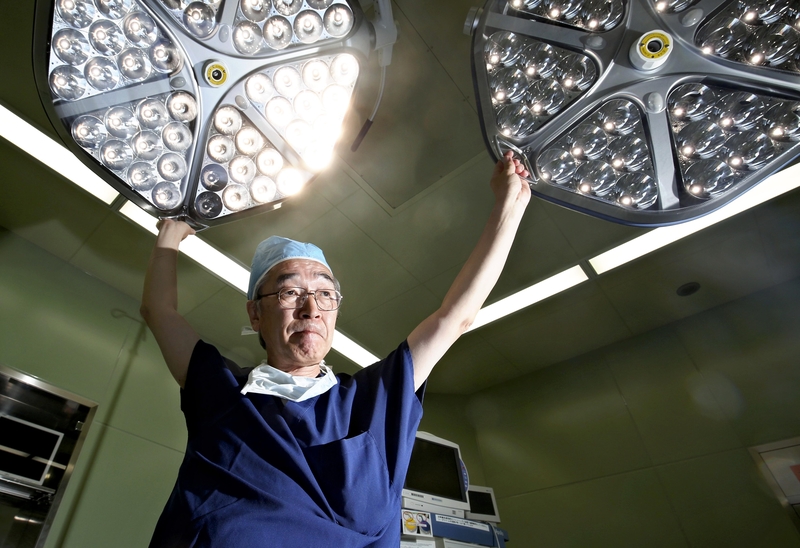
Japan's oldest and largest hospital specializing in cancer treatment is the Cancer Institute Hospital of JFCR (Japanese Foundation for Cancer Research) in the Ariake district of Tokyo. Toshiharu Yamaguchi, the leading stomach cancer surgeon in Japan, led the hospital for three years, retiring as its director at the end of last month.
Yamaguchi has been a surgeon for 45 years, and is the honorary director of the hospital today. We asked him about changes in Japan's cancer treatment, interactions with patients and safety measures. The following is an excerpt from the interview.
Eradicating cancer
The treatment methods and measures for stomach cancer, which is my specialty, have been almost completely established.
The Japanese Gastric Cancer Association published treatment guidelines in 2001. Since then, the treatments that were previously carried out independently at each university and hospital have "evened out." This means the disparity in the quality of the treatments has disappeared.
Early stage cancer can be completely cured by surgically removing it with an endoscope or laparoscope, and the survival rates of more advanced cancers have increased thanks to advances in anticancer drugs.
Above all else, the number of stomach cancer patients has declined. The main reason for this is improvements in hygiene in the servicing of water and sewer systems, leading to a decrease in Helicobacter pylori infections. The next step is to increase screening rates for early detection. In 15 years time, stomach cancer may be an extremely rare disease in Japan.
[Helicobacter pylori is a type of bacteria that lives in the human stomach. It can cause gastritis, stomach ulcers and stomach cancer. It was first identified in the early 1980s by two doctors, including Australian Barry Marshall, a discovery that won them the Nobel Prize. In Japan, the percentage of newly diagnosed cancer patients who were found to have stomach cancer in 1980 was 36 percent for men and 26 percent for women. However, by 2013, this number had dropped to 18 percent for men and 11 percent for women.]
There are still many types of cancer that are difficult to cure, but treatments are steadily advancing. There were even cases of lung cancer patients on whom traditional anticancer drugs had been ineffective showing great improvement after being given the immunotherapy drug Opdivo. Opdivo is said to only be effective for around 20 percent of patients, but this refers to "20 percent of patients who had no hope," so in that respect, I think it's a very significant percentage.
One problem is that Opdivo is very expensive. However, if the number of patients taking this drug and the number of competitor drugs increase, it should eventually drop to a more reasonable price.
[Opdivo is a new drug that disables a brake on the immune system to let it attack cancer cells. It was first covered by insurance in 2014 as a treatment for skin cancer. By the end of 2015 it could also be used to treat lung cancer, but the high annual cost of the drug (about 35 million yen per person) became a problem and the price was slashed in half in February last year, and then dropped by another 20 percent in April of this year.]
Being honest with patients
I was born in Asahikawa, Hokkaido. My family owned a hat store and until my first year of high school, it was my dream to become either a pilot or a diplomat. Unfortunately, I didn't quite fulfill the chest size requirements [to be a pilot], so I abandoned that dream, and instead aimed to become a doctor and follow in the footsteps of my older brother, who was a student at Kyoto Prefectural University of Medicine.
During my high school years, I was good at Japanese and English language studies and did poorly in math and physics. I was prepared to flunk and wait another year when I took the entrance exam for the Kyoto Prefectural University of Medicine, but somehow I managed to pass.
It's important for a doctor to have good language ability. We have to understand how patients are feeling through their words, and be able to explain treatment methods in simple language. I think that this is more important than physics or statistics.
Speaking of explanations, when I first became a doctor in the early 1970s, we did not tell patients that they had cancer. We would administer anticancer drugs to stomach cancer patients and cover it up, saying things like, "These drugs will make your liver better." It wasn't until the mid-1990s that we started openly telling people that they had cancer.
Even now, there are families who ask us not to tell the patient that they have cancer. I explicitly refuse and explain it this way: "The cancer is not your disease, but the patient's disease. Over my many years of experience, I've found that if you tell the patient about their diagnosis, they may become depressed for a few days, but in the end, they will accept it."
If we don't tell the patient, families tend to become distant from them so they can continue to conceal the diagnosis. But it's precisely at these times that patients and their families need to be together. It's far better for both the patient and the family for the patient to be informed of their disease honestly, so that they can make the most of the time they have left together. Families always understand when I explain it this way.
Introducing systems of improvement
I left Kyoto Prefectural University of Medicine for the Cancer Institute Hospital of JFCR in April 2000. Just after I started working there, it was reported that a patient had died from an overdose of anticancer drugs.
I tried talking to the people involved. When I asked them if they hadn't found it strange that the patient was suffering from such strong side effects, the nursing staff said things like "I was just following doctors' orders," or "I'm not responsible." After that, I became the chairman of the safety committee and implemented hospital reforms to enhance staff understanding, information sharing and mutual surveillance systems.
[In 1999 and 2000, there was a series of medical mistakes at university and flagship hospitals throughout the country, including Yokohama City University Hospital, Kyoto University Hospital and Tokai University Hospital. It became a major social issue. In 2014, it was discovered that there had been a number of post-surgery deaths at Gunma University Hospital. Just last month, it came to light that patients had died from missed cancer diagnoses at Chiba University Hospital and Yokohama City University Hospital.]
University hospitals conduct sophisticated medical treatments that cannot be carried out by ordinary hospitals. There are still universities that are not as thorough about safety, but advanced medical care and safety measure implementation form two halves of a whole. Universities must properly train experts in medical safety.
At university hospitals, there is also another problem. I used to carry out approximately 100 surgeries per year at the Cancer Institute Hospital of JFCR. However, at university hospitals there are far too many doctors for the number of patients, so each doctor gets to perform very few surgeries. This does not allow them to improve. I believe university hospitals that perform surgeries should be specialized in certain illnesses, so that medical staff and patients can be put together.
The age of the centenarian
How are we in Japan, a nation with an extremely aged society and now experiencing an "age of centenarians," going to face cancer in the future?
Firstly, we have to avoid cancer risks. People should not smoke, and Helicobacter pylori bacteria should be killed when found. People should also make sure to receive cancer screenings. Unfortunately, no matter how healthily people live, some will still get cancer.
In those cases, it should be understood that cancer is a part of aging. If you're over 75 and get cancer, you should understand that this is because you're getting old, and undertake a course of treatment that matches your physical strength and beliefs.
I don't want to die from cancer. I have knowledge of the disease, so I'd end up thinking too much about so many things. In my twilight years, I won't fear getting dementia and causing those around me just a little bit of trouble.
-- This interview was conducted by Yomiuri Shimbun Senior Writer Hiroya Yamaguchi.
(From The Yomiuri Shimbun, July 12, 2018)
-- Toshiharu Yamaguchi / Honorary Director of the Cancer Institute Hospital of JFCR
Yamaguchi was director of the Cancer Institute Hospital of JFCR from July 2015 until last month. Vice president of the Japan Surgical Association. He is a council member of the International Gastric Cancer Association. In his role as president of the Japanese Health Insurance Federation for Surgery (JHIFS), he called on the government for proper technical evaluations and got the payment amount increased for medical service fees.
Read more from The Japan News at https://japannews.yomiuri.co.jp/