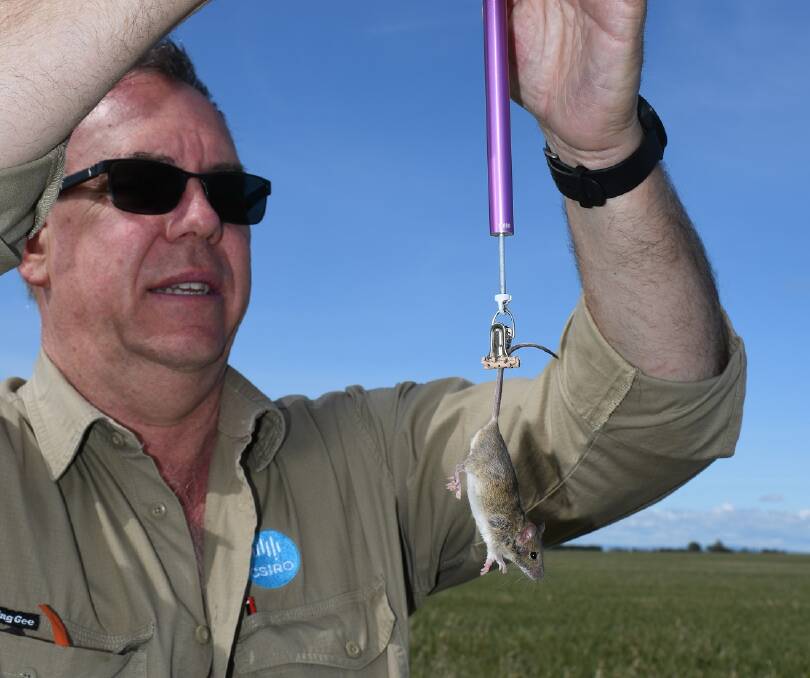
As the horrific plague of mice ravages much of country New South Wales, Canberra-based scientist Steve Henry is rushed off his feet.
He's the go-to expert as the rodent's population explodes after the wet summer, and he finds himself perpetually on the road, advising farmers.
His advice to them is that they should walk paddocks to count mice. If there are loads of them, set bait soon so there's time to put down a second tranche before the winter sowing season.
"What we are telling farmers is to get out of their vehicles and walk among the stubble to get an understanding about what's happening with mice," the CSIRO scientist said.
Poisoned mice learn to avoid further rounds of bait - he calls it the "dodgy meal effect" - and if one set of bait is put down soon, there will still be time for a second batch, but with enough time for the mice to forget the ill effects of the first lot.
#Mice numbers are exploding in many parts of NSW. Haystacks are being destroyed, silos invaded, winter crop sowing is at risk and there is a human health impact. @NSWFarmers is calling for action👉https://t.co/c17hSFMiVG#nswfarmers#miceplaguepic.twitter.com/2HH8YnnqJM
— NSW Young Farmers (@NSWYF) March 16, 2021
Mr Henry who has 30 years of experience of dealing with rodents said that supermarkets in some parts of NSW were storing food in sealed containers because of mice.
"You can imagine that every time you open a cupboard, every time you go to your pantry, there are mice present," he said.
"And they're eating into your food containers, they're fouling your clean linen in your linen cupboard, they're running across your bed at night."
Mice numbers have risen dramatically after heavy rain in the summer followed drought. The rains prompted lush paddocks in which the mice thrive. The plague started in southern Queensland and gradually affected NSW.
"The weeds, the mice, locusts, grasshoppers, have had such a great season because of the rain," Catriona McAuliffe who is based in Yass with NSW Farmers said.
Mice have also been helped because farming methods have changed. The old method was to plant a crop and clear the stubble. Burning would clear weeds and the next crop would be planted on open land.
But now stubble is left because advances in technology mean the next crop can be planted to a centimetre of accuracy within existing stubble.
"You can imagine: there's all the shelter. They've just moved into the paddocks," Mr Henry said.
Our journalists work hard to provide local, up-to-date news to the community. This is how you can continue to access our trusted content:
- Bookmark canberratimes.com.au
- Download our app
- Make sure you are signed up for our breaking and regular headlines newsletters
- Follow us on Twitter
- Follow us on Instagram