“I have planned a city not like any other city in the world. I have planned it not in a way that I expected any government authorities in the world would accept. I have planned an ideal city – a city that meets my ideal of the city of the future.”
Those were the words of Walter Burley Griffin, the young American architect who won a competition to design the new Australian capital city, Canberra, in 1912. The idealistic Griffin, along with his professional and life partner Marion Mahony, spent the next eight years tied in knots by politicians and bureaucrats determined to prevent his vision from becoming a reality.
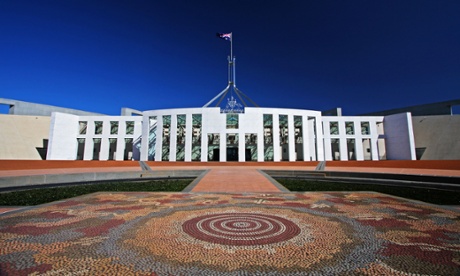
Griffin resigned from the project in 1920 without having created a single building, and little of his plan was put into effect, aside from a few roads and a lake. Yet the influence of Griffin and Mahony’s work pervades Australia’s most significant public building, the Parliament House created by Romaldo Giurgola almost 70 years later.
Griffin and Mahony believed fervently in Australia’s potential as a young and bold democracy. Griffin declared that the new capital – to be located in bushland between Sydney and Melbourne – presented a unique opportunity for a totally planned city. He said, “This virgin city under unified control … is in a position to exact unity in plan and homogeneity in expression and harmony with the whole natural environment.”
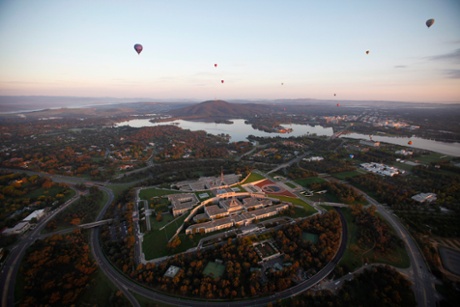
Their design ingeniously mapped a geometric plan of key buildings and main avenues on to the existing topography of mountains, hills and the river. Although Griffin was officially hired by the Australian government as federal capital director of design and construction, he readily acknowledged Mahony as responsible for “much more than half” of the plan.
The opposition of bureaucrats and frequent changes of government didn’t help Griffin; nor did the first world war, which focussed the nation’s attention elsewhere. One of the revolving door of ministers, William Archibald, accused Griffin of “grand theorising, moonshine and dreaming”, and eventually Griffin quit in despair. A temporary Parliament House was built by the Commonwealth Department of Works and Housing – though not at the location Griffin had planned.
Nevertheless, Griffin and Mahony’s idea became known in architectural circles. One of those who admired it was a young Italian, Romaldo Giurgola, who saw an illustration of the Canberra plan on a classroom wall in Rome.
Fast-forward several decades, and the nation decided it was time to build a new Parliament House to mark the bicentenary of European settlement in 1988, with Giurgola’s firm Mitchell-Giurgola Architects winning the design competition.
Like Griffin and Mahony, Giurgola believed that buildings must be in harmony with the natural environment. He saw Canberra as “a symbolic place, an art form which could survive only if harmoniously related with the configurations of the land”. Giurgola’s proposed Parliament House was not a monument imposed on the landscape and the citizens, but was integrated within a hill, thus putting the people above the parliament.
The building is packed with overt symbols of national identity. The huge forecourt mosaic – Possum and Wallaby Dreaming – was designed by Papunya artist Michael Nelson Jagamara, and the building’s 23-hectare landscape includes an indigenous garden. Inside, there are more than 5,000 works by leading Australian artists and craftspeople. These are not simply additions to the building, but an integral part of it.
Like Griffin and Mahony, Giurgola has an optimistic view of the city. “I certainly cannot think of the Parliament House without Canberra,” he told an interviewer, in 2010. “It presented to me this notion of simplicity, order, relation with the natural environment … Canberra has been growing with this kind of principle all the time.”
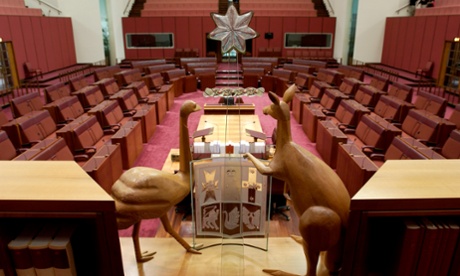
Nevertheless, Canberra today has an incoherent feel, with buildings scattered far apart in seemingly random places, lacking the unity that was originally proposed. On a more mundane level, the standard cliche is that Canberra is “boring”, with its endless quiet low-rise suburban streets, and its empty city thoroughfares. On the other hand, Canberrans speak fondly of how easy it is to get around – unlike the gridlock of Sydney and Melbourne.
“It was a utopia of sorts,” Eve, a friend who grew up in Canberra, tells me. “I lived in public housing and went to a state school with the children of cleaners and the children of diplomats all together. Everything felt accessible, not like the class system you get in Sydney and Melbourne. My mum was able to go to university and qualify as an economist while she was raising me by herself. I rode to school every day from the age of 10; there was no traffic and life was easy. But an outsider doesn’t see any of this, and they’re often blind to the social stratification and ghettoisation in their own cities.”
As for Parliament House, Eve remembers it as a place where she and her friends would, after nights out as teenagers, roll down the grassy slopes under the tolerant eye of a lone security guard. There aren’t too many parliament buildings in the world where you can roll on the roof, and it sounds like the kind of pursuit of which the building’s designer would certainly approve.
- Which other buildings in the world tell stories about urban history? Share your own pictures and descriptions with GuardianWitness, on Twitter and Instagram using #hoc50 or let us know suggestions in the comments below