When Venice launched its first international art biennale back in 1895, it was making a deliberate bid to regain its status as a cultural centre and a major player in the global art world. Over the decades, as the city has added film, music, theatre, architecture and dance festivals to the biennale roster, they’ve all had similarly high aspirations. But recently the dance festival has been reinventing itself along a slightly different tack. In addition to its regular international programme, director Virgilio Sieni has been running a yearly “college” of more modestly scaled performance, designed to fit into the smaller public spaces of the city, and often performed by local, student or amateur dancers.
Site-specific work and community performances are far from novel ideas. But in the context of Venice and the millionaire marketplace of the art biennale, Sieni’s vision has felt quietly radical. It has also come with some pretty fabulous settings. This year Annamaria Ajmone’s solo dance Buan was choreographed for the squero, or boatyard, in San Trovaso, where the city’s gondolas are repaired. It’s an absurdly picturesque location, a tumble of old brick and wooden sheds running alongside a small canal, but it’s also a challenging one. And Ajmone’s dance was created specifically out of the physical difficulties and distractions it presented as she tried to make herself at home in the space (Buan is an old German word for “inhabit”).
Navigating the steep stone ramp of the boatyard, Ajmone’s small, supple body stretched and curved in and out of a line of equilibrium, like a gondolier maintaining an even keel in rough waters. She danced along the water line, shimmied past the “squeraroli” who obligingly stopped work for the solo’s 15-minute duration; and smilingly acknowledged the passing water traffic on the canal, which at moments became part of the performance, with some of the gamer gondoliers even altering the rhythm of their stroke to the jazzy rhythms accompanying Ajmone’s dancing.
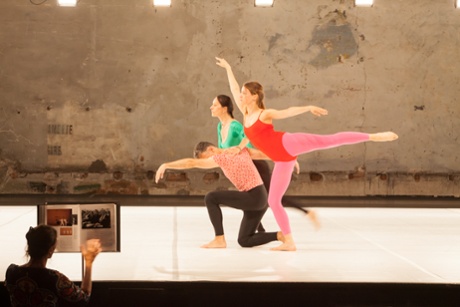
Among the festival’s other outdoor sites were a number of different squares, including the Campo Sant’Angelo, where Cesc Gelabert’s Dirty Hands and Beauty played with the idea of touch as a source of delight and disgust. Seven dancers performed a tight choreography of gestures – hands linked in play and in dance, extended in tenderness, balled-up in aggression – to create a body language of sweetness, sexuality and brutality that played out perfectly against the history-drenched backdrop of the Campo itself.
Among the interior locations, the most glamorous was the Sala delle Colonne in the old Palazzo Giustinian. Among its marble columns, Sieni presented Vangelo Secondo Matteo, a series of dance tableaux inspired by the gospel of St Matthew, created for 50 dancers from the Veneto region. Sieni has a special gift for making poetry out of the – extremely – varied movement talents of his amateur dancers. Four middle-aged women, all members of the fast-disappearing Venetian lace industry, performed a tableau of the magi; a younger group of women animated a fierce, noisy, boisterous scenario of Christ’s entry into Jerusalem; parents and children cradled each other in a variety of pietá and most movingly a single elderly women performed a slow and immensely dignified dance of the crucifixion. Even though her movements were stiff and limited, she was the centre of gravity of the whole event: the climactic moment where she split the air with one anguished shout shocked the entire room.
There was a special resonance to these tableaux being performed in a city so rich in religious art. Serge Diaghilev (the genius ballet impresario who loved Venice and whose grave in the city’s cemetery is still covered with tributes of flowers, letters and worn ballet shoes) always regarded the Italian old masters as a prime learning tool for dance. He instructed his two protege choreographers, Vaslav Nijinsky and Léonide Massine, to study these paintings for ideas about composition, line and rhythm and the expressive language of the body. And that concept of dance and physical gesture as a continuous language, transmitted from one generation to another, is also close to Sieni’s vision.
One of my favourite works this year was a revival of Boris Charmatz’s Roman Photo (roughly translated as Photographic Novel), which was also staged for a mixed cast of amateur local dancers. Charmatz’s 2009 work was inspired by Merce Cunningham Fifty Years, a photographic record of the late, great choreographer’s life and career. It’s almost a flip-book version of the original publication, constructed out of hundreds of snapshot images, linked together by Charmatz with his own transitional movements and his own selection of music.
You don’t need to be a Cunningham aficionado to get the humour and charm of this piece, but obviously it helps to have a familiarity with the stylistic tropes that flit through the choreography, the high-perched angular balances, the off-kilter jumps, the brisk triplet runs. To see these familiar Cunningham moves danced by people of all different ages, sizes and skills, and to see the different kinds of humour, passion, energy and serendipitous grace with which they’re re-embodied, was to see dance history alive and joyously kicking.
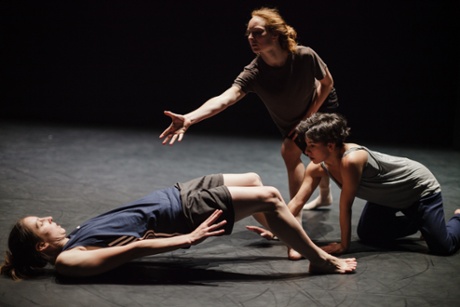
While Charmatz’s cast were not highly trained, a key strand in Venice this year was the 10 short works that had been created on young professionals, during a two-week residential period leading up the festival. The results were varied. Xavier Le Roy’s staged conversation between audience and performers veered into a complacent kind of group therapy but some pieces were outstanding. Emanuel Gat’s Third Song orchestrated its 12 dancers into a kaleidoscope of tiny physical encounters, the movements fragmented into such minute details of touch and response that the choreography appeared to pivot between a state of pure chaos and pure rigour. Alessandro Sciarroni’s Turning was equally rigorous in exploring the choreographic logic of its title, its five dancers walking in slow steady circles which became progressively tighter and faster, until the dancers were whirling nodules of energy, spinning in the cosmos of the stage.
Turning was a worthy descendent of postmodern choreographers such as Laura Dean and Lucinda Childs who, back in the late 1960s and 70s stripped dance down to the basics of space, time and physical gesture; also of the young Anne Teresa de Keersmaeker, who evolved her own musically sophisticated version of postmodern dance, in works such as Fase and Rain (and who was in Venice this year to receive the Lion D’Or, the award given by the Biennale to honour distinguished artists in all fields).
De Keersmaeker and Childs were both deeply influenced by the compositional logic of minimalist composers such as Steve Reich and Philip Glass: but it was minimalist artists like Sol Le Witt, too, who gave added shape and direction to this period of abstract choreography. The visual arts have, throughout history, been a major shaping force in dance; from the contrapposto positions of classical Greek statues, which set the ideal for épaulement, the elegant upper body torsion in classical ballet, to the lithographs of the Romantic era, to the geometries of cubism.
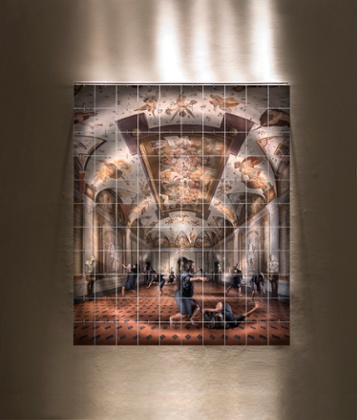
At this year’s art biennale, however, Russian artist Lena Liv reversed the debt, with Dancing Makes Me Joyful, a photographic collaboration with Zambian choreographer Lindy Nsingo.
Liv filmed Nsingo dancing in the huge, frescoed hall of the Villa di Corliano in Tuscany, and the footage tells one story of how Nsingo nerved herself to inhabit the monumental space, at first confining herself to a small tentative corner, then claiming the entire setting with dancing of exuberantly stretched lines, leaps and falls.
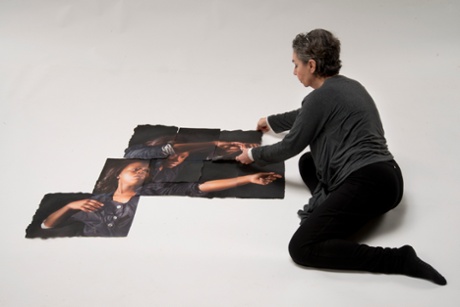
The beautiful, painterly photographs that Liv went on to create from the dance tell the story in a different way. On the one hand, she used colour and light to give Nsingo’s body the same lustrous magnificence as her surroundings, to make the dancer look as polished and perfect as any of the marble statues lining the hall. But Liv also dramatised the inadequacy of her own medium when it comes to capturing the body in motion.
In some photos, Liv tries to convey movement by deconstructing a single phrase of dance into a sequence of images that fan out across the photo: in others she cuts or tears the photo into small pieces and then reassembles it, jigsaw-like, with its jagged surfaces or joins clearly visible. These gaps and cracks are Liv’s way of introducing physical texture into the photographs, but also I think an indirect way of acknowledging everything that her camera cannot capture. It is a nod, by a visual artist, to the fact that dance can only exist in the here and now; that it will always be one step ahead of a paintbrush or a lens; and that unlike the hugely expensive artefacts on display in the 2015 art biennale, it can’t ever, quite, be reduced to a marketable product.