Next spring, the international community will converge on Mexico for the inaugural meeting of the Global Partnership for Effective Development Co-operation. The focus of the April 2014 gathering, where items up for discussion will include "a changed development landscape" and "fresh and inclusive partnership models", will be firmly on the future.
The need for fresh thinking in such areas is clear. Much has changed since September 2000, when the millennium development goals – eight targets aimed at improving the lives of millions of the world's poorest and most disadvantaged people – were established.
Development was seen at that time as a shared responsibility: countries would harness domestic resources in pursuit of the new global agenda and, where that proved insufficient, overseas aid and debt cancellation would fill the void.
Thirteen years on, in a climate of lingering economic uncertainty, that model looks precarious. Official development assistance is shrinking. After a 2% drop in real terms two years ago, aid levels fell by 4% in 2012, according to the Organisation for Economic Co-operation and Development. Moreover, risk-averse donors are increasingly directing development assistance away from the poorest countries and towards middle-income ones, often rendering civil society more fragile in the very places where it needs to be strongest.
With the world's poorest and most vulnerable people bearing the brunt of these problems, the need to ensure aid is utilised to maximum effect has become acute. So how can greater and lasting benefits be achieved?
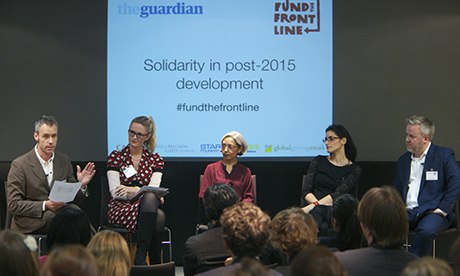
For the panellists who spoke at a recent Guardian-hosted seminar, the solution lies partly in giving the local organisations that implement development projects greater autonomy over the use of donor funding. "They are the development experts – they are the people who know exactly what they are doing," panellist Mune Wehbe, chief executive of the Stars Foundation, explained to an invited audience.
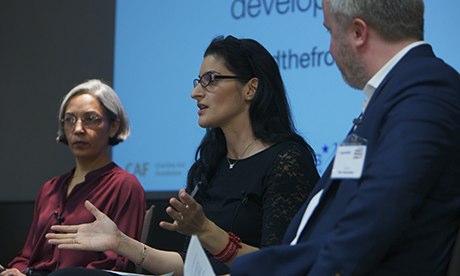
Arguing that support from international donors too often comes with strings attached, Wehbe told the seminar, which was sponsored by the Stars Foundation, that local organisations were too often obliged to spend money along prescribed lines rather than making their own decisions.
She pointed to the importance of solidarity and said those working on the frontline of the battle against poverty are best placed to make the right choices, and should be given the freedom to do so.
"We realise that isn't the only thing that should be done when it comes to funding organisations – there are different ways of funding, and donors have all kinds of different needs," said Wehbe. "But we think empowering local development actors is absolutely crucial and should feature a lot more than it currently does."
To that end, the Stars Foundation, which supports local organisations working to improve the lives of vulnerable children, has joined forces with the Charities Aid Foundation, the Pears Foundation, the Gates Foundation, GlobalGivingUK, and the Guardian on a three-week campaign called Fund the Front Line.
Employing the tagline "Local is 4,000 miles away", the initiative invites the public to make donations directly to six small organisations working "at the sharp end of the fight against poverty" in Africa, the Middle East, Asia and the Pacific. Public contributions will be matched by the project's supporters, doubling the amount raised, and the money will be used to support local organisations, many of which say they feel relegated to the role of "sub-contractors" in their dealings with international donors.
"They receive money to implement discrete projects, but they're not actually driving the process of local development," said Wehbe. "What drove the concept of the Fund the Front Line campaign was understanding more about the perceived roles and values but also, most importantly, the opportunities of being able to give direct to local organisations, and doing that in a way that changes the power dynamic."
That these issues arise at all is a reflection of the laggardly pace at which the international community has moved in implementing the principles of the Paris declaration. The declaration, agreed in 2005, emphasised country ownership and the need for donors to utilise existing domestic resources, but a report published in 2011 found that only one of 13 targets had been met globally, suggesting that conditions imposed by donors had created a bottleneck for progress.
Panellist Anjana Raza, chief executive of Developments in Literacy – a Pakistan-based NGO that does outreach work to support girls' education in Pakistan, and was among the 2012 Stars Foundation impact award winners – told the seminar that one of the biggest obstacles for frontline organisations is a lack of voice, which makes it difficult to influence policy decisions.
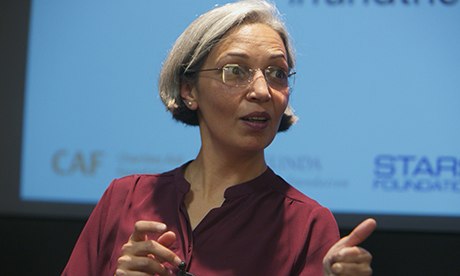
Establishing partnerships based on trust is fundamental to changing this, said Raza, who argued that when one donor expresses faith in a local organisation, others are likelier to follow suit. "That trust filters into the way we're able to approach donors, and the way donors listen to what our needs are," she explained.
Big business also has a significant role to play in providing direct support to local organisations, said Amy Clarke, head of advisory for the Charities Aid Foundation and the third of the seminar's four panellists. Arguing that companies are becoming more open to the idea of partnering with NGOs for strategic growth, Clarke urged local charities to state their case more strongly.
"The potential for businesses to be doing more is vast," said Clarke. "How do we get them to do that? It's all about engaging communication, and also for the NGO community to demonstrate the value of this kind of approach to partnership. Local NGOs need to demonstrate what they can actually achieve."
To do so, Clarke argued, they will need to overcome a seemingly innate sense of inferiority, recognising that corporate benefactors have just as much to gain from collaboration as they do.
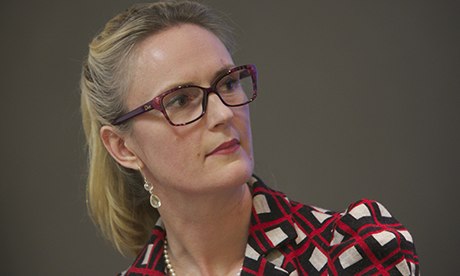
"One of the things we see a lot among NGOs, especially when they're engaging with business, is this perceived inequality, this sense that 'We're going in to talk to a large business that has the financial freedom to hire in vast assets of talent, and has huge products and services at its disposal – and we're small'," said Clarke.
"But local NGOs have to recognise that the reason businesses will be looking at them is because they can help business better position itself, be it locally or regionally. Businesses need local NGOs to help them become more sustainable and responsible global citizens."
Clarke pointed out that governments tend to listen to the business community, which means corporate sponsorship is not only important in its own right, but can also galvanise wider support.
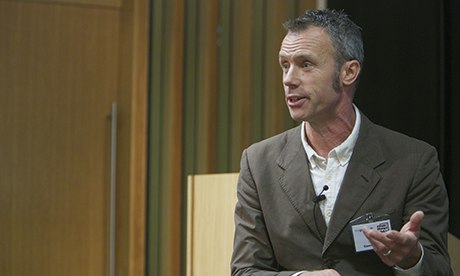
Public backing may be a tougher nut to crack, however. Citing research on public attitudes towards international development, the fourth panellist, Richard Graham, head of international grants for Comic Relief, said that only the 14% of the British public classed as "actively enthusiastic" were likely to be receptive to funding frontline organisations.
That view is reinforced by a study on public attitudes to aid and development published last summer by the Institute of Public Policy Research and the Overseas Development Institute. The report's authors noted "evidence of growing scepticism about the effectiveness of UK aid programmes and ... aid in general", emphasising "increased concerns about waste and inefficiency in the delivery of aid" at a time of economic hardship.
Against that background, said Graham, reaching out to "distracted" potential donors – people who might watch Red Nose Day on TV while simultaneously using a laptop and a smartphone, for instance – might mean making some tough decisions about messaging and imagery.
"How do you get that distracted individual to engage with what you're trying to say?" asked Graham. "The tough reality is that you have to find something that is absolutely emotionally compelling."
Raza, however, told the seminar that there is a growing demand among donors for more empowering imagery, since success stories create a sense that funders are investing in something worthwhile.
Monitoring and evaluation proved similarly contentious. Raza acknowledged the importance of metrics from a donor perspective, but said numbers alone rarely reflect the true impact of projects.
Graham pointed out that reliable data can fundamentally alter the way a project is run, but audience member Colleen LaFontaine, co-founder of Present Purpose Network, argued that methods of evaluation based on external measures risk undermining peer relationships with local organisations, jeopardising the very principle of unrestricted funding.
"When we evaluate success based on what we decide, and then turn around and tell local organisations to change their programmes, we've destroyed the whole reason we fund grassroots groups," said LaFontaine.
Both Wehbe and Clarke agreed that the best solution was to utilise organisations' existing monitoring and evaluation systems wherever possible, ensuring that funding was "unrestricted but not unaudited", as Wehbe put it.
Whatever the obstacles, however, Clarke remains clear about the wider benefits of providing unrestricted funding to local charities.
"If we can create space for the smaller NGOs, allowing them to take stock, breathe, and experiment more, then we're investing in the long-term health not only of communities but also of business and society as a whole," she told the seminar. "It's a win-win-win situation."
The challenge will be getting the global partnership to sing from the same song sheet in Mexico.