Bittersweet. What else could progressive Scots call a result that hands over Scotland (almost) lock, stock and barrel to the anti-austerity SNP, but sees the Tories returned across England to form a new majority Westminster government?
It was a night of humiliation for the Scottish “big beasts”, as Scottish Labour leader Jim Murphy, shadow Scottish secretary Margaret Curran, chief strategist Douglas Alexander and Lib Dems Danny Alexander, Charles Kennedy and Michael Moore all lost their seats. But even if Labour had won every single Scottish seat last night, the Conservatives would still be the largest party today. Some Labour voices – reeling from their end-of-an-era outcome in Scotland – have been quick to suggest a causal link. The numbers tell a different story. It’s the mother of all doomsday scenarios. For decades, Scotland voted Labour and got the Tories.
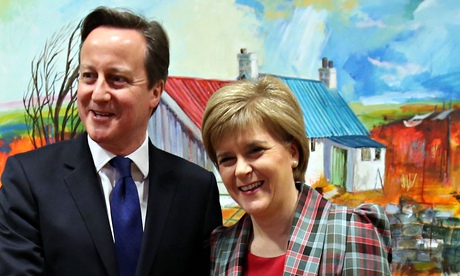
This time, Scots changed the habits of several lifetimes to vote SNP but got an even worse result. David Cameron now has a mandate for £12bn of welfare cuts, replacing Trident, an in-out Europe referendum and is restrained only by a broken Labour party and the pulverised Lib Dems.
Of course, Scots now have a “pumped up” contingent of 56 SNP MPs heading south with an explicit mandate to win more powers for the Scottish parliament and oppose more public spending cuts and NHS privatisation in England. But how successful can they be in “winner takes all” Westminster? Does David Cameron have to talk to Nicola Sturgeon, or can he ignore her completely? Indeed, having just bankrolled billboard ads portraying Alex Salmond as a burglar pickpocketing English taxpayers, can Cameron even attempt to parlay?
Maybe. Ironically, the more radical the solution to the perceived “Scottish problem,” the easier it may be to sell south of the border. The prospect of Ajockalpyse (Boris Johnson’s colourful description of SNP involvement in UK government) must surely lessen if Scots are packed off with home rule or full fiscal autonomy.
That would let the Scottish parliament control all tax and spending north of the border, reducing cross-border relations to the receipt of a Scottish cheque every five years for the shared services of foreign affairs, defence and macro-economic policy. That might seem like a constitutional concession too far, or a brilliant way to saddle Scots with a multi-billion pound deficit – at least until the oil price recovers and new progressive policies reduce dependency and increase productivity. Furthermore, if Holyrood sets and raises all its own taxes, there will be no need for Evel (English votes for English laws) and the Commons can revert to being a de facto English parliament. But constitutional furniture would have to be slightly rearranged to accommodate Scottish home rule, the Welsh, Northern Irish and English regions clamour for similar clout, renewed demands for proportional representation and perhaps a call to turn the Lords into a fully elected federal-style second chamber – especially if freshly rejected Scottish Labour “big beasts” are bumped up to the upper house. Another clumsy deal could easily leave the federal genie well and truly out of the bottle on both sides of the border.
Victory for the resplendent SNP may also prove to be a mixed blessing. On the one hand, Nicola Sturgeon is now unquestionably Britain’s most trusted social democrat and Scotland’s most popular political leader. But she’ll be reluctant to use that clout to call a second independence referendum until she’s sure she can win it. Once in a generation could conceivably become twice if more “exceptional” circumstances present themselves – like a UK vote to leave the EU while Scotland once again votes very differently – but thrice really would be pushing it. Negotiations risk producing an unworkable compromise and a too-sudden end to the Barnett formula, but will be unavoidable if David Cameron looks ready to deal. Meanwhile, a massive SNP cohort must somehow “hold David Cameron’s feet to the fire”, or risk ridicule in the run-up to 2016’s Holyrood elections as the “feeble 56” – an ironic echo of their own name for the hefty but powerless Scottish Labour contingent during 17 years of opposition at Westminster.
Yet in the cloudy aftermath of the 2015 general election, three things look clear – the inadequate Smith commission package of more Holyrood powers is certifiably dead in the water, the union is in a more delicate condition and Scots, at least, continue to live in interesting times.