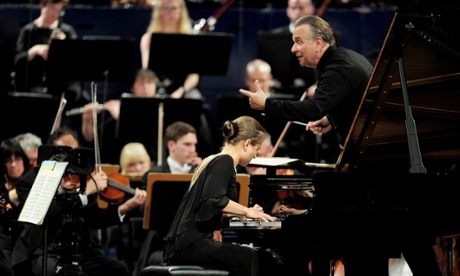
The final of the 18th Leeds Piano Competition, which ended on Saturday with the Russian Anna Tcybuleva carrying off first prize, was accompanied by more than the usual amount of self-congratulation. It was Fanny Waterman’s last competition as chairman and artistic director, roles that she has combined with tremendous energy and steely determination since she conceived the idea of the competition in the 1960s, and the tributes to her were heartfelt and thoroughly deserved. Without Waterman, together with the late Marion Thorpe and Edward Boyle – both so important in its formative years, there would never have been a piano competition in Leeds in the first place.
But this seems the right time for Waterman to be stepping down, and there is plenty about the competition in its current form for the new artistic directors, conductor and former BBC producer Adam Gatehouse and pianist Paul Lewis, to ponder and reshape. Despite some of the more fatuous things claimed in the tribute speeches, the Leeds competition is by no means the greatest piano competition in the world these days, if it ever was.
The Warsaw Chopin competition, which begins in the three weeks time, remains a far more prestigious prize, while winning the piano section of the Tchaikovsky competition in St Petersburg, for all its problems and controversies, remains a tremendous boost to any budding career. Even less celebrated events such as the Busoni in Bolzano and the Honens in Calgary attract a very high calibre of young pianists nowadays, at least as high, if not higher than Leeds.
It’s hard to avoid the conclusion that Leeds has been content to rely on the stellar reputation it gained in its early days, especially from the astonishing series of great artists who came to prominence through success there more than 40 years ago: Radu Lupu and Murray Perahia were the winners in 1969 and 1972 respectively, while Mitsuko Uchida and András Schiff were among the runners-up in 1975. But since then not a single pianist of similar stature has emerged from the competition. There have been a few very fine ones, such as Louis Lortie (fourth in 1984) and Lars Vogt (second in 1990) but there have also been many more prizewinners who have never really established themselves in the front rank.
The world for aspiring pianists today is very different from what it was when Leeds began. Perhaps success in competitions of any sort is no longer the passport to a high-profile career that it used to be. Only the Warsaw Chopin, with Ingrid Fliter, Rafal Blechacz, Ingolf Wunder and Daniil Trifonov among the prizewinners in the last three competitions, has a recent record of which it can be truly proud.
While it is difficult to see how much can be done by the new Leeds regime to counteract that, there are some changes – especially to the format of the competition and the repertoire it involves – that could give it a more distinct, up-to-date profile among the plethora of competitions today. Looking at the lists of what entrants are required to play at each stage suggests that the repertoire has barely changed at Leeds over the last half century. This year, rather than commission a test piece from a living composer for the semi-finals, competitors had to include Britten’s Notturno in their recital programmes, the piece that he composed for the very first competition in 1963. Otherwise the emphasis remained very much on a conservative core of the keyboard staples, and the prescriptive list of concertos that can be played in the final includes nothing composed since Bartók’s Third, which dates from 1945. It would not require too much imagination to add a few more recent works to that list – the piano concertos by Ligeti and Lutoslawski certainly, perhaps Tippett’s concerto and even John Adams’ Century Rolls.
As it was three of this year’s six finalists played Rachmaninov (one performance of the First Concerto, two of the Third); it was if they thought that those works represented the zenith of the piano concerto form, and that their mastery of such pieces would rubber-stamp their credentials. Yet neither of the pianists who performed the Third Concerto this time seemed to have anything special to bring to the work, whereas the young American Drew Petersen, who played Rachmaninov 1 in the final, identified with the music and its spirit so clearly you could understand immediately why he felt he had to play that work and no other.
There are signs that some things at Leeds are beginning to change. The jury for this year’s competition contained fewer piano teachers and more performers than I remember from previous years, which can only be a good thing. Juries in which teachers predominate can reach deadlock when doctrinaire principles on different playing styles collide, and horse-trading between jury members to vote for each others’ pupils is not unknown. Some competitions, the Busoni, for instance, make a point of excluding teachers from their juries for those very reasons. Compromise winners, players who are nobody’s favourites, but haven’t antagonised anyone either, are the worst thing for any competition; they will sink into obscurity, like a few too many recent Leeds products have.