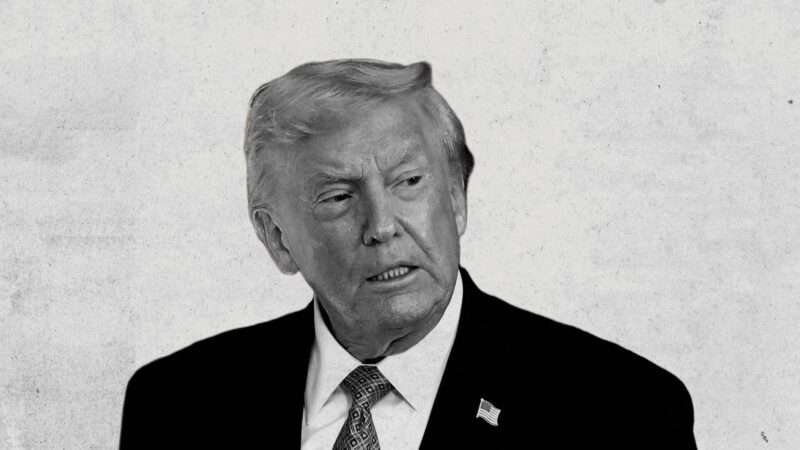
Rebate checks for all? President Donald Trump is mysteriously addressing the nation tonight. One bit of speculation: that he will use the opportunity to announce that he's sending all Americans generous rebate checks using the money the government has collected from charging tariffs.
"Next year is projected to be the largest tax refund season ever, and we're going to be giving back refunds out of the tariffs, because we've taken in literally trillions of dollars," Trump telegraphed in a cabinet meeting last week. "And we're going to be giving a nice dividend to the people, in addition to reducing debt." Government-issued checks would be in the $2,000 zone, per whisperings from administration officials.
Of course, pumping money into the economy is likely to result in inflation. We learned this lesson during the first round of stimulus checks during the COVID-19 pandemic, during Trump's first term, and we learned this during the American Rescue Plan round of stimulus checks, during former President Joe Biden's term. I understand that for politicians in power, trying to buy people's love and approval seems like the simplest path to a broad, frictionless mandate to govern, but it comes with all kinds of terrible unintended consequences. That Trump can't see this despite so many encounters with this precise dynamic in the last five years is disturbing.
"The calls for a tariff rebate resembled an idea that Mr. Trump had proposed at the start of his term, when he mused about paying a dividend to families based on savings extracted by the Department of Government Efficiency, or DOGE, as it slashed the ranks of federal government," notes The New York Times. That never happened, and cost-savings from DOGE were rather paltry. But Trump keeps wanting to have it both ways: Cost-savings or generated revenue he hopes will balance the federal budget (but end up being tiny drops in the bucket) can somehow also be repurposed to be handouts to the American people, to garner their loyalty and trust. It makes no sense.
What happened to childhood independence? "This month, The Argument polled voters about modern parenting. I found it striking how far our society has pushed back the age at which children are trusted with even the barest autonomy—or, from another angle, how many years we expect parents to dedicate all their time to closely supervising them," writes Kelsey Piper. "We asked 'At what age do you think it is appropriate for a child to stay home alone for an hour or two?' To my astonishment, 36% of respondents said that it was not appropriate until 'between the ages of 14 and 17.'…Or take the responses to another question we asked: 'When parents allow a 10-year-old child to play alone in a nearby park for three hours, should they be investigated by Child Protective Services for potential neglect?' Again, 36% of respondents said that they should—and since it only takes one person to make a CPS call, many of your neighbors thinking it's wildly inappropriate for a child to play alone at the park could amount to an effective ban on doing so."
"The role of CPS in accelerating this transition to a highly supervised, highly limited childhood is probably underrated," continues Piper. The whole piece is worth a read.
Scenes from New York:
Interesting that NY mag thinks these are the only three options, isn't it pic.twitter.com/B2KIyT9vX3
— Inez Stepman
????
QUICK HITS
- "President Donald Trump ordered a blockade of sanctioned oil tankers going into and leaving Venezuela, ratcheting up pressure on Caracas as the US builds up its military presence in the region," reports Bloomberg. "The move threatens to choke off the economic lifeblood of a country that was already under severe financial pressure. But it will have a less profound impact on global markets due to the diminished status of Venezuela's oil industry."
- Israel's plan to kill Iran's top nuclear scientists
- "Defense Secretary Pete Hegseth on Tuesday rejected bipartisan congressional demands that the Pentagon release footage of an airstrike that killed survivors of a first attack on an alleged drug boat in the Caribbean," reports Politico.
- A new homesharing app distinguishes itself from Airbnb, which has increasingly been regulated away in a lot of localities: "Part of what makes Kindred different is its selectiveness, accepting only about half of those who apply to join. Generally, your home has to be in an area where there is demand for visitors. And it has to look nice—'curated,' as Kindred says," per The New York Times. "Kindred encourages users to link their social media accounts to their profiles, and the majority of members choose to interview their potential guests. Having the ability to pick who stays in their homes is a policy that is meant to cultivate trust—but also one that may open the door to discrimination."
- Catch me on this week's Reason Roundtable:
- Ridiculous, silly thread for all your holiday party needs.
The post Can't Buy Our Love appeared first on Reason.com.