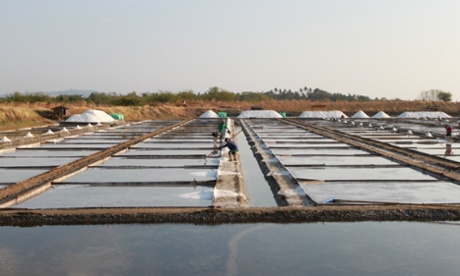
You might not expect nutrition experts to name salt as a crucial weapon in the fight against global malnutrition. In fact, salt is the best vehicle we have to tackle iodine deficiency disorders (IDD), the world’s most common cause of brain damage.
The most visible sign of IDD is goitre. Goitre is just the visible tip of the iceberg. The “hidden” effects of IDD are severe and life limiting. Iodine deficiency during pregnancy can result in stillbirth, spontaneous abortion, and congenital abnormalities such as cretinism, a severe and irreversible form of mental retardation.
Its impact lasts for a lifetime, reducing a child’s ability to learn, to earn a living and to live a healthy life. In aggregate, chronic iodine deficiency leads to a reduction in intelligence quotient of 12.5-13.5 points. Yet, just a teaspoon of iodine spread over a lifetime is enough to prevent these debilitating consequences.
Iodine can be gained naturally from the consumption of some seafood as well as meat and vegetables that have been grown in iodine-rich soil. However, the iodine content of soil is insufficient in large parts of the world.
Iodine deficiency is a worldwide public health problem, not just confined to developing countries. The 25 countries identified by the Global Iodine Scorecard as having insufficient iodine intake includes countries as diverse as Finland and Haiti, the UK and South Sudan. A 2011 Lancet study showed that up to two in three girls in Britain suffer from low iodine intakes.
Adding a small amount of iodine to every day table salt solves this. In the United States the practice of fortifying salt with iodine has taken place since 1924. The result has been a drop in the number of cases of preventable mental handicaps due to iodine deficiency. As reviewed by the World Health Organization in 2014, iodized salt has a large effect not only on reducing the risk of goitre, but also cretinism and low cognitive function.
Furthermore, there is data suggesting that the introduction of salt iodization in the U.S. helped boost IQ in the general population. Salt was chosen as a vehicle for iodine for a number of reasons. It is widely consumed by most people and in fairly similar doses. Adding iodine does not impact the colour, taste or odour of salt. Salt is also the only fortification vehicle that is consistently able to reach the groups with highest risk of iodine deficiency, including the rural poor.
Crucially, it’s a simple and low cost process. In fact, universal iodization of salt (USI) is now widely recognized as the most cost-effective measure to prevent iodine deficiency and is credited for the virtual elimination of IDD in many countries, confirmed by the 2008 Copenhagen Consensus as one of the best investments we can make in international development. Furthermore, WHO strongly endorses salt iodization as a safe and effective strategy for the prevention and control of iodine deficiency disorders.
Currently GAIN and Unicef are working together in 16 countries to scale-up iodization and improve iodine intake. This represents more than 500 million people vulnerable to IDD including more than 19 million newborns every year. Due to national salt iodization programs like these, the number of iodine-deficient countries has decreased from 54 to 25 from 2003 to 2015, a significant reduction from back in 1993 when iodine-deficiency was prevalent in 110 countries. But there is still room for much improvement. UNICEF estimates that 25% of households globally are not consuming adequately iodized salt.
More needs to be done to achieve universal coverage and there are many opportunities to improve and extend iodization programs. In Ethiopia, for example, it is now a national law to mix salt with iodine. But 90 percent of the national demand for table salt comes from Afdera. Afdera is one of the woredas in the Afar Region of Ethiopia and is an isolated location with limited infrastructure, so like many other small salt producers around the world, it will take time and ongoing support to ensure quality salt iodization processes are in place in the Afar Region. Organisations like GAIN and are able to work with government and policy makers to help strengthen monitoring systems, putting laws into practice.
The current emphasis on eating less salt to avoid health risks like heart disease and stroke is changing the landscape also for salt iodization. But, it provides a useful opportunity to make programs work better, building on the momentum to closely monitor salt consumption habits to ensure that people’s iodine needs are met in a way that is healthy and sustainable. Creating more synergies between public health actors in salt iodization and salt reduction will help to make sure that as consumption decreases iodine levels in salt are increased.
According to WHO eliminating iodine deficiency would rank alongside some of the world’s biggest public health achievements like eradicating smallpox. With a simple, safe and inexpensive intervention and the many opportunities at our fingertips there’s no reason why we can’t eliminate IDD by 2020.
GAIN and Unicef are committed to this goal, a goal that is absolutely achievable within our lifetimes. GAIN and Unicef work with other partners of the Iodine Global Network to achieve this aim.
GAIN is honoured to co-host the #FutureFortfied summit in Tanzania with Unicef and a range of other co-conveners this September, find out more on the GAIN website.
Content on this page is paid for and provided by GAIN, a sponsor of the Guardian Global Development Professionals Network.