Not many people realize that if you are aiming to build up Rs 1 crore, a goal many dream of, using a mix of fixed deposits (FDs) and recurring deposits (RDs) can be super effective. Let’s break down how this benefits you.
Both post offices and banks offer FDs and RDs of different tenures. Interest rates may vary. For instance, the post office offers a 6.7% interest rate on its RD, while its rate for the 5-year FD is 7.5%. The post office RD account matures in five years, but can be extended for five years with or without additional deposits. The 5-year post office FD, like its other three FDs, can also be extended for another term.
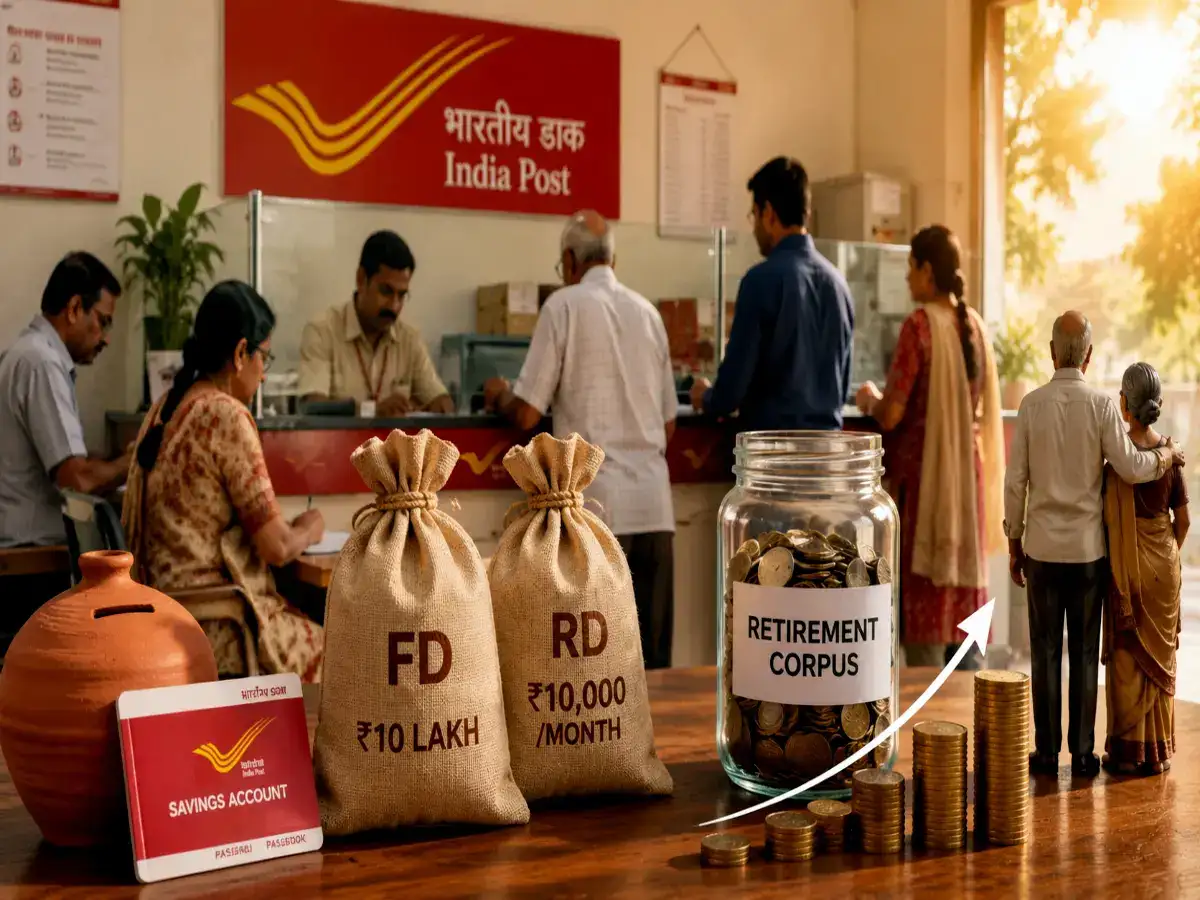
Using both post office FD and RD for financial planning, you can potentially create a retirement corpus of nearly Rs 1 crore in 20 years even if you invest Rs 10 lakh in the FD and contribute Rs 10,000 every month in the RD.
Also Read: SIP vs RD: With Rs 10,000 monthly investment, where can you make more money in 10, 15 and 20 years?
Let’s check the calculations to see if it is possible!
Corpus from Rs 10 lakh investment in post office FD and Rs 10,000/month in post office RD in 10 years
| Initial FD investment | ₹ 10,00,000 |
| FD maturity after 10 years | ₹ 21,02,349 |
| RD investment (p.m.) | ₹ 10,000 |
| RD maturity after 10 years | ₹ 17,08,546 |
| Total maturity after 10 years | ₹ 38,10,895 |
Since the maturity period of RD and FD is five years each, in this case, we will need to extend the tenure by five years in each scheme.
In 10 years, on maturity, the amount will be Rs 38.10 lakh.
Thus, the total gain will be Rs 16.10 lakh before tax. Both FD and RD are taxed at an individual’s slab rates. But in our calculations, we are considering the person to have zero tax liability.
Corpus from Rs 10 lakh investment in post office FD and Rs 10,000/month in post office RD in 20 years
Since 10 years can be the maximum tenure post extension in a post office FD and RD, we will withdraw the maturity amount from both the accounts and invest in a 5-year post office FD. We will keep investing Rs 10,000 monthly in the RD for the next five years. After completing five years in each scheme, we will take another five-year extension in each scheme. During the extension period, we will keep investing Rs 10,000 monthly in the RD.
| FD investment (after 10 years) | ₹ 38,10,895 |
| FD maturity (after 20 years) | ₹ 80,11,832 |
| RD investment (p.m.) from year 11-20 | ₹ 10,000 |
| RD maturity after 20 years | ₹ 17,08,546 |
| Total maturity after 20 years | ₹ 97,20,378 |
When we complete 20 years of investment, on maturity, we will get approximately Rs 97.20 lakh. Our investment in those 20 years from our own pocket will be Rs 34 lakh (Rs 10 lakh in FD and Rs 24 lakh in FD).
If we invest this amount in a mutual fund where our annualised returns are 6%, we can withdraw a monthly amount of Rs 68,700 through the systematic withdrawal plan (SWP) for 20 years.
Can we use FD and RD investments for our financial goals?
Swapnil Aggarwal, director, VSRK Capital, told ET Wealth online FDs and RDs are best suited for financial goals where safety of capital and guaranteed returns is the priority. “They work well for conservative investors, retirees, or people who do not want to take market-linked risks. These instruments can also be useful for short- to medium-term goals and emergency funds,” says Aggarwal.
Vinayak Magotra, product head & founding team, Centricity WealthTech, told ET Wealth Online that FD and RD are typically best suited to meet short- to medium-term financial goals such as emergency funds, education planning, planned large expenses or goals within a defined time horizon.
"The core appeal of such options lies in capital protection and return visibility, which gives an investor a higher degree of certainty in meeting those goals without being exposed to market volatility," says Magotra.
How FD and RD investments can be used for long-term financial planning?
Magotra says the best way to use FDs and RDs in the long term is usually alongside growth assets such as equities, SIPs and mutual funds rather than in isolation.
"Allocating a disproportionately large share of savings to them in long term may not effectively be able to beat inflation over time, especially after taxation. Therefore, it is better to diversify across asset classes for inflation adjusted wealth creation," says Magotra.
Aggarwal says FDs are ideal for those who have lump sum amounts and want a stable monthly interest income, while RDs are suitable for disciplined monthly savings.
Does taxation reduce real FD/RD returns for salaried investors?
Magotra says taxation visibly impacts the real returns on FDs especially for higher salaried individuals as they pay tax on interest earned as per their income bracket along with TDS (if interest is more than Rs 50,000 for a non-senior citizen).
Magotra advises FD and RD to be treated as capital preservation tools and safety nets rather than wealth creation tools as mostly they don’t offset inflation impact in long term.
Calculator used: Groww