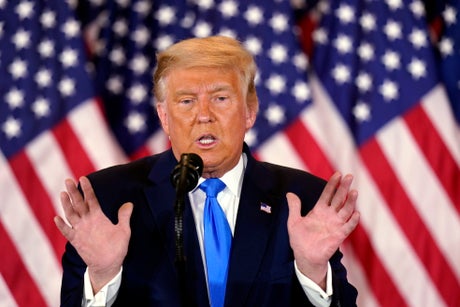
Despite Donald Trump's arguments otherwise, his time in the Oval Office is coming to a close.
Though his time in office has been anything but traditional, the president will almost certainly take advantage of one outgoing presidential tradition; issuing a slew of pardons.
He’s already signed off on a number of get-out-of-jail free cards for his most loyal aides, as reports indicate he has even discussed giving himself a pardon following his defeat in the 2020 elections.
Mr Trump has consistently put his presidential pardon powers to use; in 2017, Mr Trump pardoned former Maricopa County Sheriff Joe Arpaio, who was charged and found guilty of being in contempt of court after refusing to cooperate with federal authorities attempting to make the law enforcement entity less racist.
He also pardoned Scooter Libby - who was convicted of obstruction of justice in the Valerie Plame incident of the early 2000s - and conservative campaign fraudster and content creator Dinesh D'Souza.
He's even issued some good pardons; in 2018, Mr Trump pardoned legendary black boxer Jack Johnson, who was found guilty of violating the hugely racist "White Slave Traffic Act" for crossing state lines with a white woman in 1912.
But could Mr Trump pardon himself? As Democrats call for his second impeachment, or for the Cabinet to invoke the 25th Amendment and remove him from office after what many said was effectively encouraging his extremist supporters to storm the Capitol, the question has been reignited once again in the national conversation.
The short, unsatisfying answer is "maybe."
There is no precedent for such an act, so its legal validity would ultimately be left up to a court to decide, assuming Mr Trump's attempt to do so would generate a lawsuit.
The president's pardoning powers are very broad. Mr Trump could pardon his friends - as he already has done with conservative hatchet-man Roger Stone - and his family without issue.
Mr Trump would not have to wait until charges are formally brought against him to pardon himself, either. The president's pardoning powers extend to actions that have not been revealed or charged.
Some legal experts have argued that a president pardoning themselves would be unconstitutional because it violates the idea that no one should act as the judge in their own case.
There is one substantial obstacle to Mr Trump pardoning himself.
The first is that pardons are only applicable to federal crimes. Charges brought by lower courts - like those facing Trump associates from the Manhattan District Attorney - are not eligible for a presidential pardon.
Rather than trying to pardon himself, Mr Trump could also resign at some point prior to leaving office, passing the authority to pardon over to Vice President Mike Pence.
Gerald Ford pardoned Richard Nixon in this way, which establishes both the legal and historical precedent for the action.
It's difficult to say what would happen if Mr Trump tries to pardon himself.
As with so many other unprecedented issues during the Trump administration - from whether or not the president can invade a city with federal troops to whether or not the president can refuse to leave office - the answer to the question is not so much "if" he can, but rather "who is going to stop him?"
What comes next is anyone’s guess, though House Speaker Nancy Pelosi and Senate Minority Leader Mitch McConnell have both called on the Cabinet to invoke the 25th Amendment while threatening impeachment.
“What happened at the U.S. Capitol yesterday was an insurrection against the United States, incited by the president," said Mr Schumer in a statement. "This president should not hold office one day longer."
“The quickest and most effective way — it can be done today — to remove this president from office would be for the vice president to immediately invoke the 25th Amendment,” he said. “If the vice president and the Cabinet refuse to stand up, Congress should reconvene to impeach the president."
But it’s clear the writing is on the wall for his presidency, after Congress finally reconvened after a six hour delay spurred by the riots to officially certify President-elect Joe Biden’s victory.