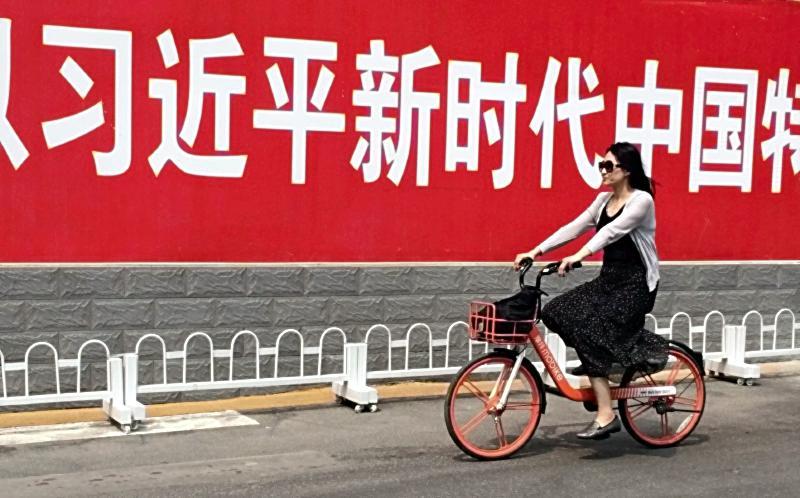
BEIJING -- Chinese television and newspapers continue to produce propaganda urging people to learn from and obey President Xi Jinping, who also serves as general secretary of the Chinese Communist Party and wields tremendous power. He has been effusively praised, flattered and cast as an infallible leader, raising concerns that the government could become divorced from reality.
Self-defense mechanism
In the Communist Party and government power structures, in which obedience to superiors is strictly demanded, praise is often used as a political self-defense mechanism.
Political leaders often make three types of mistake while governing. The first is corruption and misconduct, such as using their position to solicit bribes or misappropriate public funds. Second are policy failures like massive developmental projects that result in ghost towns. The third is insubordination to superiors.
Those charged with corruption are said to only represent a fraction of the misconduct in government. As long as policy failures do not lead to major accidents or riots, there is little in terms of accountability.
But insubordination is different. Stances that disrupt party stability and solidarity are forbidden. What's more, Xi's system strictly demands party unanimity on matters. Any top official caught in the web of investigations, monitoring and secret informants faces demotion, relegation, or even corruption charges.
"Everyone is afraid of President Xi. It's natural that they praise and obey him," said one party official.
The vast majority of party leaders actively obey and praise Xi, and those with objections remain silent. This is considered the safe and "correct" attitude to take. There are already plenty of expressions for honoring Xi, including "leader" and "helmsman."
A new legend
"Learn from the General Secretary. Follow in the footsteps of his youthful efforts."
The China Youth Daily, the official newspaper of the Communist Youth League of China, published this message for Chinese youth in May. It also described Xi, who was sent to a farming village in Shaanxi province during the Cultural Revolution (1966-76) at the age of 15 and worked to improve the lives of village people for nearly seven years, as a "living textbook."
Since spring, the official party newspaper People's Daily and other media have recounted Xi's past accomplishments as a regional leader in Hebei, Fujian, Zhejiang and other provinces, stating that Xi's "new age" is the result of "a long process of thought and action."
It can be said this propaganda serves to create the "legend" that Xi, now the "leader" and "helmsman" guiding the nation, has personally followed the "correct" path all his life. Such language is qualitatively different from previous praise lauding the Xi administration's "achievements" since its inauguration in 2012.
In unipolar systems, in which one individual wields great power, the main concerns center around whether the leader's mistakes can be corrected. However, no one possesses the will to raise his or her concerns, and the infallible notion that Xi makes no mistakes has proliferated.
When asked about this, a government official responded, "There are no concerns."
Altered statistics
This year, the Inner Mongolia Autonomous Region and Tianjin admitted to falsely inflating economic statistics (see below), shocking people both at home and abroad. The incident also legitimized long-standing, widely held suspicions about China's official data.
It is said that performance evaluations of top officials are directly tied to growth rates, which is thought to underlie the falsification.
But under the Xi administration, which touts "high-quality growth" that prioritizes quality of life and environmental conservation, it has become more dangerous to inflate data.
Does this mean that statistics in China will normalize?
"Maybe a little," one economic specialist said with a bitter smile. A fundamental problem plagues the system, one that will not be easy to solve, according to the specialist.
That problem is pandering to superiors. Even if data falsification becomes less widespread, top officials have a strong tendency to "prioritize their superiors over reality in their reports," according to a party official. As a result, it is still possible that officials could invent numbers to please Xi.
China has a tragic history of data falsification. In 1958, Mao Zedong, who ruled as a dictator, ordered a drastic increase in agricultural and industrial production. In response, regions and departments delivered fake reports meant to curry favor with him. Mao's mistakes were not corrected, leading to a collapse of both agriculture and industry. Tens of millions of people starved to death during this period.
Whether the administration can grasp the actual situation amid the praise and flattery will continue to be an extremely important challenge for Xi.
Who takes the blame?
The economy is key to the long-term stability of the Xi administration.
Xi's policy direction, which in practice modifies the development of the market economy and takes a state-led growth strategy, has the potential to be a great success. On the other hand, there is no denying the danger that it could become divorced from economic realities and hit a dead end.
Yet even if the economy runs into trouble, Xi would not take the blame.
Instead, those deemed "disloyal to President Xi" would be condemned. Along with its praise for Xi, the media has spoken out against corruption, bureaucrats and those who pledge "fake loyalty."
No one wants to take the blame for failure. Top officials would treat such circumstances as a competition, praising Xi and further proclaiming their loyalty.
Speed, ambition as strengths
The unipolar system certainly does have its own strengths.
One of the catchphrases for praising the Chinese leader is, "President Xi solved a problem that went unsolved for years."
Xi condemned corruption among top government officials, who had previously enjoyed a special status, and is getting behind anti-poverty and environmental conservation efforts that were overlooked during the country's period of rapid economic growth.
Democracies like Japan, the United States and European countries cannot hope to match the speed with which economic policy decisions are made and the ability to concentrate vast amounts of resources on specific projects. There is enough power to move the entire country at once.
Xi has also overseen recent improvements in Sino-Japanese relations and does not need to worry about the reactions of political elders who harbor anti-Japanese sentiment.
On the other hand, this makes it difficult to change course when Xi makes a poor decision.
It is not just political elders -- none of the current leaders, including the No. 2 official in the party, Premier Li Keqiang, can stop Xi.
And with last year's move by the National Congress to abolish presidential term limits, among other measures, the power to contain individual power has been lost as well.
(From The Yomiuri Shimbun, May 25, 2018)
--Falsely inflating economic statistics
In January, the government of the Inner Mongolia Autonomous Region admitted that its 2016 statistics inflated its revenue by about 25 percent and its industrial production by about 40 percent. The city of Tianjin was also found to have fabricated part of its provincial gross product for the same year and revised its numbers downward by one third. An investigation by the central government turned up many cases of regional governments reporting fabricated numbers.
Read more from The Japan News at https://japannews.yomiuri.co.jp/