Kentucky Republican Senator Mitch McConnell announced on Sunday that he fell last month, which led to his hospitalization and multi-week absence.
The senator's announcement comes after Kentucky Governor Andy Beshear urged McConnell to provide a health update, given the limited information since his hospitalization on June 14 and weeks of speculation about his health.
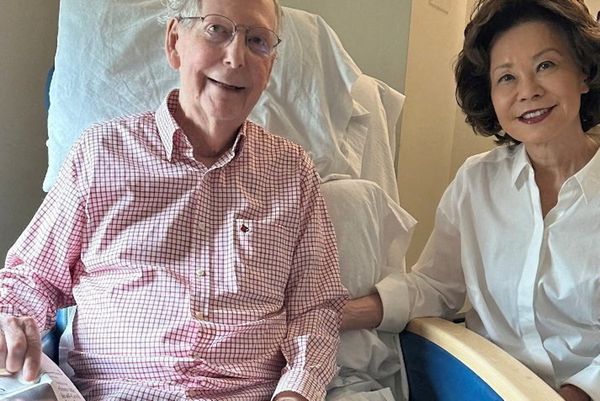
"My doctors have confirmed that I didn't break any bones or suffer a concussion," McConnell said in a statement, accompanied by a photo of the senator and his wife, Elaine Chao.
McConnell, 84, said he was "briefly unconscious" when he was first taken to the hospital and had undergone a battery of tests as doctors determined what caused his fall.
"I didn't have a heart attack or a stroke. I don't have any tumors or hemorrhages."
The Kentucky senator's latest hospitalization adds to a long history of health challenges. McConnell had polio in his early childhood and previously acknowledged that the illness left him with lasting difficulty walking and climbing stairs as an adult.
In a statement released Sunday, the physician's office in Congress said McConnell has "experienced several falls this year" due to a "post-polio condition."
What Is Post-Polio Syndrome?
McConnell's disclosure has drawn attention to post-polio syndrome (PPS), a neurological condition that can emerge decades after a person has recovered from polio.
According to the National Institute of Neurological Disorders and Stroke, PPS typically develops 15 to 40 years or more after the initial infection, following a long period during which symptoms remain stable.
Although the poliovirus is no longer active, survivors may later in life experience new muscle weakness, overwhelming fatigue, muscle and joint pain, difficulty swallowing or breathing, and worsening balance.
Researchers believe the condition develops because nerve cells that survived the original infection worked overtime for decades to compensate for damaged neurons. Over time, those overworked nerve cells can gradually lose function, leading to new symptoms.
Why Falls Become More Common
One of the most significant complications of post-polio syndrome is an increased risk of falls.
As muscles weaken and fatigue becomes more pronounced, everyday activities such as walking, climbing stairs, and maintaining balance become increasingly difficult. Symptoms often progress slowly but can have a major impact on mobility and independence.
McConnell's physician said the senator's physical therapy is specifically aimed at reducing his risk of future falls.
Who Develops Post-Polio Syndrome?
Not every polio survivor develops PPS.
The Centers for Disease Control and Prevention estimates that 25% to 40% of people who survived polio eventually experience post-polio syndrome. Those who had more severe cases of polio or regained significant muscle function after recovery may face a higher risk.
There is no single test to diagnose PPS. Instead, doctors rely on a patient's history of paralytic polio, the appearance of new symptoms after years of stability, and tests to rule out other neurological or orthopedic conditions.
There Is No Cure, but Symptoms Can Be Managed
While there is no cure for post-polio syndrome, treatment focuses on managing symptoms and preserving mobility.
Doctors often recommend carefully supervised physical therapy, low-impact exercise that avoids overexertion, energy-conservation strategies, pain management, and assistive devices when needed. Experts caution that excessive exercise can sometimes worsen symptoms by placing additional stress on already weakened muscles.
Although polio has largely been eliminated in the United States through vaccination, its effects can persist for a lifetime. For some survivors, new muscle weakness, fatigue and balance problems may not simply be signs of aging but the delayed consequences of an infection they overcame decades earlier.