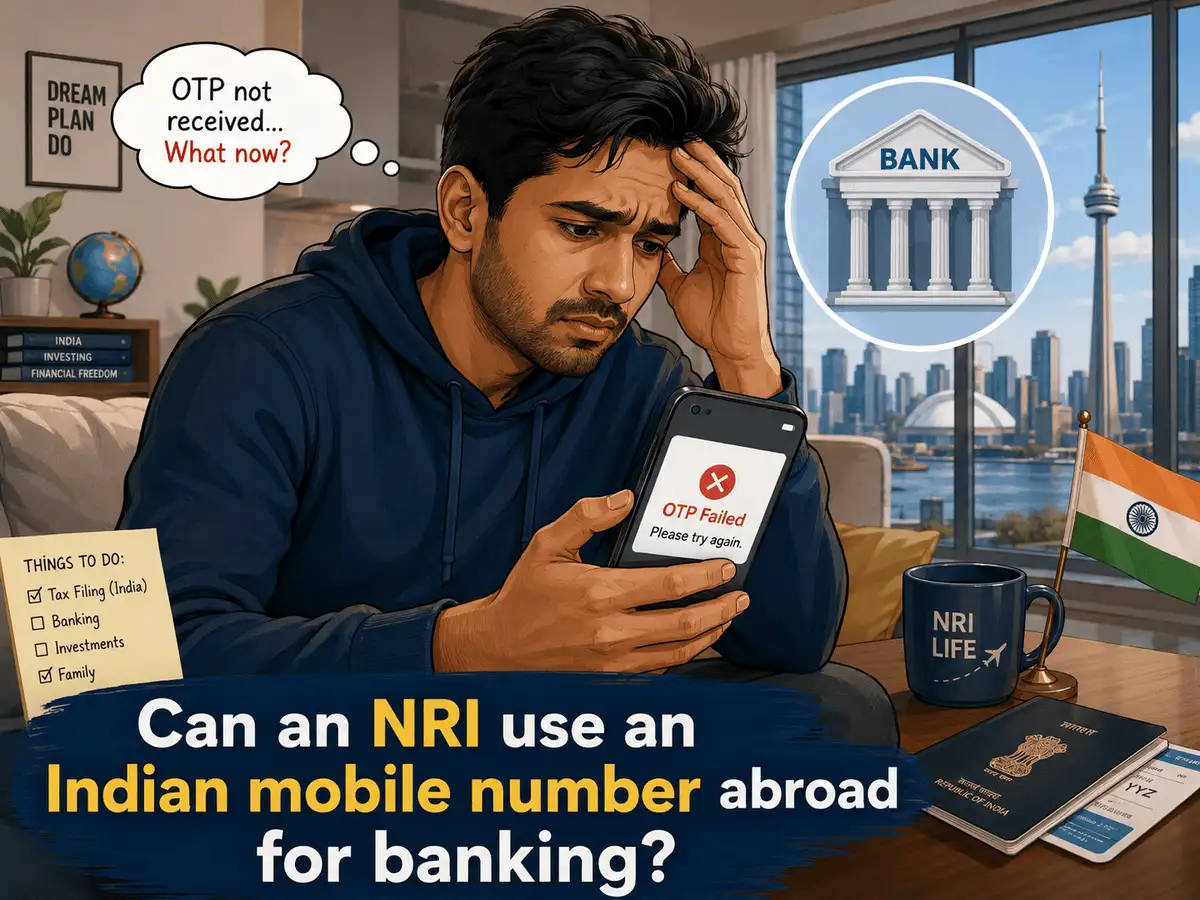
Moving abroad as an NRI usually involves handling bank accounts, investments, taxes and UPI payments online from overseas. But many NRIs realise the importance of their Indian mobile number only when an OTP fails during a crucial banking transaction.
Maintaining an Indian number while abroad can be tricky. Frequent OTP delays, roaming charges, SIM card deactivation and issues accessing banking services are typical worries for NRIs managing their finances from afar.
Continue reading to discover how NRIs can keep their Indian mobile number active, tackle OTP challenges overseas and avoid common banking access issues.
Should NRIs continue using Indian mobile numbers for banking access?
Indian banking and financial systems are still largely designed around domestic mobile numbers, making them critical for transactions, account access and compliance-related activities. NRIs can continue using their Indian mobile number to access bank accounts and many still rely on it.
“The biggest advantage is OTP delivery across banking, investments, and UPI, since most Indian systems are built around domestic numbers, says Abhishek Agarwal, CFA | Chief of Staff, SBNRI.
Also read: NRI but using resident savings account? Here’s what you must know about NRE, NRO, and FEMA rules
Many Indian organisations, both government and private, still rely heavily on Indian phone numbers for various processes, and the OTP system is one of the biggest reasons for this dependence and also remains essential for updating KYC, filing taxes, and accessing DigiLocker, EPFO, and Income Tax portals, he adds.
Banks also acknowledge that OTP delivery on Indian numbers generally continues to work for NRIs, although the experience may vary depending on telecom operators and countries.
“If the customer can get SMS alerts/OTPs to Indian number, he/she can continue the same. The delivery depends on service provider/country,” says Prashanth George Tharakan, Head - NR Branch Banking, South Indian Bank.
Why is maintaining an Indian mobile number not always easy?
Even though it’s convenient, maintaining an Indian mobile number while abroad has its own challenges.
A major issue is that many NRIs use these numbers just from time to time for OTPs, which raises the chances of deactivation due to inactivity.
“The cons are high international roaming costs add up quickly, there's a constant risk of SIM deactivation due to inactivity, and OTPs often arrive delayed when routed through foreign carriers, which causes serious frustration during time-sensitive transactions like fund transfers, says Agarwal.
Another point worth noting is that keeping a physical SIM rather than just opting for an e-SIM matters because if you lose or change your phone, transferring an e-SIM to a new device is a cumbersome process, he adds.
Can NRIs use international mobile numbers?
Over the years, banks have gradually started supporting overseas mobile numbers, especially for NRI-specific accounts. However, the experience still differs across banks and account types.
“If you are operating an NRE or NRO account, most banks today do allow you to register an international mobile number and receive OTPs on it. So from an NRI banking standpoint, it is definitely possible to function without an Indian number,” says Ankur Choudhary, Co Founder and Chief Executive Officer at Belong.
However, this support is still not fully consistent across all banking products.
For regular resident Indian accounts, international numbers are often not supported. Some banks do offer email based OTPs, but in our experience, this tends to be inconsistent. It may work for login authentication but not always for transactions. So while alternatives exist, they are not always as reliable as SMS based OTPs on an Indian number, he adds.
As a result, many NRIs are now increasingly relying on app-based verification systems instead of traditional SMS OTPs.
“App-based authentication has also become one of the most reliable alternatives, allowing approvals through push notifications, biometrics, or device-based verification that completely bypass SMS routing issues,” says Agarwal.
The combination of app-based authentication as the primary method and a registered international number as backup is the most practical setup for NRIs without an Indian SIM, he adds.
How to keep an Indian SIM card active abroad?
To avoid disruption, many NRIs now maintain their Indian SIM purely for banking and OTP purposes. Typically, this involves activating international roaming and ensuring periodic recharges to avoid inactivity-related disconnection.
“NRIs typically keep their Indian SIM active by enabling international roaming and maintaining a minimum recharge plan. It is important to periodically recharge or use the SIM to prevent deactivation, as telecom operators may disconnect inactive numbers permanently after the grace period, which can mean losing the number tied to your bank accounts altogether,” says Agrawal.
Many telecom operators have also started offering longer-validity plans tailored for such users.
A practical approach is to retain the Indian number purely for OTPs and many telecom providers now offer NRI-specific plans that can be recharged just to keep the account active for OTPs, including 365-day validity prepaid options from Airtel and Jio that eliminate the worry of monthly renewals, he adds.
Common OTP issues NRIs face with Indian mobile number
Despite improvements, OTP-related disruptions continue to be one of the biggest pain points for NRIs managing Indian banking remotely.
The most common issues include delayed OTPs, SMS failures, SIM deactivation and blocked messages from Indian banking short codes.
“NRIs often face issues like OTP non-delivery, delays due to international SMS routing, or complete loss of access if their Indian SIM gets deactivated, and these problems can disrupt critical transactions like investment redemptions, large transfers, or tax filings. International carriers sometimes block SMS from Indian short codes, which is one of the top complaints from NRIs,” says Agarwal.
What should you do?
To reduce these risks, you can maintain multiple backup authentication methods instead of relying entirely on a single mobile number.
“To avoid these disruptions, NRIs should maintain a dual setup, keeping an Indian number as backup while registering an international number as primary and enabling app-based authentication as the most reliable layer,” he adds.
NRIs can even switch between Indian and international numbers as banks are moving towards a more flexible approach.
“Now NRIs can register their Indian number as an alternative number in their bank account and switching between Indian number and international number can be done digitally using SIB Mirror+ application,” says Tharakan.