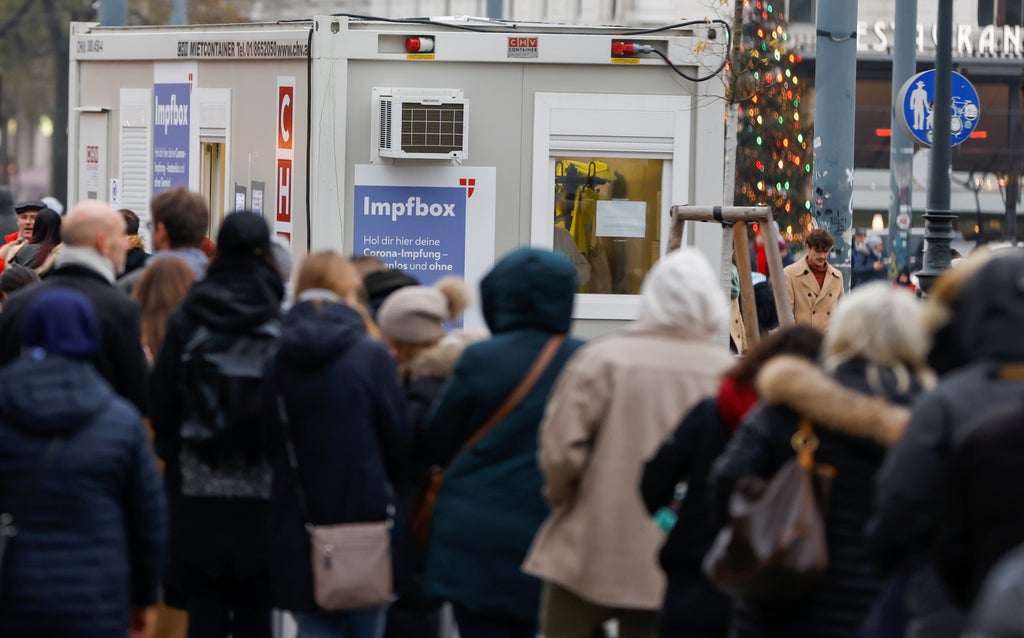
Following a nationwide lockdown sparked by a spike in new Covid cases, Austria has eased its strict domestic Covid rules.
The national lockdown began on Monday 22 November for all, and ended on 12 December for vaccinated people only. From 20 December, everyone was released from lockdown rules, though so-called “2G” rules for entering local venues remain.
“The infection situation in Austria has eased,” reads a statement on tourist board website Austria.com.
“With Vienna reopening hotels and restaurants/cafés/inns on December 20, the nationwide lockdown in Austria comes to an end. Travel to Austria for touristic purposes is possible again for vaccinated and recovered people!”
However, testing requirements for entry have also been changed, and are now contingent on whether you have had a booster vaccine shot or not.
So what do the new rules mean for travellers? Here’s what we know so far.
Can Britons travel to Austria?
Only fully vaccinated (at least two doses) and recently recovered people can visit Austria for tourism purposes.
Unvaccinated people cannot visit, except for Austrian residents, who must self-isolate for 10 days on arrival.
For vaccinated people, whether you need to show a negative test result to enter depends on whether or not you have had a booster injection.
If you’ve been to certain African nations in the past 10 days, you may not be allowed into Austria regardless of vaccine status.
“Entry from South Africa, Lesotho, Botswana, Zimbabwe, Mozambique, Namibia and Eswatini is currently prohibited. This also applies to people who have been in those countries in the last 10 days,” reads the current Foreign Office guidance.
What are the rules for travellers visiting Austria?
As of 20 December, only fully vaccinated people - or those who can prove they have recovered from Covid-19 within the past 180 days - can enter Austria.
For double-jabbed and those with a booster, Austria will accept the UK’s NHS Covid Pass.
For recovered people, the tourist board gives this warning: “Attention: For people arriving from the United Kingdom, the NHS email / text message that you tested positive is not sufficient.”
You can instead show a letter from the NHS or your GP which states the date of recovery - the NHS is slated to reveal an official proof of recovery document later this month.
From 20 December, fully vaccinated people who have not yet had a booster must also provide a negative PCR result from a test taken within the past 72 hours.
“When entering Austria you must provide either proof of Covid-19 vaccination, or proof of recovery from Covid-19. Additionally from 20 December 2021 you must provide evidence of a current negative Covid-19 test, if you have not had a booster,” reads the current Foreign Office advice.
Those who have had a booster dose are exempt from the on-arrival PCR test, and your booster jab is deemed valid from the first day after you’ve had it.
And you must make sure your vaccination is still in date - Austria is one of a handful of countries that has introduced an expiration date for vaccine passports.
This means that, to be considered fully vaccinated, your final dose of the vaccine must have been administered between 14 days and 270 days before you arrival date.
If your second vaccine was more than 270 days ago, you must have a booster jab to be considered fully vaccinated.
Assuming you meet these criteria, fully vaccinated travellers do not have to register with a health clearance form or quarantine on arrival.
Children of any vaccination status up to the age of 17 are able to enter Austria with no need to quarantine if accompanied by a fully vaccinated or recently recovered adult.
However, those aged 12 to 17 must show proof of a negative PCR test, full vaccination or recent recovery on arrival.
For unvaccinated travellers:
At present, only unvaccinated citizens and those with residency in Austria may enter, and must quarantine for 10 days on arrival.
Are there restrictions in place once there?
Austria has so-called “2G” rules in place, meaning fully vaccinated people are able to access more venues, services and public places than unvaccinated people.
You must show proof of full vaccination to enter hotels, restaurants, bars, nightclubs, leisure centres, gyms, cultural institutions such as theatres, Christmas markets, ski lifts/cable cars and hair salons.
Restaurants and cafés are currently closing at 11 pm (though New Year’s Eve is an exception). Bars and clubs remain closed for the time being, as will the apres-ski scene.
FFP2 face masks - the European equivalent to N95 respirator masks - must also be worn on public transport and in taxis, plus in shops, banks, bakeries, cable cars, museums, libraries, post offices, pharmacies and doctors’ offices.
For children and teenagers who have yet to have both jabs, they can apply for a Ninja Pass and undergo regular testing instead of having to show proof of vaccination.
Can I cancel my holiday to Austria?
If you’re due to holiday in Austria, your cancellation rights will depend on what you’ve booked. If you’ve purchased a package holiday, you’re protected by the 2018 Package Travel and Linked Travel Arrangements Regulations; it’s likely your provider will allow you to shift dates or claim a full refund.
If you’ve booked separate elements, things get more complex. Whether you can get a refund from the airline will depend on whether the flight you’re due to take is cancelled. If it still runs, the carrier is not obliged to refund you. However, many airlines have introduced more flexible rebooking policies during the pandemic, so you will be likely be offered a voucher or the option to change your dates instead. Likewise, if you contact your accommodation provider, they may be willing to shift your booking.
Also check what’s covered by your travel insurance - depending on your policy terms, you may be able to claim money back through this.
What are the rules for returning to the UK?
As of late November, all arrivals to the UK must provide a negative result from a pre-departure test (PCR or antigen) taken on the day of departure or within the two days beforehand. This is regardless of vaccination status.
They must also book a “day two” test on arrival in the UK or within the two days after, which must be a PCR test, and fill in the UK’s passenger locator form within the 48 hours before arrival.
Vaccinated arrivals must now self-isolate between getting home or to their accommodation and receiving a negative result from their day two test.
Unvaccinated or partly vaccinated arrivals must also self-isolate for 10 days, and book a further “day eight” PCR test. They also have the option of paying extra for a “day five” or test-to-release test which could release them from quarantine slightly earlier.