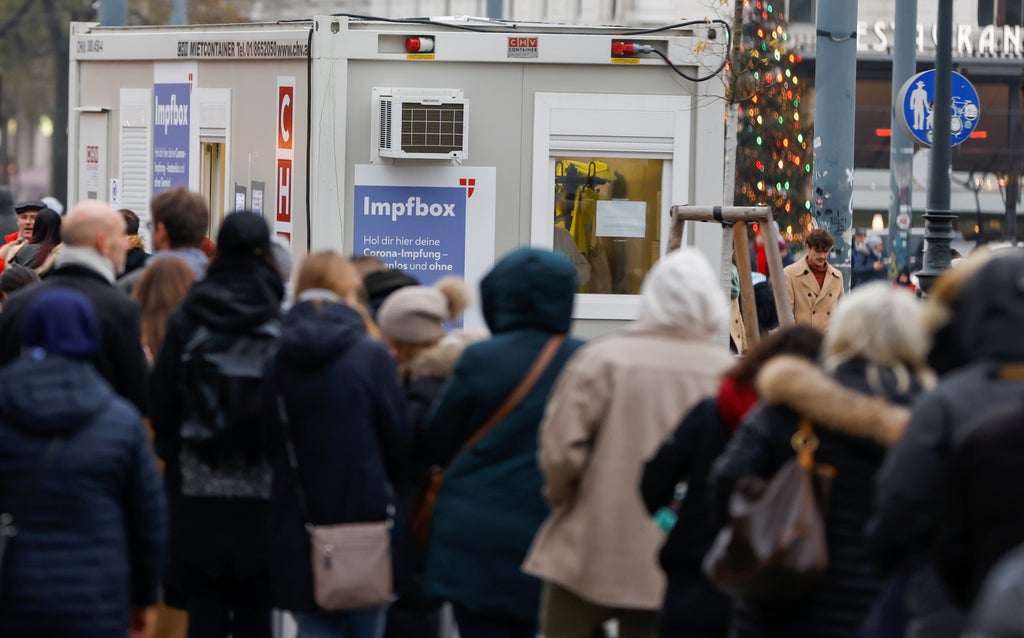
Austria has introduced a nationwide lockdown following a spike in new Covid cases.
The new restrictions came into effect on Monday 22 November and will be in place for at least 10 days, with the option to extend them for a further 10 days. The lockdown will end on 12 December at the latest.
There was previously a lockdown in place in the country specifically for the two million people who had yet to be fully vaccinated. Since 15 November, unvaccinated residents and visitors have only permitted to leave home for a slim number of reasons, such as food shopping or work.
The latest lockdown applies to vaccinated citizens too, following record case numbers of coronavirus and Austria suffering from having one of the lowest vaccination levels in Western Europe.
“We don’t want a fifth wave,” said Chancellor Alexander Schallenberg, adding that vaccination would become a legal requirement from 1 February 2022.
But what do the new rules mean for travellers? Here’s what we know so far.
Can vaccinated Brits travel to Austria?
No. The official travel information portal, Austria.info, says: “A lockdown will be in effect in Austria from 22 November until probably 13 December.
“Travel to Austria for touristic purposes will only be possible again after that date.”
The Social Ministry in Vienna says: “Entry into Austria from individual countries is … only permitted for specific reasons.”
Many flights from the UK to Austria have been cancelled as a result - though not all.
What about after lockdown ends?
British travellers should be allowed back in once the nationwide lockdown ends, with different restrictions depending on whether or not they are fully vaccinated.
For vaccinated travellers:
If you provide proof of vaccination, you do not have to self-isolate or register upon entry to Austria. Austria will accept the UK’s proof of Covid recovery and vaccination record. If you are travelling with a printed PDF proof of vaccination status, it must date from after 1 November to ensure that the certificate can be scanned successfully.
Austria is one of a handful of countries that has introduced an expiration date for vaccine passports. “For double-shot vaccines (eg AstraZeneca, Moderna), you must show that you received the second injection no more than 360 days before arrival,” says the Foreign Office (FCDO). “If you received a booster more than 120 days after being fully immunised, this must not have been more than 360 days before arrival.”
This timeframe is reducing next month – from 6 December 2021, you are only considered vaccinated for 270 days after receiving a second or third dose of a recognised vaccine.
For unvaccinated travellers:
Travellers who aren’t fully vaccinated must present a negative test or proof of recovery from Covid, plus self-isolate for 10 days on arrival.
For proof of a negative Covid test, PCR results must be no older than 72 hours, antigen test (eg lateral flow) results must be no older than 48 hours, and antigen self-test results (which must be recorded in an official data processing system) must be no older than 24 hours.
For proof of recovery, travellers must show evidence of recovery during the past 180 days or evidence of neutralising antibodies no more than 90 days old.
Children up to the age of 12 do not have to provide a test result if travelling under the supervision of an adult. If the accompanying adult has to self-isolate, the child must self-isolate too. The child can then leave self-isolation at the same time as the adult. If travelling unattended, the same requirements apply as for adults.
Children aged 12-18 must self-isolate and register on arrival, unless they or the adult travelling with them are exempt from self-isolation, for example through vaccination.
Will there be restrictions in place once there?
The Austria.info portal says: “After the end of the current lockdown, the 2-G-rule (proof of full vaccination/past infection) will be in effect again in Austria, as well as FFP2 mask requirements in many areas.”
This means that, even when lockdown lifts, unvaccinated people will still be barred from visiting restaurants, hairdressers, cinemas, Christmas Markets, bars, restaurants, nightclubs, theatres and hotels.
FFP2 face masks - the European equivalent to N95 respirator masks - are compulsory on public transport and in taxis, plus in shops, banks, bakeries, cable cars, museums, libraries, post offices, pharmacies and doctors’ offices.
Can I cancel my holiday to Austria?
If you’re due to holiday in Austria, your cancellation rights will depend on what you’ve booked. If you’ve purchased a package holiday, you’re protected by the 2018 Package Travel and Linked Travel Arrangements Regulations; it’s likely your provider will allow you to shift dates or claim a full refund.
If you’ve booked separate elements, things get more complex. Whether you can get a refund from the airline will depend on whether the flight you’re due to take is cancelled. If it still runs, the carrier is not obliged to refund you. However, many airlines have introduced more flexible rebooking policies during the pandemic, so you will be likely be offered a voucher or the option to change your dates instead. Likewise, if you contact your accommodation provider, they may be willing to shift your booking.
Also check what’s covered by your travel insurance - depending on your policy terms, you may be able to claim money back through this.
What are the rules for returning to the UK?
There are no countries left on the UK’s red list at present, meaning all nations are on its Rest of World (ROW) list.
Requirements for returning to the UK depend on whether the traveller is fully vaccinated or not. Those who are double jabbed have no need to test before returning or quarantine – they must simply book and take a private Covid test (lateral flow is now acceptable) within two days of arriving.
Travellers who are not fully vaccinated must present a negative Covid test (lateral flow is acceptable) taken in the three days before departure, self-isolate for 10 days on arrival, and take two private PCR tests on days two and eight of quarantine. Those in England may opt to pay for a third test on day five to leave self-isolation early if the result is negative.
All travellers must fill in a passenger locator form before departure for the UK.