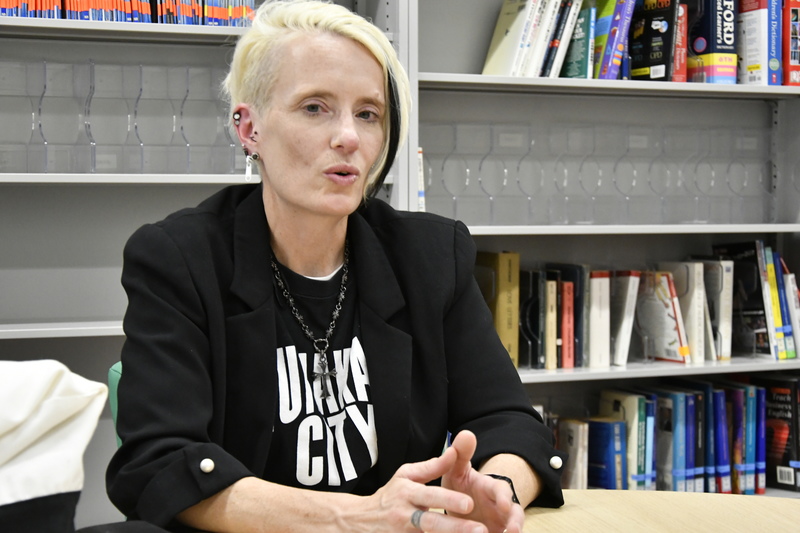
"I think Hakata and Kitakyushu can understand each other," said Anne Crescini, associate professor at the University of Kitakyushu, in heavily accented dialect. Fukuoka and Kitakyushu are two leading cities of Fukuoka Prefecture and have long been rivals, but Crescini said confidently that the perceived barriers between the citizens can be overcome. As she has lived in the different cultures of both America and Japan, I asked her what the key is to breaking down barriers.
Anne was born and raised in a town of about 7,000 people in Virginia in the United States, a very conservative town where many people spend their whole lives without ever leaving. She came to Japan about 20 years ago from that town. In Kitakyushu, she often heard, "Oh, it's a gaijin." But to her, it was the Japanese people themselves who were strange "gaijin" whom she could not understand.
She liked Japan, but she found it difficult to understand. After spending many of her days feeling lost and uncertain she returned to America temporarily and found she was shocked by her home culture.
"At that time, our family had just moved to Munakata, Fukuoka Prefecture, and we felt comfortable there. Around this time I went to America. Being back in America was fun, but I also felt like it wasn't where I was meant to be, even though it's my home country. I cried for about two months because of the culture shock. When I went through customs in the United States, a customs officer said, 'Welcome home.' But I responded with, 'This is not my home.'"
The person who changed the way she felt was a woman whom Crescini met in Munakata. She was born and raised in Kyoto and married into a family in Munakata. It wasn't only the language that was completely opposite between them, it was their food culture, values and religious views, too.
"I have nothing in common with her. Her way of thinking is 'purely Japanese' and totally different from mine. But we became very close. I enjoy interacting with her so much, but I clash with her a lot. Even though I had been living in Japan for a long time and I thought I had a deep understanding of Japanese culture, I began to wonder why I had so many encounters where I couldn't see eye to eye with Japanese people."
It was a trip to Kyoto together with her friend that triggered the change.
"We went to temples and shrines in Kyoto. I thought that I had enjoyed it, but during the car ride home she said, 'I understand that you're a devout Christian. I know you don't want to go to temples and shrines. I can tell from just looking at you that you don't even want to go through torii [shrine gates].' She then went so far as to say, 'If you hate Buddhism and Shintoism so much, why did you come to Kyoto?' That was the turning point for me."
With a serious expression, she continues to talk about her feelings.
"I was unconsciously rejecting the Japanese way of thinking. I lived in Japan and always thought that I loved Japan, but what I loved was only the Japan that I could understand and accept. On the other hand, I was looking at Japan with a superior attitude. When I didn't understand, I thought that 'Japan is weird. The U.S. is right.'"
Understanding another's way of thinking can be difficult. But if you never give up trying to understand, you'll eventually be able to. Her feelings since that realization have remained unchanged.
"The difference between America and Japan isn't a matter of 'right' or 'wrong' but simply a different way of thinking. After the incident in Kyoto, I stopped to think before criticizing something. By doing so, my way of thinking changed. I still clash with my best friend, but we try to respect and understand each other. It's great to clash with someone, because it helps you mature," she explains.
"The virtue of the Japanese is to refrain from conflict or to be patient and do sontaku [to perform preemptive acts to ingratiate themselves to their superiors]. But you can't grow up if you don't clash with each other. Before I met my best friend, I would always socialize with people with the same values as me, so these thoughts never occurred to me. Even though we're best friends, we think very differently, and we clash with each other, fight and cry."
Alongside her regular job, she also works as a local TV commentator. Fukuoka City, which she showcases in her program, is growing and Kitakyushu City is losing its vitality. She sometimes worries about the comments she receives online.
"The relationship between Hakata and Kitakyushu is very delicate. When a TV show posted a message saying, 'Fukuoka dialect is Hakata dialect,' my social media comment section became a warzone," she jokes. "Because both Kitakyushu and Chikuho have their own dialects."
She has lived in Japan as a foreigner, and through clashing with her best friend, she has overcome differences and built relationships of mutual understanding and trust.
"I don't think there's any wall you can't get over. There is a very big wall between my best friend and I, and I tried to give up many times. Crying and crying, I thought it was impossible," she recalls. "It's natural for the people of Kitakyushu to take pride in their dialect and culture. With that in mind, I think you can try to understand the thoughts and pride of the people in Hakata. 'I don't like Hakata because I like Kitakyushu,' or something like that is not right. I like American culture, and I am trying to understand Japanese culture and values while having faith in Christianity."
She also said jokingly: "The relationship between Kitakyushu and Hakata isn't so bad as to start a war, is it? If there was willingness to try to understand each other, there would be no war. Trying to impose your ideas on others is the root of all wars. You don't have to abandon yourself for mutual understanding."
She has a belief that she can talk about things like this because she has lived back and forth between the two differing cultures of the U.S. and Japan. Finally, she said with a serious expression: "Speaking calmly while respecting the other person's thoughts. Making an effort to understand. For me, the relationship with my best friend is the foundation. There are many things I can't sympathize with, but we can respect each other. We became friends even though we clashed with each other. With this kind of thinking, people can solve various problems. It's a pain trying to understand others. It's easier to break up, but I think to do so is a shame. Because becoming friends with people who have different ideas from me changed my life."
Read more from The Japan News at https://japannews.yomiuri.co.jp/