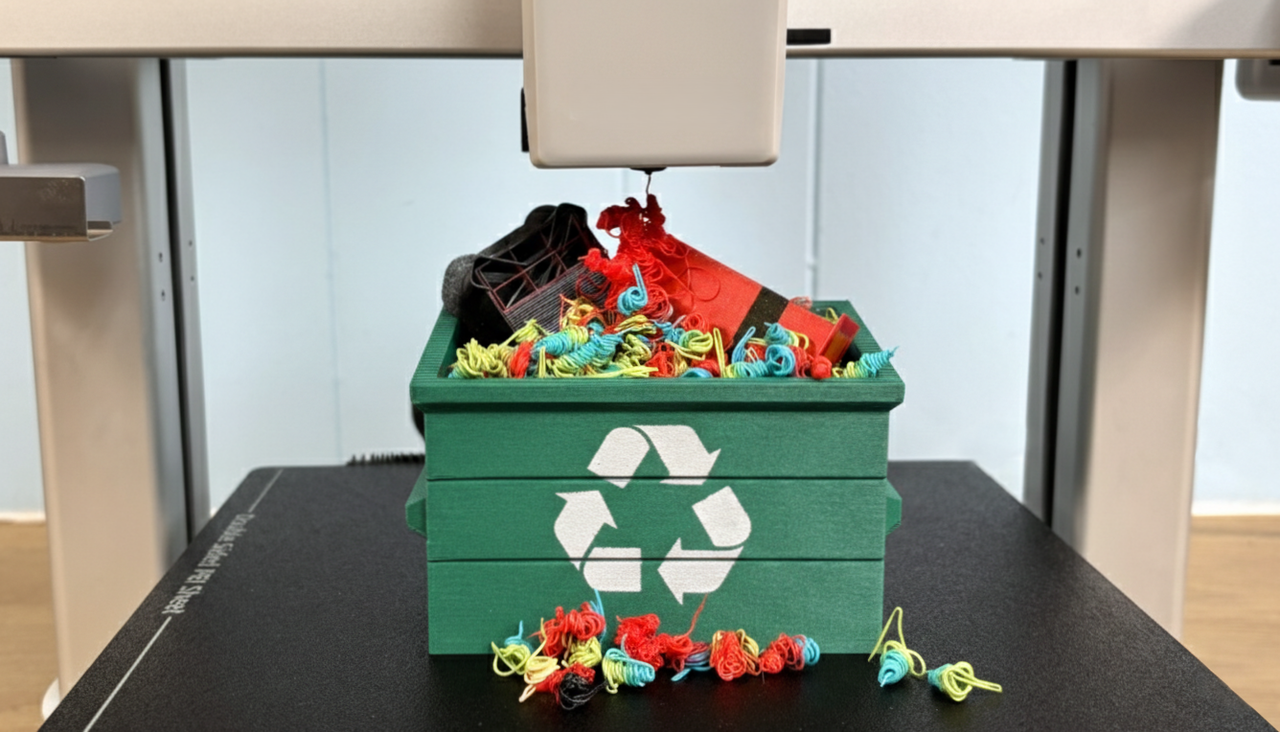
3D printing no longer belongs to a few hardcore geeks. It’s become a popular tool among the mildly nerdy and artistically inclined makers. Cheap 3D printers and cheaper filament are making it easier than ever for people to crank out functional parts, toys, and buckets of silly knick-knacks. But the thrill of having one of the best budget 3D printers in every home workshop has come at an unexpected price: overflowing bins of wasted filament and scrapped prints.
The rise of Bambu Lab’s AMS system made four-color 3D printing the norm for casual makers. Why spend time painting your models when you can have the printer do it for you? But despite recent innovations in tool changers and swappable nozzles, many budget-minded makers find it cheaper to throw spools at their ravenous 3D printers than upgrade to a filament-sipping Snapmaker U1 or Bambu Lab H2C.
On top of it all, 3D printed plastic is notoriously difficult to recycle. Even though common PLA and PETG could be easily recycled, home-manufactured parts aren’t labeled with resin codes. That means sorting facilities can’t identify the plastic and will reject it outright. Tossing failed prints into your little blue bin is only going to contaminate the recycling stream and doom your failed prints to the landfill. And even when plastic is properly labeled, many U.S. cities still struggle to find buyers or processing plants for low-value plastics, with some programs quietly stuffing local landfills full of recycling.
What can we do with 3D Printer waste?
Your options are limited if you want to avoid dumping 3D printing scraps in the landfill. If you’re crafty, you can melt your PLA scraps into silicone molds using a heat gun or toaster oven, but results will vary. And honestly, there’s not much of a market for 3D printer poop art.
Many filament companies offer “recycled” PLA or PETG, but they are typically recapturing waste generated by their own system. Protopasta offers an inexpensive Black Recycled PLA for $20 a kilogram that is a mix of scraps from every black they make, including those with glitter. Very few take scraps from the community due to the concern that the plastic isn’t carefully sorted. One PETG print in a batch of PLA will cause lumps that don’t melt at the same temperature, which can cause jams and clogs in your 3D printer.
Printerior, in St. Louis, MO, is one of the few filament manufacturers that accepts consumer 3D printed PLA and PETG scraps. The program is free, but if you don’t live nearby, you’ll have to pay to mail your scraps.
A basic industrial filament extrusion line easily starts at $15,000 and goes up astronomically from there. They also take up massive amounts of space and energy, and simply aren’t practical for individual use.
The notion that a desktop machine can do the same job as a 75-foot industrial extrusion line sounds far-fetched. But a couple of Italian makers developed a working prototype from plywood and old computer parts back in 2014. You would think that twelve years later, we’d all have our own little “Mr. Filament” machines right next to our printers.
It turns out to be a bit of a math problem. A professional, high-quality setup costs thousands of dollars. You would need to recycle hundreds of kilos of scrap plastic just to break even. Most hobbyists don’t generate enough waste to be worth the investment. Plus, recycling filament requires diligent sorting, cleaning, and painstaking calibration to get a single roll of material that won’t clog your machine.
Now that 3D printing is going mainstream, filament recycling is getting a closer look. With more potential customers interested in a plug-and-play option, there’s a greater chance that a major manufacturer will pick up the torch.
In the meantime, here are five 3D printing recycling machines that you can either pick up today or dream about for tomorrow.
Creality
1. Creality Filament Maker M1 + Shredder R1
Prototype
Price: Unannounced
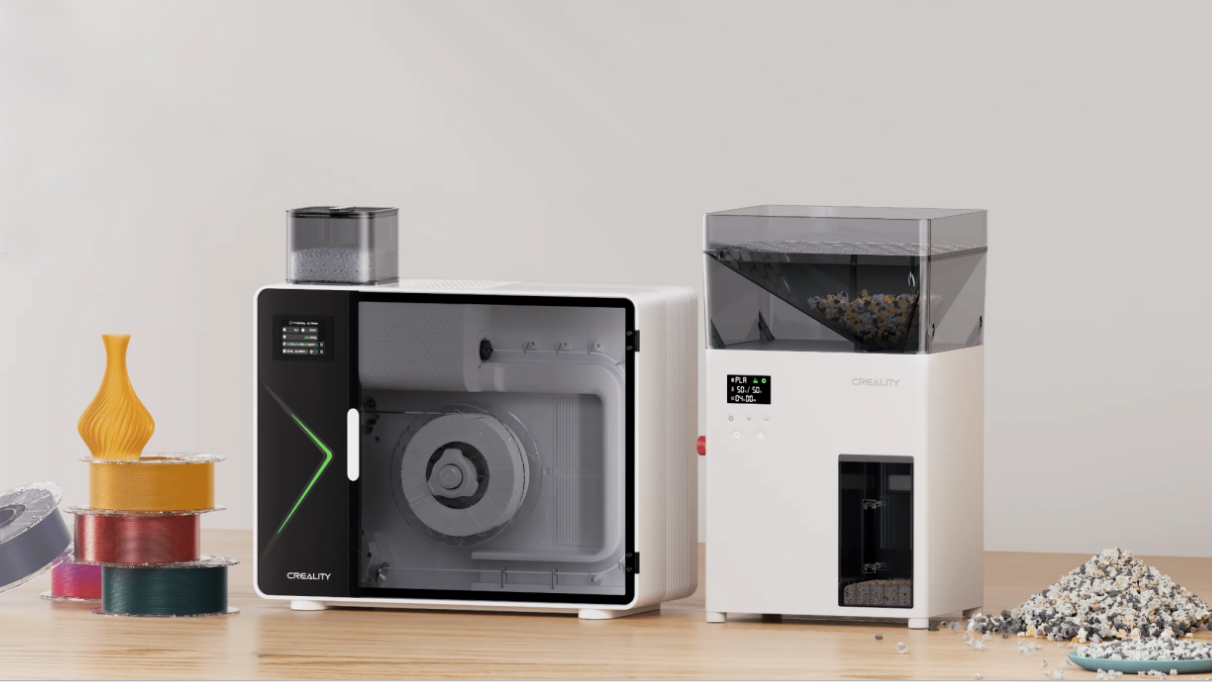
Creality recently announced the Filament Maker M1 and Shredder R1, the first consumer recycling system from a major 3D printing brand. It’s a two-part setup consisting of a grinder to shred and dry 3D printing scraps, paired with a compact desktop extruder capable of producing a one-kilogram spool in about an hour. The two units can be purchased separately, so users who only want to extrude fresh pellets can skip the shredder. Creality claims tolerances as tight as ±0.05 mm with virgin material and ±0.1 mm with recycled grind. This is good enough for most hobby printers, though not quite at the level of professionally made filament.
The M1 is still in the prototype stage. But the product feels like proof that big manufacturers are ready to tackle the filament waste problem for their customers.
LOOP
2. LOOP Desktop 3D Filament Maker
Launching 2026
Price: $100 deposit, Early Bird Price $1,489, Retail Price $2,499
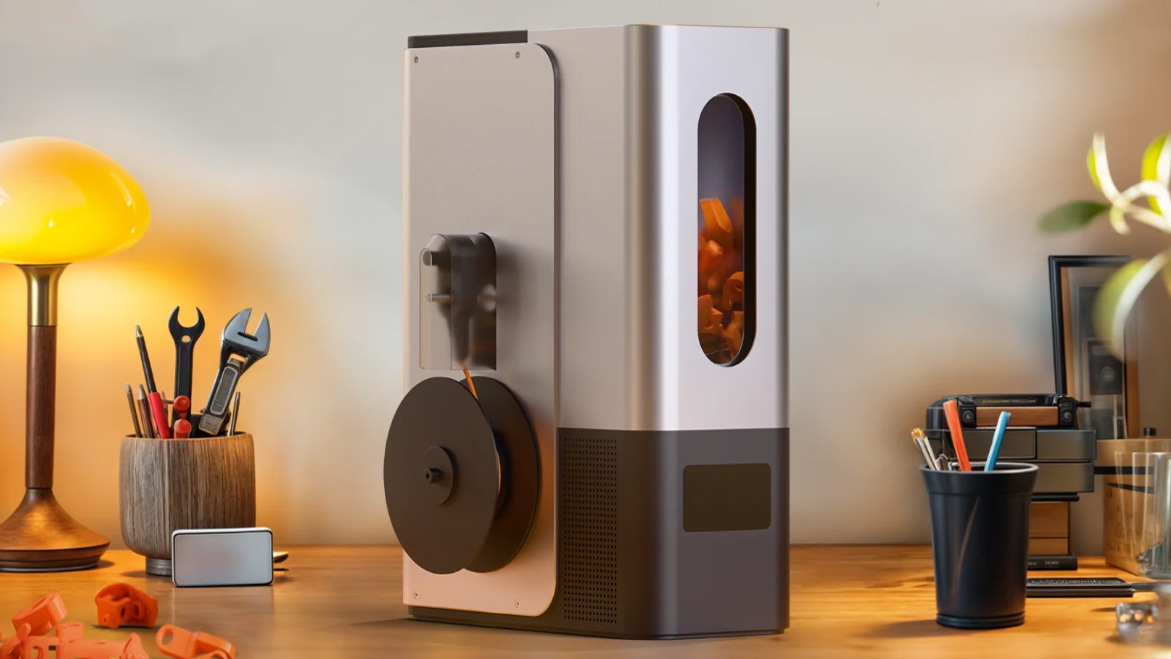
LOOP’s concept is so ambitious that it was called out as a scam by YouTubers shortly after it was announced in 2024. Fortunately, LOOP’s small team of Boston-based engineers responded by posting a demo on YouTube to show off a working prototype.
LOOP is housed in one machine, with a blender-like grinder on one side and a filament extruder on the other. It claims to have a dimensional precision of .01 mm, with a tolerance range of +/- 0.07. Units were supposed to ship in 2025, but the website now promises a 2026 launch date. The project also claims to be Open Source, which may give it a boost in the DIY maker community.
We haven’t heard anything new since October 2024. If you become a backer with a $100 deposit, you’ll get access to a Discord with project updates and photos.
ExtrudeX
3. ExtrudeX DIY Kit
DIY Kit
Price: $59 to $239
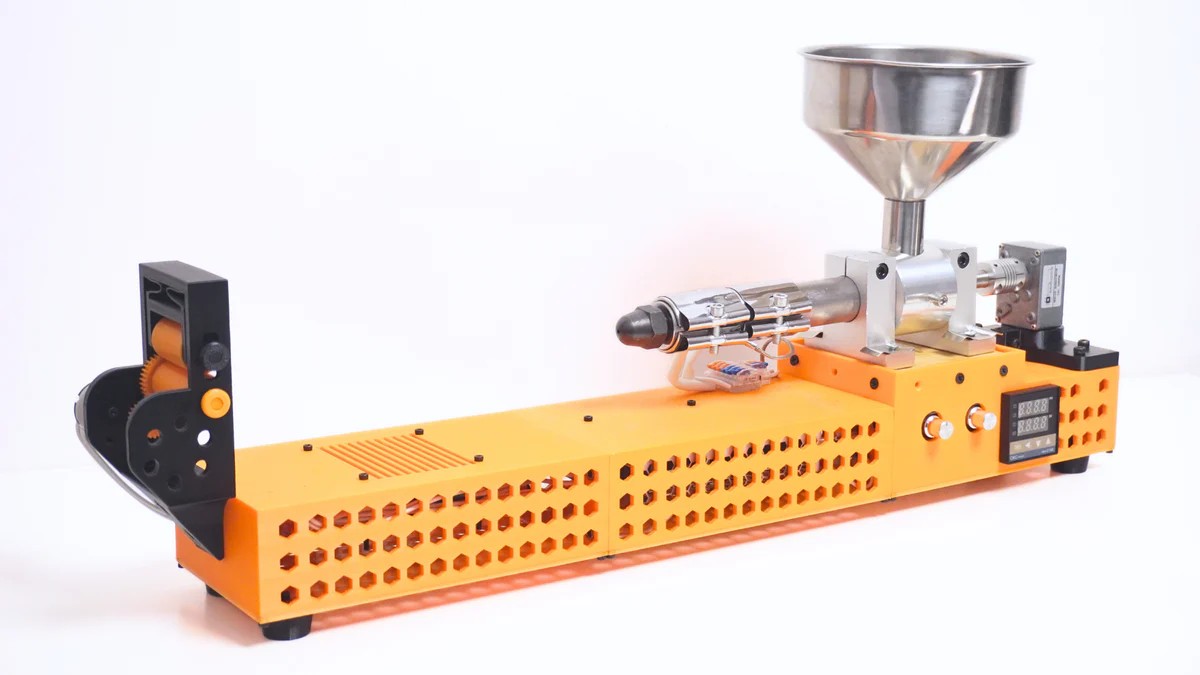
We covered the ExtrudeX while it was a Kickstarter, but now this DIY kit can be yours for just $59, $180 worth of hardware, and a roll or two of ASA. You’ll also need to source your own grinder and a bag of fresh, virgin pellets, as the designer recommends using a 60-40 mix of new to recycled materials.
ARTME 3D
4. ARTME 3D DIY Kit
DIY Kit with printable parts
Price: $770 to $1,056
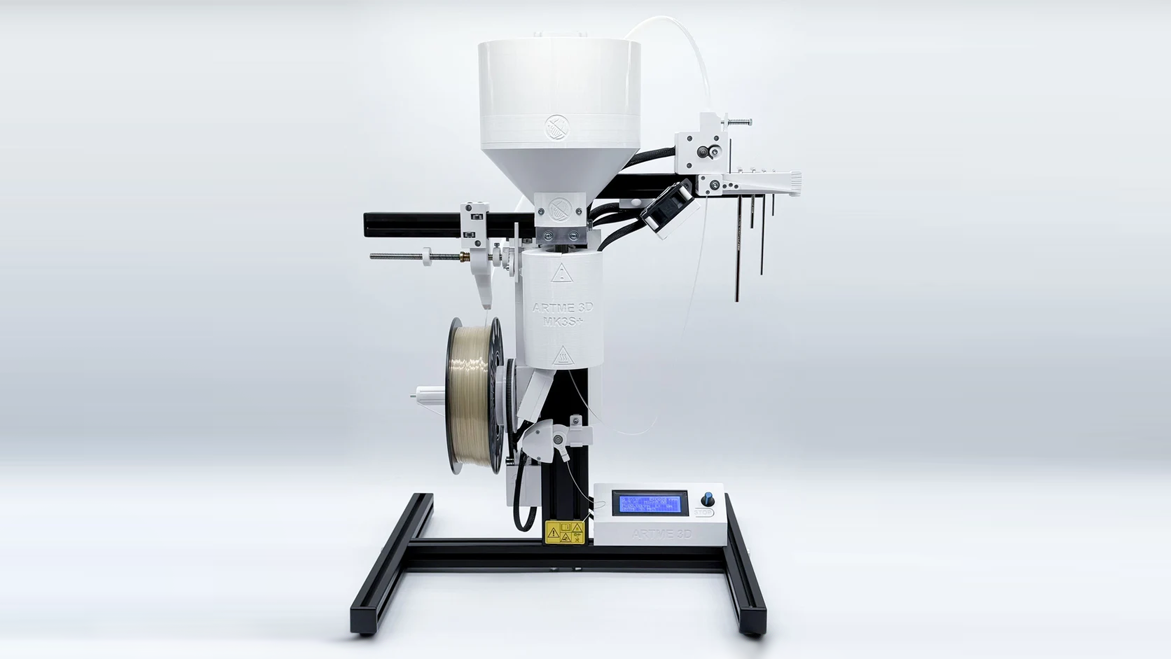
The ARTME 3D is a DIY kit made in Germany for advanced makers. The kit includes printed parts and electronics, but requires 3D printed parts from the user. This is a fully functional machine that was demonstrated by CNC Kitchen in a video back in 2023. It is an open-source design, and with printable parts, it could be refined by a skilled maker.
The ARTME does not come with a grinder or dryer. It can melt PLA well, but users have reported difficulty with PETG.
Felfil
5. Felfil Evo Extruder
DIY Kit or Complete System
Price: $699 to $2,999
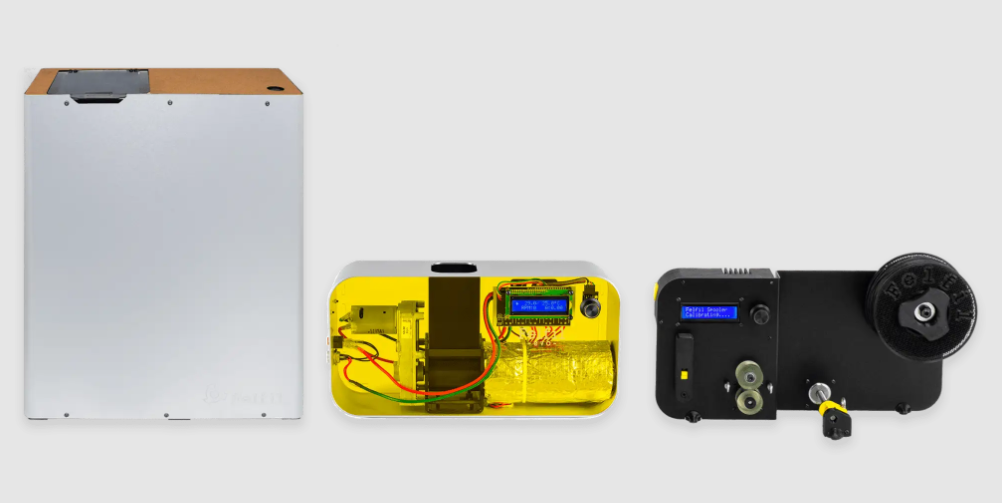
Italy-based Felfil has been in the filament-making space for years with a modular, prosumer system that splits the process into separate tools: the Evo extruder, a spooler, and an optional shredder. It’s popular with universities and FabLabs and aimed at makers who don’t mind tinkering around. The hardware is proven and available today, but it still requires hands-on calibration and careful material prep.
The Bottom Line
Desktop recycling won’t replace industrial systems anytime soon, but it’s no longer just a geeky garage experiment. A few of these machines already work, and more polished options are on the way thanks to companies like Creality. For heavy users and makerspaces, the numbers are starting to make sense today. For everyone else, it’s a sign that the industry is finally taking responsibility for the waste it creates.
If the next wave gets cheaper and easier, your failed prints might become your next spool instead of landfill.
MORE: Best Filaments for 3D Printing
MORE: Best 3D Printers

Follow Tom's Hardware on Google News, or add us as a preferred source, to get our latest news, analysis, & reviews in your feeds.