Thanks to US President Donald Trump's oft-repeated mantra "America First", accompanied by his disdain for and hostility towards globalisation and multilateralism, the rest of the world is perplexed. Some countries on various continents are getting together in like-minded groups that would be able to respond to the inward-looking US policy. East Asia is no exception. Very few countries will be acting alone as the US holds formidable power in the world.
During the Cold War, two superpowers were fighting for supremacy. The US won the endgame. This time, however, it is a different ball game. The jury is still out on whether the US will be able to find a new nemesis as powerful and formidable as the former Soviet Union which kept the world divided for four decades. As a deal maker, Mr Trump needs to win. But to win you need an opponent.
Since November 2017 release of the National Security Strategy, the Trump administration has made clear that China is currently its No.1 strategic rival. It was a nice way to put it. However, just take a close look at the current US-China trade talks and terms of punishments that followed, and the US has treated China liked as its sworn enemy. China has yet to take up the challenge to fight one on one. Obviously, as an early manifestation of America's new policy to counter China's rise, the economic war will continue and soon will morph into something more geopolitical in nature that could last a very long time.
As such, East Asian countries should not sit idle. They need to come together, overcoming their rivalries and past historical bitterness to forge a new relationship that will stand up against "American First". Each country in the region has its own "exceptionalism" which must be accommodated before emergence of combined powers.
Against this background, former Japanese prime minister Yukio Hatoyama was succinct in his keynote speech at the Jeju Forum last week that it is about time for the three Asian economic powerhouses to get their act together and form a bloc to promote peace and prosperity. He said that his own country has been too dependent on the US and now must move closer to South Korea and China.
Mr Hatoyama went so far as to urge his country to apologise to its former colonies. In his view, Japan has not done enough to reconcile with the past. Furthermore, he suggested that an "East Asia Regional Cooperation Council" be set up to take on sensitive issues such as national security, nationalism, the environment, energy, education and culture that bigger organisations such as the UN cannot handle. Later on, he said, regional groups could come together to jointly work out solutions.
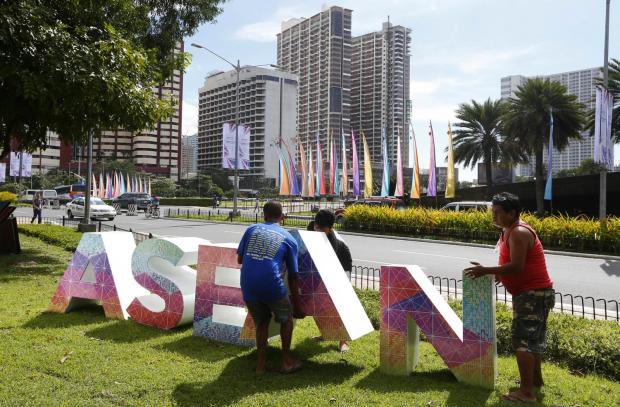
His speech impressed the 3,000-strong audience. Mr Hatoyama's premiership lasted only nine months, from September 2009 to June 2010, a period that saw the deterioration of US-Japan ties. He also said China, Japan and South Korea (CJK) should consider joining the Association of Southeast Asian Nations (Asean), but he did not elaborate. The 52-year-old Asean has 10 members, with East Timor waiting in the wings to become the 11th. CJK are major Asean dialogue partners. Their extensive ties with the bloc are supported in the three countries' capitals by a separate centre with long lists of cooperation projects. The leaders of Asean and South Korea will hold a summit to celebrate their 30-year-old relationship in Busan on Nov 25-26. There will also be a first summit between South Korea and the Mekong riparian countries.
It must be noted that Mr Hatoyama's comments come two decades after Asean helped CJK to institutionalise their relationship -- no more piggy-back rides with the annual Asean ministerial meeting known as the Asean Plus Three. It was during the post-ministerial Asean meeting in 2008 that the three agreed to become an independent forum. A year later in May 2008, the Trilateral Cooperation Secretariat (TRC) was established in Seoul to promote cooperation that would bring stability and prosperity to the East Asian region. Now, the TRC strongly supports globalisation and multilateralism as well as development projects.
The level of CJK cooperation has a great impact on the global economy for three reasons. First, their combined populations account for 20.9% of the global populace. Second, their GDPs comprises 23.1% of the world total, and third, their combined trade equals 18.5%.
At the forum, some academics suggested that to overcome the chilly ties among the three, CJK should adopt the so-called plus X formula to engage the other parties in development projects.
Former world leaders, experts and scholars on East Asia also exchanged views at the forum on hundreds of issues related to peace, resilience and sustainability. They said that CJK could reconcile with the past to cooperate with one another. Former Australian prime minister Malcom Turnbull's views also augured well for the clarion call for a stronger East Asian fraternity. He said that East Asians have to cooperate more closely with one other as their economies are growing rapidly.
However, he warned that strong economies create stronger military and military capabilities. As such, he pointed out, increased wealth creates stronger strategic ambitions with military prowess, which could create potential regional flashpoints.
The East Asian fraternity has been further strengthened by the return of Malaysian Prime Minister Mahathir Mohamad. There were talks about the revival of the East Asian Economic Community, an idea that was promoted by Dr Mahathir in the early 1990s but it was quickly shot down by Washington and it allies, as it excluded the US. Now with the US trying to exclude others and practise only transactional engagements, East Asian solidarity is growing stronger. China has already approached Asean Plus Three members about this turnaround.
Whenever, the future of East Asia is being debated, the dual relationship of Japan-China and Japan-South Korea ties comes up. Without any further reconciliation of their governments and stakeholders, the combined power of CJK, both in economic and political terms, will not materialise.
Kavi Chongkittavorn is a veteran journalist on regional affairs.