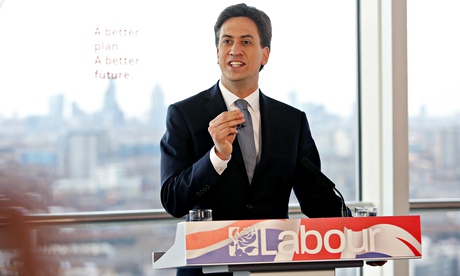
Shortly after the 90-minute Channel 4 and Sky television grilling of David Cameron and Ed Miliband drew to a close on Thursday night, Alastair Campbell tweeted his verdict. “Despite rightwing prism of the evening @ed_miliband nailed it. To those who say I would say that – if he hadn’t I’d have said nothing.”
Campbell is under no illusions about Ed Miliband. He knows he is no Tony Blair. The former spin doctor, who helped deliver two election victories for his boss, has been helping to coach the Labour leader for the television debates over long weekends in country hideaways with a former adviser to President Bill Clinton, David Axelrod, and the progress they had made was said to have been slow.
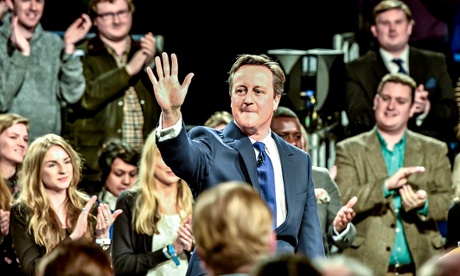
But on Thursday night, something clicked. Miliband not only survived his interrogation by Jeremy Paxman but in the eyes of many of his sternest Labour critics – including senior ones from the Blair days – he outshone David Cameron.
Ever since he became leader in 2010, many, if not most, Labour people from left, right and middle of the party have found themselves unable to get excited about Ed Miliband. On Friday morning, however, in the afterglow of the TV debate, the Labour party woke up more optimistic.
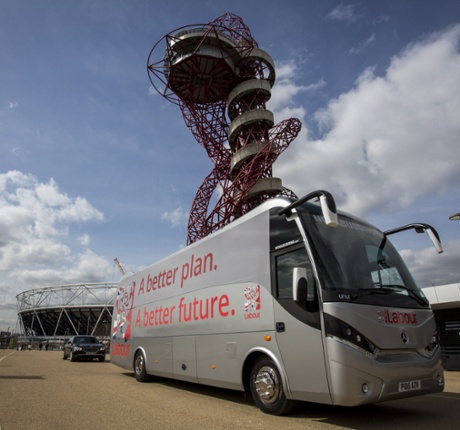
As Miliband and his shadow cabinet launched their party’s election campaign at the top of the country’s tallest sculpture, the ArcelorMittal Orbit which overlooks the Olympic Park, a clearly detectable degree of belief had returned.
Suddenly, Labour looked like an energetic party again. Young men with strong American accents, wearing smart red Labour jackets (were they ground forces jetted in by David Axelrod from the US, people asked?) lined the route to the Olympic Park and directed journalists to the event.
It was upbeat, optimistic, alive. Harriet Harman had to shout above the cheers and whoops as she praised the leader’s “spirit, determination and above all his guts”. Miliband had “defied expectations”, she said, and “put us in touching distance of winning the general election”.
Labour was further boosted by a Sunday Times/YouGov poll showing it on 36% with the Tories on 32%, enough to give it 314 seats to the Tories’ 251. While this would be short of the 326 needed for a majority it could mean Labour would have enough to form a minority government.
On Monday David Cameron will perform constitutional formalities which are not strictly necessary now that we have five-year fixed-term parliaments but which provide a good photo opportunity – one that his PR people will have told him is too good to miss. The prime minister will drive up the Mall, enter the gates of Buckingham Palace at 10am, and seek Her Majesty’s permission to dissolve parliament and call a general election on 7 May. Then, five and a half weeks of campaigning will begin in earnest, in what promises to be the closest and least predictable election in living memory.
With the buoyant Scottish National party on course to take many Labour seats in Scotland, Ukip threatening both Tory and Labour support across the country, the Lib Dem vote likely to fall markedly – in a way that will probably help Labour more than the Conservatives – and the Greens mopping up protest votes particularly among the young, few pundits dare to predict anything other than that we will be left with a very tight result and another profoundly hung parliament.
The polls show Labour and the Tories in a virtual dead heat. Sunday’s Opinium survey for the Observer puts the Tories on 34%, only one point ahead of Labour, which is on 33%. Ukip is at 13%, the Lib Dems 8% and the Greens 7%. However, the Sunday Times poll, taken after the two leaders’ TV interviews last Thursday, was a further suggestion that Labour had received a bounce from Miliband’s performance.
At a series of Westminster drinks parties last week for departing MPs, Labour and Tory members who are standing again were equally anxious and unsure.
A Conservative cabinet minister said he was confident the Tories would be comfortably the largest party on 8 May – winning more than 300 seats – but he was not so sure as to think it would all be plain sailing. “We will no doubt have a wobble,” he boomed. “We always have a wobble. Thatcher used to have what were known as ‘wobbly Thursdays’ when she went into a panic and thought we were going to lose.” At that party he was on the positive end of the Tory spectrum. Some of his colleagues feared Miliband the underdog could come up on the rails.
This weekend, it is Labour MPs who seem a little more perky than their Tory counterparts. It is not that they think they will win a stack more seats than the Conservatives, or that they see a Labour majority in sight. But many MPs and activists feel a sense of uplift following Miliband’s TV performance, which they did not expect a few weeks ago. They are encouraged too by Labour’s resilience in the polls.
One senior Labour figure said: “The Tories said our strength in the polls would dissolve like a lump of sugar in tea. By now, they expected to be well ahead of us. But they are not. We are in this – even if some of us did not expect to be.”
The big question now for Labour is whether it can hold firm in the campaign proper, against the full force of Tory gunfire. The polls may be close at the moment, but will they remain so after the main five-week battle? Financed by their hedge-fund donors, the Tories are pouring money into expensive direct mail and internet campaigns, paying companies to deliver material through letterboxes.
Labour, meanwhile, has received less from the unions than it hoped for and must watch every penny it spends. With cash in short supply, it is relying on the goodwill and energy of activists on doorsteps. During the period from the start of the long campaign last December to 6 May, the Tories are expected to outspend Labour by three to one. A senior figure at Labour HQ said the Conservatives were throwing money at their online operations in a way Labour could not hope to match. Leaked invoices have shown the Tories have been spending about £100,000 a month on getting their material into people’s Facebook accounts since November, in comparison with about £10,000 a month that Labour is able to devote to the same kind of activity.
“It is a massive difference,” said the source. It is what activists call the Tory “air war”, which Labour is trying its best to counter with its own “ground war”. The effects can be seen in every constituency where the two parties are fighting it out.
Last week, the energetic Labour candidate for the marginal west London seat of Brentford and Isleworth, Ruth Cadbury, looked enviously at a pack of slick, glossy leaflets distributed by the Tories and said it was impossible to compete in the same way. “I wish I could produce that kind of direct mail but I simply don’t have the resources,” she said.
Instead, she is toughing it out on doorsteps, standing at school gates most afternoons, distributing her much more modest literature and confronting voters face to face. Hers is an old-fashioned campaign, dictated by financial necessity. The image of this plucky army of volunteers is one that Labour is happy to promote.
“What we are about is real conversations with real people in real places, a national campaign fought locally,” said one activist. In Milton Keynes South, number 69 on Labour’s list of targets, its candidate , Andrew Pakes, says he has more activists than the Tories and Lib Dems put together. One of them is 21-year-old Ellen Goodwin, who is taking time off from her studies at Leeds University to campaign with Labour in her home town. She thinks many of the modern assumptions about political campaigning – that it is all about slick glossies and online communication – are misplaced and that people respond better to conversations on doorsteps.
She accepts that her generation has yet to buy into Miliband but she believes the best chance to win them, and the rest of the electorate, round is in person. “I think things get lost in translation on Twitter and social media,” she says. “It is really important to talk to voters. It is the best way to get the messages across.”
Campaigning in Bletchley on Wednesday, Pakes and his team found it hard going. One of the first to open a door was Terry Keen, a data centre manager. “I can’t stand Ed Miliband,” he said. But there are successes too. In Brooklands Road, 90-year-old Ron Mercer remembers going to public meetings with Aneurin Bevan in the 1940s and thinks Miliband is a worthy leader in the same tradition as the architect of the NHS. He promises to vote Labour. “I like the new leader,” he says. “I think he has done OK and has been unfairly treated.”
On Saturday, as he launched his party’s election campaign in Manchester with the promise to create a “truly seven-day” NHS if the Conservatives are returned to power, Cameron admitted the result was on a “knife edge”.
He coupled his health pledge with another strong personal attack on Miliband, warning that the Labour leader was not up to the demands of running the country. “Now five years in this job teaches you some things. I know what this role needs – and frankly, I don’t think Ed Miliband has it,” he said.
“Some might say ‘Don’t make this personal’, but when it comes to who’s prime minister, the personal is national. The guy who forgot to mention the deficit could be the one in charge of our whole economy.”
It all went down well with grassroots Conservatives. But there is a nervousness spreading in Tory ranks that the election is now little more than five weeks away and yet they are still neck and neck with Labour, whose leader they deride daily. The problem with sustaining that argument is evident to many Conservative MPs. Earlier this year, Cameron’s chief strategist, the Australian Lynton Crosby, told MPs to expect clear and regular poll leads over Labour during March. That hasn’t happened. Now he says he expects them to move into the lead in the last few days of the campaign. There are some concerns that Crosby’s campaign is too focused on the economy and lacks “sunshine” messages. A member of the executive of the 1922 Committee of backbenchers said: “There is no great revolt against Crosby. But there is a feeling that the campaign is too narrow. We need to offer more to people, more hope that the corner has been turned and that there is something at the end of the tunnel for them.”
Tory commentators such as former MP Paul Goodman, now editor of ConservativeHome website – owned by former deputy chairman Lord Ashcroft – believe the Crosby approach may be successful in getting the Tories close to or even across the winning line in terms of winning more seats, but not much more.
“In the short term, this tight and targeted campaign is David Cameron’s best chance of getting to 35%,” says Goodman. “But for the medium and long, a bigger, more broad, more ambitious one-nation appeal is needed to get them north of 40%.”
Matthew Parris, another former MP, now a Times columnist, wrote that in Thursday’s TV grilling Miliband had not fitted the Tory caricature of him. The Miliband who took on Paxman “looked very human – and human without seeming weak or vulnerable”, said Parris. “Moments of passion, idealism and even ferocity in that performance were among his best yet.” Parris said too many voters still believed the Tories “aren’t very nice or sympathetic people”.
Last week, Cameron also revealed that he would not serve a third term as prime minister and named his potential successors as Theresa May, Boris Johnson and George Osborne. His decision to talk about the future at a time when the challenge of winning the election is so immediate astonished Tory MPs. One Conservative source asked whether Cameron was really that interested in politics any more. “Do you think his heart is still in it?”
As the campaign gets under way, Miliband still has much to prove but suddenly he looks the hungrier of the two party leaders, and if that impression sticks, the Tories may well have even more to worry about after 7 May.