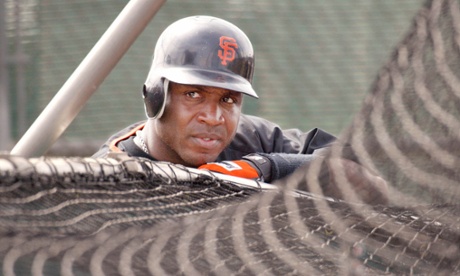
At the end of the 2007 Major League Baseball season, Barry Bonds had 762 home runs ... and counting. Then he couldn’t get a job. Yes, he was old. Yes, he was hated. Yes, his outfield defense was subpar.
Yes, he could hit, and better than most. A lot better.
The all-time and single-season home run leader believes he was systematically kept out of baseball for his links to the Bay Area Laboratory Co-Operative (BALCO) performance-enhancing drug scandal, with the game’s owners binding together with MLB’s brass to keep Bonds from digging into a 23rd big-league season.
Now, according to Jon Heyman of CBS Sports, Bonds is set to hold MLB accountable for what he calls collusion, first via a grievance through the Major League Baseball Players Association, and then possibly through a lawsuit against MLB.
If you get the idea that Bonds has been waiting for this moment for years, that’s because he has. Barry Bonds, owner of a staggering seven MVP awards and one of if not the most destructive offensive forces the game of baseball has ever known, was poised to take on Major League Baseball for colluding against him just months after his final game at-bat on 26 September 2007.
His agent, Jeff Borris, told USA Today in July of 2008:
I am not talking to any club about Barry Bonds because they all made it very clear to me they are not interested in him. ... I can’t believe he doesn’t have a job. No one has offered even the minimum salary. He made the All-Star team last year, and there’s no reason to believe he wouldn’t have a repeat performance in 2008, except for the conspiracy against him.
Then Bonds and his MLBPA reps did a deal with the Commissioners’ Office to forestall any legal action until his trial was over.
Well, just weeks ago, Bonds, who supposedly was none the wiser to the PEDs he was administered while he crushed MLB’s most prestigious power records, made his final escape from the sea of legal issues related to his alleged lies under oath during the BALCO trial. With his conviction for obstruction of justice overturned, Bonds has completely cleared the deck and is ready to put Major League Baseball on trial.
If MLB’s team owners getting together to keep Bonds of the game sounds like a crackpot conspiracy developed by an agent with an agenda and a player with an axe to grind, consider all of the circumstantial evidence the internet has unleashed since the story broke. Bonds hit 28 home runs in less than 400 at-bats at the tender age of 43. His 2007 on-base percentage plus slugging percentage (OPS) was 1.045 – a total that would have nestled him behind National League leader Albert Pujols in 2008. We’re talking about a player whose intentional walks matched his years, during that final season.
Regardless of how the public, other players and owners hated the aging Bonds for his role of poster child in poisoning the statistical pool, not to mention Barry being Barry, in a competitive environment, how is it possible that a player of that skill set is completely ignored, especially when made overtures about playing for the league minimum?
As usual, in baseball these days, we look to Alex Rodriguez for insight.
Former commissioner Bud Selig and MLB showed that their desire to take down A-Rod for his role in the Biogenesis PED scandal knew no bounds, with the league reportedly going as far as buying stolen documents for $125,000 in pursuit of evidence linking clinic owner Anthony Bosch to A-Rod’s use of PEDs. MLB had to be hoping that after double surgeries on his hips and a year on the sidelines, his year-long suspension would force him out of the game at best, or out of the limelight at least.
“One would have to assume with Major League Baseball’s recent attempts to eradicate Alex Rodriguez from the game then perhaps the same thing has happened to Barry Bonds,” said Marc Edelman, Law Professor and Sports Scholar at the Zicklin School of Business at Baruch College. “But rather than doing it through the legal collective bargaining process, Bonds believes his eradication from baseball was handled through a covert, collusive process, that violated the collective bargaining agreement.”
So, as the theory would go, booting Bonds out of baseball would be much easier than the work it took to discipline A-Rod, who still was under contract after his suspension – management would convince teams not to sign him (it takes just two teams to collude), effectively banning him from the game – that’s exactly what Bonds believes took place.
It would not be the first time MLB were found guilty of colluding against a player. From 1985 through 1987, the league was found guilty in three separate judgements, forcing payouts of of $280m and an agreement that any future judgements against MLB would carry a penalty of triple the damages.
That means if Bonds can convince an arbitrator that MLB violated the CBA, he could possibly have one last big league payout ahead of him. Does he have a case? Well, union general counsel Michael Weiner, who passed away in 2013, said in October 2008:
“Our investigation revealed a violation of the Basic Agreement. It’s a violation of the Basic Agreement related to Barry Bonds and free agency.”
Since then, it’s very possible that more information could have been gathered against MLB. It’s also possible that Bonds could win a judgement with limited evidence, according to Edelman.
In rare cases, collusion can be shown based upon evidence that absence of collusion, such a result would be, in essence, impossible to have occurred.
In the context of 2015, where meek offenses are whipped by pitchers on a daily basis, it’s pretty hard to imagine a player with his offensive capabilities being completely ignored. Now, Bonds is at the plate with one final at-bat to prove he was forced into retirement.