OSAKA -- With outdoor recreational activities becoming more popular, the number of people using mountain climbing and camping equipment as a part of their emergency kits is increasing.
The reason these types of equipment are becoming more popular is because of their lightweight and compact design. Some stores specializing in outdoor equipment have set up a section to display equipment that can be used during an emergency. There are also workshops held to teach people how to survive in the event of a disaster.
-- Emergency goods department
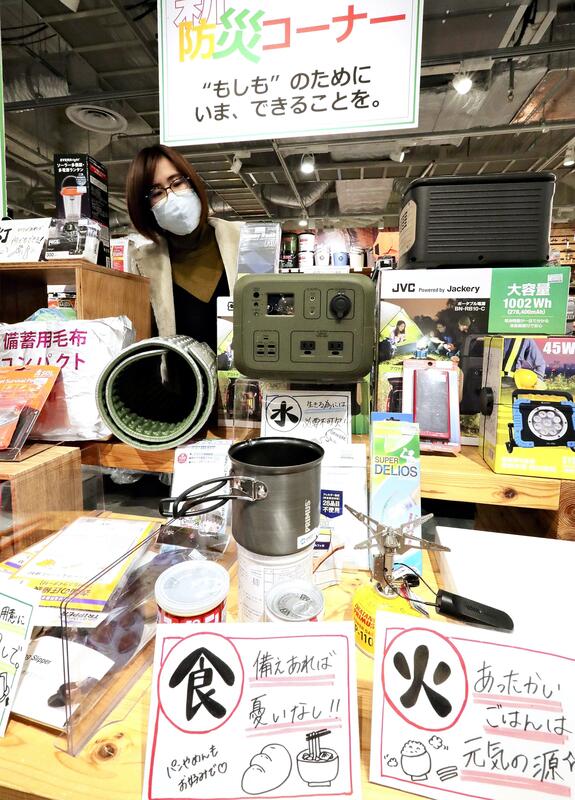
Inside an Ishii Sports Co. store that sells mountaineering and skiing equipment in Links Umeda in Kita Ward, Osaka, a section has been set up to display goods that can be used in the event of a disaster. First-aid kits by The North Face, lanterns and other lighting equipment by Logos, plus emergency food, gas burners and a portable power source by about 30 other brands are being sold. The section was set up for six months last year, and the store received positive feedback from its customers. As a result, it plans to keep the section throughout the rest of 2021.
One of the customers, Ryoichi Narita, 65, a company employee from Nishinomiya, Hyogo Prefecture, has always been prepared for a disaster because mountain climbing is his favorite hobby and he has hit equipment ready to go.
"My headlamp leaves my hands free, and my gloves protect my hands from the cold," Narita said. "[The equipment] is light, easy to carry and is highly functional."
-- Prompted by tsunami
Outdoor equipment manufacturers have begun developing goods that are meant to be used during a disaster. Mont-Bell Co., a leading manufacturer of outdoor equipment based in Osaka, has provided or lent tents and sleeping bags to disaster-hit areas since the 1995 Great Hanshin Earthquake.
Prompted by the damage caused by the tsunami during the Great East Japan Earthquake in 2011, the company developed a "U Cushion" (floating vest), which costs 5,238 yen including tax. The item can normally be used as a cushion, but it can then be converted into a life jacket in an emergency.
Mont-Bell has also developed "RISOTTa," a freeze-dried risotto that can last for more than five years. The emergency food costs 421 yen including tax.
"Emergency-preparedness goods were selling well, especially around January and March, when the major earthquakes occurred, and around Sept. 1, which is Disaster Prevention Day," an official in charge said. "But lately, they have been selling well all year round."
-- Getting hands-on experience
When the Great East Japan Earthquake occurred, many people needed to learn how to make a fire to cook, set up a tent and keep themselves warm. As a result of that event, workshops are being held nationwide to teach people how to survive during an emergency, using mountain climbing or camping equipment.
Sunny Side Outdoor School, which is based in Fujinomiya, Shizuoka Prefecture, allows customers to try outdoor recreational activities. In 2019, it started a course in which participants learned to make a fire and cook rice using an empty can at a campsite.
"With a massive earthquake expected to occur in the Nankai Trough in the near future, a tsunami-induced disaster is highly likely to occur," said Hirokazu Nagata, 52, chief director of Plus Arts, a nonprofit organization that holds classes on disaster preparedness based in Kobe. "As the world has become more convenient, our ability to survive has degraded, making it necessary for us to relearn how to take care of ourselves in the event of a disaster."
Read more from The Japan News at https://japannews.yomiuri.co.jp/