Running for election is said to be costly, but the reality of campaign expenses can be hard to see.
Anri Kawai, 46, was elected to the Diet for the first time in the July 2019 House of Councillors election but was later indicted on the charge of violating the Public Offices Election Law. In a large-scale vote-buying scandal involving Kawai, what drew attention was financial assistance totaling about 150 million yen offered to her camp by the headquarters of the ruling Liberal Democratic Party. However, the amount of campaign expenses reported by the lawmaker was only about 26 million yen. Behind this is lack of clarity is the current system that vaguely defines "election campaign" and "political activity."
-- Prior to campaign
"The top priority was to raise the candidate's profile prior to the election," said a secretary of a lawmaker who was first elected in the July 2016 upper house election.
The lawmaker obtained their political party's endorsement about six months before the election. From that point until the official campaign kickoff, a total of about 7 million yen was spent, including: about 3.5 million yen for creating membership application leaflets for the supporters' association; about 1 million yen for the party's bulletin featuring the lawmaker; and about 900,000 yen for signboards. With labor costs, expenses for printing the bulletin that were paid by the party, and other costs, total election expenses amounted to some 50 million yen.
However, the campaign expenses reported by the lawmaker to the election administration commission were only about 20 million yen. This is because expenses that have to be reported to the commission are limited to those spent during the campaign period, in principle. Expenses incurred before the campaign kicks off are supposed to be reported as political activity expenses in political funds reports submitted by political organizations.
The official campaign period is usually 12 days for the House of Representatives and 17 days for the upper house. A former secretary of a lower house member clearly said, "Between 80% and 90% of election results are determined before the campaign officially kicks off." Even so, expenses spent before the campaign period are not included in campaign expenses.
-- No substance to upper limits
The Public Offices Election Law caps campaign expenses so that a candidate's financial power will not determine the results. While the upper limit differs depending on the number of seats appointed to the electoral district, the number of eligible voters and other factors, the limit in electoral districts is said to be about 25 million yen for lower house elections and about 30 million yen to 60 million yen for upper house elections.
According to the Internal Affairs and Communications Ministry and others ources, the average spend by electoral district candidates in the 2016 upper house election was about 16 million yen among 48 official LDP candidates and about 13 million yen among 33 candidates endorsed by the then Democratic Party, the largest opposition party at that time.
However, the reality is different. Quite a few people related to politics believe that LDP candidates in upper house elections need 50 million yen to 100 million yen on average. A source close to the Nagatacho political district who is familiar with election issues said, "First-time candidates with a low profile need more money to promote themselves to many unspecified voters."
For the 2019 upper house election, it was decided in March to field first-time candidate Kawai as the second official LDP candidate in the Hiroshima electoral district. After that, a total of 150 million yen was offered to her camp by the LDP headquarters, an amount that is said to be 10 times the average. With that, Kawai carried out an "extraordinary" election strategy, as a former member of the Hiroshima prefectural assembly put it, in both qualitative and quantitative terms, starting before the campaign kicked off.
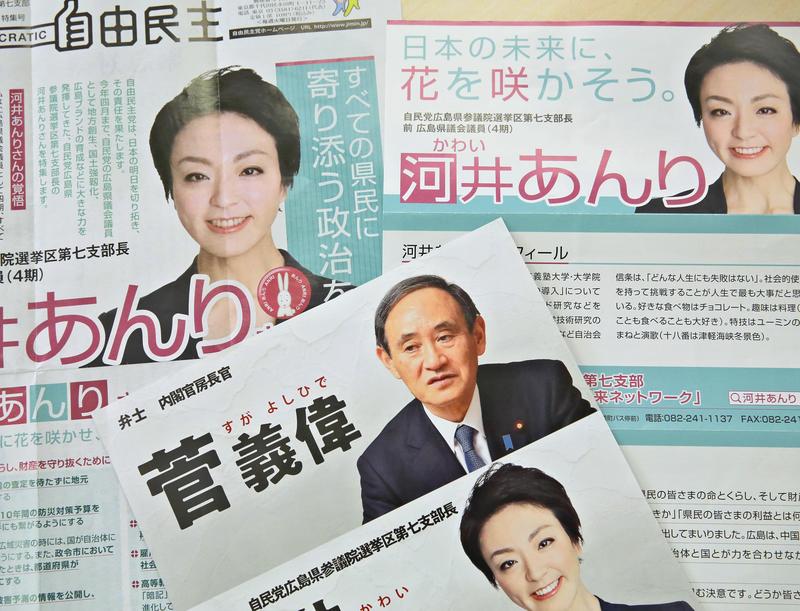
In Hiroshima Prefecture, which has about 1.2 million households, flyers were distributed to all households four times. This reportedly costs more than 10 million yen each time. Furthermore, about 2,000 posters of Kawai standing with Prime Minister Shinzo Abe were put up around the prefecture, which is said to be twice as many as usual. These expenses were not included in campaign expenses but will be reported in a political funds report to be released by the end of November.
Takashi Tomizaki, professor of political studies at Komazawa University, said, "All political activities can be regarded as election campaigning, and so it is essentially impossible to strictly separate the two. The upper limit on campaign expenses deviates from the reality. In order to make them more transparent, it is necessary to create a system that allows us to conduct validation and examination easily, such as having politicians report expenses for both activities in a single political funds report and making them available online quickly on the occasion of elections."
Read more from The Japan News at https://japannews.yomiuri.co.jp/