Afternoon summary
- David Cameron has announced that he has yet to decide whether to impose collective responsibility on ministers in the referendum on Britain’s EU membership, saying it would be a step-by-step process. As Patrick Wintour reports, the prime minister said his remarks in Bavaria on Sunday had been misinterpreted by a series of newspapers, including the Guardian, which reported overnight that ministers would have to leave the government if they opposed his new EU settlement. Speaking at a press conference on Monday afternoon, the prime minister said: “It is clear to me that what I said yesterday was misinterpreted. I was clearly referring to the process of renegotiation and am happy to repeat exactly what I said yesterday.
- Andy Burnham, the favourite for the Labour leadership, has warned the party should be careful not to distance itself from everything it has stood for in the last five years at a hustings for the parliamentary party. As Rowena Mason reports, Burnham spoke at the meeting alongside the shadow home secretary, Yvette Cooper, shadow care minister, Liz Kendall, shadow development secretary, Mary Creagh, and leftwing backbencher Jeremy Corbyn, as MPs make up their minds about who to support for the leadership. According to people present at the private meeting, there was a clear contrast between the positions of Burnham, and Kendall, cast as the Blairite candidate, while Cooper made her pitch as the most experienced, safest choice. George Eaton has his own write-up at the Staggers.
- The G7 leading industrial nations have agreed to cut greenhouse gases by phasing out the use of fossil fuels by the end of the century, the German chancellor, Angela Merkel, has announced. As Kate Connolly reports, on the final day of talks in a Bavarian castle, Merkel said the Group of Seven leaders had committed themselves to the need to “decarbonise the global economy in the course of this century”. Environmental lobbyists described the announcement as a hopeful sign that plans for complete decarbonisation could be ruled on in Paris climate talks later this year.
That’s all from me for today.
Thanks for the comments.
As Tim Shipman said earlier (see 3.29pm), blaming the press is never a wise move for a politician (even when it is justified, which in this case it isn’t.)
New definition for 'misinterpreted': I screwed up, but it's your fault #G7 #journalese
— Tom Newton Dunn (@tnewtondunn) June 8, 2015
Here is a Guardian video of Cameron at his press conference insisting he was mis-interpreted.
At his press conference, David Cameron told the journalists that, if they were ever not clear about anything, they should just ask. As Guido Fawkes points out, that would be a lot easier if he held regular press conferences.
(Cameron only routinely holds press conferences now when he goes to international summits, where leaders are expected to brief the media when the talks wrap up. Press conferences at Number 10 have become exceedingly rare.)
And here is some more Twitter reaction to David Cameron’s news conference.
From 5 News’s Andy Bell
this is the most uncomfortable Cameron has looked since the election #EURef
— Andy Bell (@andybell5news) June 8, 2015
From the Daily Mirror’s Jason Beattie
Quite a performance by Cameron. Shame he missed Tony awards by 24 hours, would have been shoe-in for Best Actor in a comedy or farce
— Jason Beattie (@JBeattieMirror) June 8, 2015
From the Independent’s Nigel Morris
Exchanges between Cameron and journalists at G7 press conference were pretty tetchy....PM's post-election honeymoon is fast wearing out
— Nigel Morris (@NigelpMorris) June 8, 2015
From Sky’s Faisal Islam
Not just Cameron suffering from G7 alpine fog... Obama too facing questions over reported words on the "strong dollar" at this summit
— Faisal Islam (@faisalislam) June 8, 2015
From the Guardian’s Rafael Behr
Cameron buying time saying wants good EU deal that can recommend to British people. Can safely bet he will also say he has achieved that ..
— Rafael Behr (@rafaelbehr) June 8, 2015

Updated
The Sunday Times’s Tim Shipman has posted his reflections on David Cameron on U-turn. I’ll quote them in full because they’re shrewd.
Many of the Cameron governments problems occur when journalists write down what he says and put it in their newspapers... @jameskirkup
— Tim Shipman (@ShippersUnbound) June 8, 2015
1) This shambles goes back 3 yrs when No 10 briefed that ministers wd be free to campaign for Out + DC told cabinet next day they wouldn't
— Tim Shipman (@ShippersUnbound) June 8, 2015
2) Many around Cameron think it will end up as a free vote but he wants to keep that concession in the locker a while longer
— Tim Shipman (@ShippersUnbound) June 8, 2015
3) Also PM looks at who might resign and wonders whether he might like a way of getting rid of some of them without even trying
— Tim Shipman (@ShippersUnbound) June 8, 2015
4) Yes the lobby interprets shifts in language, but DC was signalling no free vote yesterday, not by mistake but because that's his position
— Tim Shipman (@ShippersUnbound) June 8, 2015
5) Cameron, particularly abroad, is not always as precise in his language as he might be, but this morning's explanation is made up
— Tim Shipman (@ShippersUnbound) June 8, 2015
6) Throughout his leadership Cameron's worst trait has been party management. Nothing has changed.
— Tim Shipman (@ShippersUnbound) June 8, 2015
7) Blaming the press for your own mistakes is never a smart move
— Tim Shipman (@ShippersUnbound) June 8, 2015
8) Sunday journalism is more fun than daily journalism. Except when there is a shambles on a foreign trip. #nostalgic
— Tim Shipman (@ShippersUnbound) June 8, 2015
In summary: Cam's position is no free vote so he thought nothing of saying so, misunderstanding how controversial that is with the 50 outers
— Tim Shipman (@ShippersUnbound) June 8, 2015
The Mail’s Matt Chorley has done a good job refuting David Cameron’s claim that the media ignored his comment to Andrew Marr in January about ministers facing the sack if they wanted to campaign against EU membership. (See 3pm.)
Cameron claims no-one reported in January that he would sack ministers. Not true pic.twitter.com/eSy5cU36rn
— Matt Chorley (@MattChorley) June 8, 2015
Across the board papers reported in Jan after Cameron's Marr interview that he threatened to sack anti-EU ministers pic.twitter.com/DllMGsADSQ
— Matt Chorley (@MattChorley) June 8, 2015
David Cameron's press conference - Summary
Here is a summary of the main points from David Cameron’s press conference.
-
David Cameron has blamed a “mis-interpretation” for the fact that news organisations reported him this morning as saying that ministers would be sacked if they campaigned for Britain to leave the EU. Repeating the line used by Number 10 earlier, he said that he was only saying ministers had to abide by collective responsibility now, during the renegotiation process. Asked if ministers would be allowed to campaign against the government line during the referendum, he said that this was “hypothetical” and that he would address this issue at the time.
It is clear to me that what I said yesterday was misinterpreted. I was clearly referring to the process of renegotiation. But the point is this. I have always said what I want is an outcome for Britain that keeps us in a reformed EU. But I have also said we don’t know the outcome of these negotiations, which is why I have always said I rule nothing out.
Therefore it would be wrong to answer hypothetical questions. I know that can be frustrating. I know you want to jump to the end of the process and have all the questions answered now about the end of that process. That is not going to be possible. You are going to have to take this stage by stage, step by step and you will get the answers.
Asked why he told Andrew Marr in January that he was not going to allow ministers a free vote, he said that Marr was interrupting him so much that his comments were not clear.
-
Cameron has rejected claims that the Conservative party is as split over Europe as it was in the early 1990s. The party backs his approach, he said.

Updated
And that’s it. The press conference is over.
That was not one of David Cameron’s happier encounters with the media.
When David Cameron starts having to blame Andrew Marr’s loquaciousness for Tory turmoil over Europe, you know he’s in trouble.
I’ll post a summary shortly.
Q: Did you mis-hear the question yesterday? You were asked about the referendum.
Cameron says he has repeated again what he said. He does not have anything to add.
Q: You said the government will have a view in the referendum. If ministers cannot support the government view, will they have to resign?
Cameron says that is hypothetical. We have not got to that point yet. If we do get to that point, he will address the question then.
Q: You have missed out the part in the Marr transcript when you said there would not be a free vote. And you said yesterday the government would not be neutral. So how could ministers have a free vote?
Cameron says this will be a big issue for Britain. The government will have a clear view.
On Marr, he says the only completed sentence was the one he read out earlier. See 2.58pm. If people thought that was significant at the time, they should have said so.
Q: America is talking about Britain withdrawing from the world. Will you keep defence spending at 2% of GDP?
Cameron says he has kept it at that level in every year he has been prime minister. He does not accept that Britain’s role in the world is shrinking.
Q: You were very explicit on the Andrew Marr show (see 12.34pm) in January that there would not be a free vote for ministers. Will you re-state that. If you can’t, that’s a sign of weakness.
Cameron says, when he was on Marr, he was interrupted so much that it is hard to know what he did say. But he reads out the quote about “if you’re part of the government, then clearly you’re part of the team that is aiming for the renegotiation”. That is almost exactly what he said yesterday, he says.
(Cameron has ignored a key part of the Marr transcript. See 12.34pm.)
Cameron is now taking questions.
Q: When will collective responsibility apply over the EU?
Cameron says what he said yesterday was misinterpreted. He offers to read his quote again. (See 1.01pm.) He does not want to speculate about the outcome of the negotiation, because it is not over yet.
Q: The reaction has shown how fractitious your party will be. This is the 1990s all over again, isn’t it?
Cameron says he does not accept that. The party supports his approach.
He says when he read today’s papers he thought there had been a “mis-interpretation”.
Cameron says, fresh from the election, he was about to show that “Britain is back”. Britain is playing a leading role in delivering prosperity and security, he says.
On security, Cameron says the G7 discussed measures to combat Islamist extremism.
Updated
David Cameron's press conference
David Cameron is starting his press conference with an opening statement.
He says at home his priorities are security and boosting growth. The same two priorities dominated the G& summit too, he says.
On the subject of promoting growth, he says he pushed for progress in three areas: fighting corruption, securing trade deals and encouraging green growth.
Every day we wait for the US/EU trade deal costs the world £630m, so they are pushing for a deal in the next six months, he says. And they discussed an EU/Japan trade deal.
Here is a link to the G7 communique.
Take a look at the #G7 communique for yourself: leaders endorse” 40-70% reductions by 2050 compared to 2010 levels -https://t.co/5cJRGZvLet
— Road Thru Paris (@RoadThruParis) June 8, 2015
David Cameron is just about to hold his press conference at the G7 summit.
There will be a live feed here.
This is what the G7 communique says about extending sanctions to Russia.
No surprise, but #G7Summit communiqué makes clear #EU will extend its sanctions vs #Russia. http://t.co/g1VdV2KaAf pic.twitter.com/m1fnRJ0nwL
— Peter Spiegel (@SpiegelPeter) June 8, 2015
Q: What did you agree about Ebola research?
Merkel says, with diseases like this, there is often a problem of logistics. Medicines are available, but it is hard to distribute them.
The leaders discussed the need to share more information about research.
Q: Did you discuss how you could tighten sanctions on Russia? And did you talk about Russian fighters invading the airspace of EU countries?
Merkel says the second issue was not discussed.
On sanctions, she says they agreed to maintain the current approach.
Turning away from the Merkel press conference for a moment, this is what Philip Webster, the former Times political editor, is saying about Number 10’s claim that David Cameron was “over-interpreted” yesterday. Webster does not accept this. In his Red Box briefing, he says Cameron backed down.
When Wilson allowed his ministers to campaign both ways there were at least half a dozen ministers, the likes of Tony Benn, Peter Shore and Barbara Castle, who would have resigned if he had not done so.
Observers have suggested that Cameron is in a stronger position than Wilson was then. But is he really? His majority is only 12 and there may be up to half a dozen of his ministers who would rather quit than back a deal they did not like. People like Michael Gove, Philip Hammond, Theresa May and Iain Duncan Smith come to mind.
This episode, which is continuing, shows just how hard it is all going to be. It appears that Cameron has backed off at the first real sign of trouble. If so, that will embolden the sceptics, not deter them.
Q: Did Fifa come up?
Only when David Cameron said that corruption did not just come up with Fifa, Merkel says. Cameron said corruption undermined faith in state organisations, and that this helped terrorism.
Q: What about TTIP?
Merkel says President Obama said he would fast-track this through Congress. She says in Europe countries want this agreement. There are difficulties for the European, for example on arbitration courts. But the Americans have problems with some aspects too. We said we wanted a successful agreement by the end of the year.
Updated
Q: Would you invite countries like Australia and India to attend the G7?
Merkel says other important economies are represented at the G20. But they are not thinking of changing the format. Leaders were pleased with the format here, she says.
Q: What are your plans for Greece and the eurozone? Would you follow the Lehman Brothers solution?
Merkel says it is not the same as Lehman Brothers. And she says they did not talk much about Greece.
She says she wants Greece to remain part of the eurozone.
But Greece will have to implement new measures.
And there is not much time left, she says.
She will discuss this at a summit in Brussels with the Greek prime minister later this week.
Merkel's Q&A
Angela Mekel is now taking questions.
Q: Will Russia ever come back to the G7/G8?
Merkel says the G7 leaders did not talk about Russia a great deal. There are formats that allow the G7 countries to speak to Russia, she says.
G7 agrees decarbonisation of global economy over course of century & global reduction in carbon emissions in upper end of 40-70% by 2050.
— Patrick Wintour (@patrickwintour) June 8, 2015
Angela Merkel's press conference
Angela Merkel is holding her press conference at the G7 now.
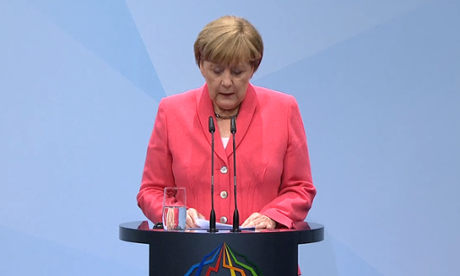
There is a live feed with an English translation here.
Updated
Here is the “team photo” from today’s G7, with the G7 leaders plus leaders from other countries who were invited for an “outreach meeting”.

My colleague Patrick Wintour was there when David Cameron spoke to reporters yesterday. Here is his take on whether or not Cameron’s comments were “over-interpreted” (see 12pm and 1.01pm.)
Was at Cameron briefing. Things get lost in translation but when has collective ministerial responsibility re EU renegotiation been at issue
— Patrick Wintour (@patrickwintour) June 8, 2015
#G7 communique also threatening #Russia w harsher sanctions if situation in #Ukraine continues to escalate reports @dpa
— Kate Connolly (@connollyberlin) June 8, 2015
My colleague Kate Connelly has been tweeting from the G7 summit, where Angela Merkel, the German chancellor and summit host, is about to hold a press conference.
While the world is shut out of #G7 talks it's left to this #AFP picture to tell real story #EveryPictureTellsAStory pic.twitter.com/QpeQZyinHo
— Kate Connolly (@connollyberlin) June 8, 2015
Reports coming of #G7 leaders having agreed on 2deg #climate goal & by latest 2050 use of fossil fuels - coal & oil - to be sharply reduced
— Kate Connolly (@connollyberlin) June 8, 2015
Here are the G7 leaders posing for their group photograph.
Sky’s Faisal Islam has posted the transcript of what David Cameron said to reporters yesterday about collective responsibility during the referendum.
Here the official transcript of the words that @Number10gov say were "overintrepreted" re sacking ministers over EU: pic.twitter.com/Ta46Ay02V1
— Faisal Islam (@faisalislam) June 8, 2015
David Cameron’s words are open to the interpretation that Downing Street is putting upon them (see 12pm), but, given that Cameron was specifically asked about allowing ministers a free vote, it was entirely reasonable for reporters to conclude that he was ruling this out.
And, if it was just an honest misunderstanding, Number 10 would have been expected to clarify this earlier. After all, it is not as if the newspapers buried the story.
TELEGRAPH: Cabinet told: vote for Europe or resign #tomorrowspaperstoday #bbcpapers pic.twitter.com/Q4NfZsOYSU
— Neil Henderson (@hendopolis) June 7, 2015
MAIL: PM: Back me or I will sack you #tomorrowspaperstoday #bbcpapers pic.twitter.com/pN5Qak306R
— Neil Henderson (@hendopolis) June 7, 2015
GUARDIAN: PM: I will sack ministers who call for EU exit #tomorrowspaperstoday #BBCPapers pic.twitter.com/K9qPdCW72x
— Neil Henderson (@hendopolis) June 7, 2015
The Mail is writing this up as David Cameron’s EU reform plans being “in chaos”.
One furious Tory MP on EU sack/don't sack confusion: 'They must make up their f***ing minds.' http://t.co/h4qjxs1YLj pic.twitter.com/s9FSrQ8JmS
— Matt Chorley (@MattChorley) June 8, 2015
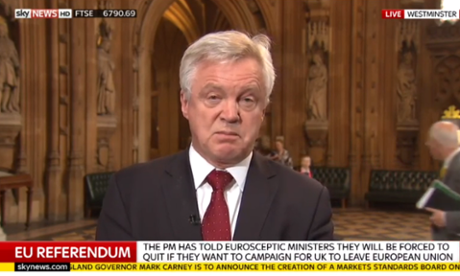
David Davis, the Eurosceptic Conservative MP, has just given an interview to Sky News saying he welcomes Number 10’s clarification about David Cameron’s stance on ministers who campaign against membership of the EU. But it did not go far enough, he said. He restated his call for ministers to be allowed a free vote. (See 9.10am.) He said:
It is vital that ordinary, decent honourable members of the government, ministers in the cabinet or junior ministers, are allowed, as everybody else is, to vote the way they want, to speak the way they want, to campaign the way they want. Sure, they should wait til after the negotiations are complete. That’s when they know what the deal will be. But it should be made very, very clear indeed that after that point they are free men and women to vote the way they want ...
The point of the referendum is that it is not the government making the decision, and therefore not the prime minister making the decision on what’s good enough and what’s not good enough. A referendum allows the whole people to make that decision, and that should include everybody, including ministers in government.
The Spectator’s James Forsyth has got a compromise solution if David Cameron does not want to let ministers campaign for Britain to leave the EU, but does not want to sack them either.
Challenge for Cameron isn't just 'winning' EU referendum, but keeping Tories together over the issue. One option short of suspension of 1/2
— James Forsyth (@JGForsyth) June 8, 2015
Alternative to suspension of collective responsibility is 4 ministers to resign to campaign for out, but not to be replaced and return after
— James Forsyth (@JGForsyth) June 8, 2015
A week tomorrow (Tuesday 16 June) Guardian events are hosting a debate in the Guardian Newsroom on what Brexit would mean. It will be hosted by Jonathan Freedland and the panel will include foreign affairs commentator Natalie Nougayrède, economics editor Larry Elliott and chief political correspondent Nicholas Watt.
Full details, including information about how to buy tickets, are available here.
One reason why Number 10’s claim that David Cameron’s comments yesterday were “over-interpreted” was failed to convince journalists is that Cameron was just re-stating something that he said earlier this year, on the Andrew Marr show (pdf).
In January Marr asked Cameron if he would give Conservative ministers the freedom to campaign for Britain to leave the EU in the propose referendum.
Cameron replied:
Well, there are Conservative Members of Parliament who want the leave the European Union come what may, but if you’re part of the government, then clearly you’re part of the team that is aiming for the renegotiation.
Marr then asked for clarification. “So you’re not going to do a free vote, as Labour did in the 1970s?”
Cameron repled:
No, I’ve set out that very clearly in the past.
If you want to understand why Number 10 decided to withdraw - at least, for now - the threat to sack ministers who campaign for Britain to leave the EU, Nicholas Watt’s interview with the former Tory chief whip Andrew Mitchell helps to provide some context.
Mitchell said trying to enforce collective discipline on this would be a mistake. He told the Guardian:
My strong advice to the prime minister would be to let ministers campaign and vote as their conscience and their convictions dictate. Not to do so will put too much pressure on the parliamentary party and the lid could blow off.
Having been through the ghastly experience of the Maastricht era, 1992-95, when the Conservative government whips’ office kept the show on the road, I bear the painful marks of that era.
The prime minister’s official spokeswoman was conducting the Number 10 lobby briefing from the G7 summit in Germany, but reporters like me in London were able to participate via a conference call.
The spokeswoman said that David Cameron’s comments when he spoke to journalists yesterday were “over-interpreted”. She said that there were two stages in this process, the renegotiation process and the referendum. She said that what the prime minister said about ministers having to resign if they did not support the government’s position only applied to the renegotiation process. She said that the prime minister had not taken a decision yet what rules would apply during the referendum period.
But the BBC’s Norman Smith has just told BBC News that, at yesterday’s briefing with the prime minister, he specifically asked Cameron to clarify that his remarks applied to the referendum period. Cameron suggested they did.
At the lobby briefing the spokeswoman was unable to explain why any minister would want to resign during the renegotiation process anyway.
And she also could not explain why Number 10 only “clarified” Cameron’s position at a briefing at 11am when this story has been running in the media for hours.
Updated
Cameron withdraws threat to sack Brexit ministers in EU referendum U-turn
The lobby briefing was over. And we got a major story.
- David Cameron has withdrawn his threat to sack ministers who want to campaign for an EU exit - at least, for now.
- Number 10 says his comments yesterday were “over-interpreted” and that he was just talking about ministers having to abide by collective responsibility during the negotiation process. Journalists at the prime minister’s briefing do not accept that they misrepresented his words, and the transcript supports their account.
-
Number 10 says Cameron has not yet decided whether or not ministers will be sacked if they oppose Britain staying in the EU during the renegotiation.
I’ll post more shortly.
Updated
You can read all today’s Guardian politics stories here.
As for the rest of the papers, here is the PoliticsHome list of top 10 must-reads, and here is the ConservativeHome round-up of today’s politics stories.
And here are two articles I found particularly interesting.
Sometimes after an election, you get a sense that people think ‘Oh my God, that is terrible, what a disaster.’ A lot of people felt that because we got nearly 40,000 new party members who were very disappointed. But there is an even greater number of people, even though they were not enthusiastic about David Cameron or the Tories, who feel relieved that we are not in government. We have got to address it. It was not a blip.
Well, now we have the opportunity to produce reform that is right for Britain and right for Europe, and all the momentum is with the Prime Minister. Let’s get a deal that is good for the productiveness and competitiveness of the whole EU economy; and in making the case it strikes me that there is only one negotiating position that is sensible.
You can’t begin talks by telling our friends in the rest of Europe we hate the whole Brussels caboodle, and are determined to recommend a No. Why, in the face of such fundamental negativity, should they make any concessions to Britain? And symmetrically it would be ludicrous to tell them that whatever happens we will want to stay in the club, and can therefore be counted on supinely to vote Yes to continued membership. That would rightly be seen as hopeless tactic, and, again, unlikely to produce reforms or concessions of any substance. There is only one way forward, and that is to enter the negotiations in good faith, but to make clear that if we don’t see progress then we must be prepared to walk away.
He also says the Tories should take the opportunity presented by Labour being in disarray to seize new political territory.
As we go forward towards the next election, every vehicle in the Tory convoy should be bear a fluttering pennant saying “Living Wage.” Winston Churchill campaigned for it in the early years of the last century, and he was right.
The political landscape is in flux. Labour is in disarray – but eventually they will get their act together. If we want to keep serving the interests of the British people, at home and abroad, then we need to engage our forward gears and roar on, so that the breakthrough becomes a full-scale breakout.
I’m off to the Number 10 lobby briefing now. I will post again after 11.30am.
The Telegraph has identified six senior Tories who it thinks could resign over Europe. It’s a slightly odd list, because it includes Boris Johnson, who has not got a government job he could resign from (although he does attend political cabinet). The other names are: Philip Hammond, Sajid Javid, Michael Gove, Michael Fallon and Iain Duncan Smith.
On Sky just now Tim Montgomerie, the ConservativeHome founder and Duncan Smith’s former chief of staff, said that he thought the number of ministerial resignations over Europe could reach double figures.
President Hollande’s office has been tweeting from the G7.
Le président @fhollande : "L'enjeu du #G7 ce matin, c'est le climat" http://t.co/DY7dGnwUGS #COP21 #ClimateChange pic.twitter.com/AmarOShLNS
— Élysée (@Elysee) June 8, 2015
Douglas Carswell, the Ukip MP, is taking much the same line as Daniel Hannan. (See 9.58am.)
One of the reasons I left my old party was the realisation that Cameron sees EU referendum as a device to keep us in
— Douglas Carswell MP (@DouglasCarswell) June 8, 2015
That’s not surprising. Carswell and Hannan are close friends.
Updated
Sir Eric Pickles, the Conservative former communities secretary, has backed David Cameron’s threat to sack colleagues who do not support his EU policy.
Europe: A divided cabinet in opposition is an embarrassment, in government it is fatal
— Sir Eric Pickles (@EricPickles) June 8, 2015
Daniel Hannan, the Eurosceptic Conservative MEP, says it is now obvious that David Cameron’s EU renegotiation will be minimal.
It must now be obvious, even to the most credulous journalist, that David Cameron wants to stay in the EU on pretty much the existing terms.
— Daniel Hannan (@DanHannanMEP) June 8, 2015
Farage says Cameron's threat to sack Brexit ministers means referendum will be less fair than 1975's
Nigel Farage, the Ukip leader, says that David Cameron’s decision to threat to sack any minister who campaign against Britain remaining in the EU shows that the referendum will be less fair than the one in 1975. He issued this statement.
As European Commission president Jean-Claude Juncker himself said, David Cameron’s entire focus is on docking Britain inside the EU.
Cameron clearly wants to keep Britain inside the EU under any circumstances.
It is perfectly clear that Mr. Cameron does not want this to be full, free and fair referendum, given that he is threatening his own ministers rather than allowing MPs to campaign according to their own conscience as ministers were in the last European referendum campaign in 1975.
The prime minister is committing to campaigning to remain inside the EU before his so-called renegotiation has even taken place.

The former England footballer Sol Campbell has told the Sun that he will be standing in the election to be the Conservative party candidate for mayor of London in 2016. He told the paper:
I’m going in with my eyes wide open. I know I’m not going to be a frontrunner. But I look at people who have been in politics for five, 10, 15 years, and muck up, you see them muck up and think ‘You guys are supposed to be pro!’ People that have gone to Oxbridge, had thousands spent on their education, and I mean they are royally mucking up.
I bring something new to the table. This is a whole new road for me, something I can get my teeth into, but I just felt it was something I had to do. I come from a working-class background, it wasn’t easy for me at all, but I worked hard. And now it’s about giving something back.
David Cameron is still at the G7 summit in Germany and this afternoon he will be holding a press conference. In the meantime, Westminster is responding to the news that he plans to sack any minister who campaigns for Britain to leave the EU if, as Cameron expects, the government is recommending that Britain stays following the EU renegotiation.
On the Today programme this morning David Davis, the Eurosceptic Conservative former Europe minister and Cameron’s rival for the leadership in 2005, said this move was “rather unwise”. He explained:
This is a once-in-a-lifetime, history-changing event. For many people, it’s the reason they got into politics. Not mine, but for some it is. And yet the only people who will not have the freedom to vote and speak on it, according to this, are ministers in the government, which, of itself, is extraordinary. That will likely lead, I’m sorry to say, to some people resigning from the government or being fired ...
This doesn’t show a great deal of confidence in the outcome of those negotiations, that he has to say now ‘My way or the highway, stay and play the line, or leave’.
I will be covering further reaction this morning.
Here is the agenda for the day.
11am: Number 10 lobby briefing.
Around 2.30pm: Cameron holds a press conference at the G7.
2.30pm: Michael Fallon, the defence secretary, takes questions in the Commons.
3pm: George Osborne, the chancellor, holds a meeting with his Scottish opposite number, John Swinney.
3.30pm: MPs debate the Scotland bill.
As usual I will be covering the breaking political news as it happens, as well as bringing you the best reaction, comment and analysis from the web. I will post a summary at lunchtime and another in the afternoon.
If you want to follow me on Twitter, I’m on @AndrewSparrow