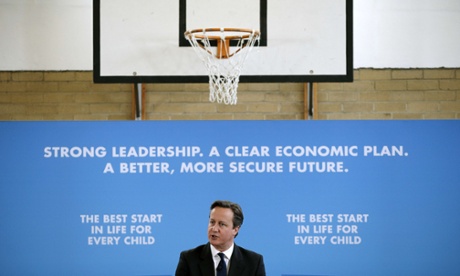
Afternoon summary
- David Cameron has said that a single piece of intelligence from Saudi Arabia may have saved hundreds of British lives. He made the revelation as he sought to justify the government’s decision to fly the Union flag at half-mast to mark the recent death of the King Abdullah of Saudi Arabia. (See 4.31pm.)
-
Gordon Brown, the Labour former prime minister, and Jim Murphy, the Scottish Labour leader, have unveiled what they call “the Vow Plus” - proposals to give Scotland more powers on top of those in the Smith Commission report that implement the “Vow” made by Wesminster leaders before the independence referendum. Although Brown used to be opposed to devolving welfare spending (see the speech he gave on March last year), today he said Scotland should have the power to top up welfare benefits.
The Vow Plus is an insurance policy against the Conservative government today and any attempt in the future to impose benefit decisions that don’t accord with Scottish needs and conditions.
The Vow Plus is a guarantee that in the final analysis the last word on benefit changes can rest with the Scottish people.
And implementing the Vow Plus is in my view a better way of delivering the social justice agenda of the Scottish parliament than breaking away from our UK pensions – worth £500 million extra to Scotland – and our UK-wide system of help for the unemployed and families for which the risks are shared across the UK and from which we also benefit.
Scottish child benefits, unemployment benefits and pensioner benefits would start from the social and economic rights guaranteed by the UK welfare state, and we would start from UK benefit decisions about rates and eligibility.
That would be the base line, but if the Scottish parliament wished to do so and was prepared to pay for it the parliament would be able to top up rates it found did not accord with Scottish needs or Scottish conditions.
The SNP said that Labour had been panicked by the SNP’s success, because until recently Labour was opposed to going beyond the devolution plans in the Smith Commission report. Stewart Hosie, the SNP deputy leader, said”
Today’s announcement from Jim Murphy and Gordon Brown shows that their disastrous poll ratings are causing panic in Labour’s ranks. Labour are under severe pressure from the people of Scotland, who are backing the SNP in increased numbers. And if this is what Labour do when faced with disastrous opinion polls, Scotland will be able to achieve so much more by electing a strong team of SNP MPs to hold the balance of power at Westminster.
Last month, Labour tried to tell people that the Vow had been delivered and there should be no more discussion of further powers for Scotland.Today, as more and more people back the SNP ahead of the coming election, Labour have been dragged along in Scotland’s wake.
And Nicola Sturgeon, Scotland’s first minister, said:
If our poll lead has Labour desperately trying to make the Vow sound better, think how much real power a big SNP team can win for Scotland
— Nicola Sturgeon (@NicolaSturgeon) February 2, 2015
- David Laws, the Lib Dem schools minister, has dismissed Cameron’s school spending announcement (see 2.26pm) as “unbelievably weak”. He said:
This is an unbelievably weak commitment from David Cameron and the Conservatives. The Conservatives have failed even to protect the schools budget in real terms and it is clear that they will have to make deep cuts to early years and 16-19 education. There has been radio silence over the £2.5bn pupil premium, which is getting extra money to the children who need it most, and already starting to transform the life chances of poorer pupils. This makes a mockery of the Conservatives’ claims to want to raise standards. You simply can’t improve education while starving schools, nurseries and colleges of the resources they need.
-
Northern Ireland’s health minister, Jim Wells, has backed plans to introduce standardised cigarette packaging. He said the region would be included in the UK Government’s proposals for plain tobacco product packets, which is set to be voted on by MPs in Westminster before the general election.
That’s all from me for today.
Thanks for the comments.
Updated
Back to school spending, and the Institute for Fiscal Studies has some numbers on what has happened to school spending in England since 2010. This is from the Press Association.
According to the Institute for Fiscal Studies (IFS), spending on schools has increased from £39.7bn in 2010-11 to £41.6bn in 2014-15, a real-terms increase of 4.7% or just over 1% per year on average.
But because the number of pupils in state schools increased by 3.9% over the same period, the IFS calculated that spending per pupil has risen by only around 1% in real terms between 2010-11 and 2014-15.
Cameron on Ask the Leaders - Summary
Sky News have now had four party leaders at their Stand Up and Be Counted event. From the tone of the Sky commentary, you would think that no one in democratic history has ever before had the idea of getting politicians to take questions from young people. In truth, it wasn’t exceptional. But it was a good event, with a few sharp questions (as well as some quite poor ones), and it provided an informative platform.
Did anyone “win”? As far as I can see, no. From what I saw, it did not look as if any one leader won over the audience more than the others. Ed Miliband’s worst moment probably came when he was asked about his “real life” experience. He is often weak when faced with these “left field” questions (remember feeling “respect” when he sees a white van?), and he probably should have talked about being a father in his answer instead. But even Dan Hodges thought he did really well (honestly), and his answer on tax avoidance and Stefano Pessina was strong. Cameron has probably had easier gigs, but, even if he wasn’t fully briefed on tampon tax law, he got through it unscathed quite comfortably. The only real false note came when he said he would urge his children to consider doing an apprenticeship. Somehow, that seems unlikely.
My only complaint would be the format. Why did the poor under-25s in the audience have to stand up and be counted? Why couldn’t they sit down? It looked as if Cameron, Miliband et al were addressing a gaggle at a bus stop, or as if Sky management can’t afford chairs. Some executive clearly thought it would be clever to link the title and the stage directions in this manner, but in the end it looked a bit silly.
Here are the main points from David Cameron’s session.
-
Cameron said that Saudi intelligence had saved potentially hundreds of British lives and that this was the main reason why Britain had to maintain good relations with the country. This came when he was asked why flags flew at half-mast in the UK following the death of the Saudi king. Cameron replied:
There’s a long-standing relationship between the Kingdom of Saudi Arabia and our United Kingdom, a relationship between our monarchs, a relationship between the governments. We don’t agree with lots of things the Saudis do ... But when their king dies, as a mark of respect, we thought it right to show that respect.
When the questioner put it to him that this was not very respectful to the victims of the Saudi regime (a great follow-up question), Cameron went on:
We have a relationship with Saudi Arabia, partly over things like trying to achieve peace in the Middle East, but crucially over fighting terrorism ... I can tell you one time since I’ve been prime minister a piece of information that we have been given by that country has saved potentially hundreds of lives here in Britain. Now, you can be prime minister and say exactly what you think about every regime in the world and make great headlines and give great speeches. But I think my first job is to try and keep this country save from terrorism and, if that means you have to build strong relationships, sometimes with regimes you don’t always agree with, that, I think, is part of the job. And that’s the way I do it.
He also admitted that oil was part of this relationship.
Yes, of course. Of course Britain needs to have relationships that we trade with , including those that we buy oil and gas from. We can’t make all our own oil and gas here in the UK.
-
He suggested he would like his successor to reform PMQs. Asked to defend PMQs, he said that it was good for accountability and that it was not representative of the overall work of parliament. But he went on:
If I changed it, said ‘you know what, let’s get rid of this’, I think people would think you are running away from accountability. So I don’t think I can do it. But I do wish we could make it a bit more responsible.
- He said he thought there should be a Commons voting on lowering the voting age to 16. But he would vote in favour of keeping it at 18, he said. (Although he said there should be a Commons vote, he did not specify a free vote, although he did not sound wholly opposed; he said he was in general in favour of using free votes a bit more.)
- He said he would encourage his children to considering doing an apprenticeship.
When it comes to my own children, who are still at primary school, I would advise them as they go through primary school: think about either doing an apprenticeship or think about going to university rather than leaving school at 16 or 18. I think that is the future for our country.
Updated
Lord Ashcroft has published his latest polling.
Labour and the Conservatives are once again tied in this week’s Ashcroft National Poll. Both parties are down a point at 31 per cent, with UKIP on 15 per cent for the third consecutive week and the Greens unchanged on 9 per cent. The Lib Dems are up two points at 8 per cent.
Earlier I said that his Scottish seat-by-seat polling was coming out today. I’m sorry; that’s my mistake. It’s coming on on Wednesday.
Q: Just 4.2% of MPs are from an ethnic minority, even though they make up 12.9% of the population. And women are under-represented too. Can we trust you to introduce representative policies?
Cameron says parliament is not properly representative. It is making progress in terms of representing women, and people from ethnic minorities, but we have not done enough.
Q: Why should 16 and 17-year-olds have a view if you are not listening to us?
Cameron says politicians should listen to young people. There should be a vote on lowering the voting age, he says. But he would vote to keep it at 18, he says.
And that’s it.
I’ll post a summary shortly.
Cameron says more needs to be done to address the pay gap. The government has forced companies to undergo pay audits if they lose a case at tribunal.
Q: Do you think there will be more cross-party government?
Cameron says he hopes that politicians can work together on this.
All the politicians who have taken part in this Ask the Leaders event love their country, he says.
He is in favour of more free votes. There will be one tomorrow.
And there have been more referendums. He would give people a vote on Europe, he says.
Q: Are you in favour of voting at 16 and online voting?
Cameron says he understands the argument for voting at 16, but that he thinks it is best to keep 18 as the age of majority. That is an age when other things change.
On online voting, he thinks people are asking the wrong question. People are not declining to vote because it is too complicated to vote.
Q: My university is selling sanitary products profit-free. Would you do the same?
Cameron says that sounds like a good idea.
Q: Would you cut VAT?
Cameron says he has looked at this before. He thinks there is a technical reason why the government cannot remove VAT from sanitary products, but he cannot recall the details.
Q: What is you government doing to support Muslim communities who are not engaged in terrorism?
Cameron says he is pleased about Muslim leaders coming out to denounce acts of terror. President Obama recently cited the #NotinMyName hashtag campaign as a good thing.
Q: What will you do to engage young people more?
Cameron says the best thing he does is go into secondary schools and have a reasoned debate with sixth formers. More of that would be a good thing.
Q: Which party leader will eradicate PMQs? Aren’t there enough comedies on TV already?
Amen, says Cameron.
He thinks having to do it is a nightmare.
But it forces him to be on top of his game, and on top of what is happening. It enforces accountablity, he says. It is noisy and frustrating. But there is some point to it.
Q: It is horrible and disgusting. It is too noisy.
Cameron offers to get the questioner a ticket. It is noisy; that is why he has to shout.
It is not representative of parliament, he says.
It is like a Roman Circus, he says.
He could not change it. But it would be nice to make it more responsible.
Cameron says the badger cull is probably the most unpopular thing he is responsible as prime minister.
But bovine TB could end up costing £1bn, he says. That is why the badger cull was introduced.
Q: Why will the Tories cut housing benefit for under-21s, but protect the winter fuel payment for wealthy pensioners?
Cameron says being unemployed and on housing benefit should not be an option for young people. It is not a good thing to do. But there would be exceptions for some people who can’t stay at home.
Q: Housing benefit was the only thing that enabled me to go to FE college.
Cameron says some people can’t stay at home. But for most people this should not be an option.
Q: Is there a case for legalising drugs?
Cameron says he is glad that drug use has gone down.
The government has put more emphasis on treatment.
But he would not change the criminal law. That would be a mistake. Parents are trying to stop their children using drugs. Legalising drugs would send the wrong message.
Q: [From someone who has done a dissertation on drugs policy] You used to be in favour of legalisation.
Cameron says he used to sit on the home affairs committee. It did not quite say that, he says.
He says he has spent a lot of time thinking about this. He thinks legalising drugs would send out the wrong message.
Cameron says Saudi intelligence has saved hundreds of British lives
Q: Why did we fly flags at half mast after the death of the Saudi king, given their human rights record?
Cameron says there is a long-standing agreement. It was a sign of respect.
Q: But it is not a sign of respect to the victims of that regime?
Cameron says he understands people’s concerns. But there is an important point; the Saudis have helped the British fight terrorism. One piece of information they provided saved hundreds of lives.
- Cameron defends decision to fly flags at half mast following the Saudi king’s death, saying Saudi intelligence has saved hundreds of British lives.
Cameron says he visited a Dagenham plant recently. The apprentices there told him that, after four years, they would be earning £30,000.
Q: You say people should go to university. But some graduates are unemployed, or have low-paid jobs.
Cameron says he wants everyone to be able to go to university if they want to.
He said he would advise his own children to do an apprenticeship or go to university.
(Somehow, I suspect the chances of Cameron’s children following the apprenticeship route are slim.)
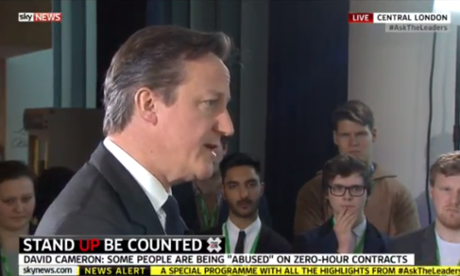
Q: How are people on zero-hours contracts expected to pay for their food and transport, and to plan for the future?
Cameron says he wants good jobs for everyone.
But some zero-hours contracts are abused. People are forced to work for one employer exclusively. That is being banned, he says.
Q: But these are bad for young people. They do not allow people to have a career.
Cameron says he wants young people to be able to get apprenticeships. The pay is not that high, but apprenticeships provide a route to a good career.
Cameron at the Ask the Leaders event
David Cameron is about to take questions at the Sky News Ask the Leaders event.
Nick Clegg has been on Ask the Leaders. Inevitably, he had to defend the Lib Dems’ U-turn on tuition fees.
Nick Clegg defends the tuition fees policy arguing that ppl pay less per month, only when they can afford it. #asktheleaders
— Anushka Asthana (@SkyAnushka) February 2, 2015
Clegg says he's apologised over fees but wishes PM would do same for failing to hit immigration targets & Ed M over economy #AskTheLeaders
— Anushka Asthana (@SkyAnushka) February 2, 2015
Clegg focusing on fact that fees wasn't on front page of manifesto. But it was those video-ed pledges that he & his MPs made before election
— Anushka Asthana (@SkyAnushka) February 2, 2015
Lunchtime summary
-
Labour has signalled that it would protect school spending in real terms. Tristram Hunt, the shadow education secretary, made this declaration as he denounced David Cameron for saying that schools could face a real-terms cut in the next parliament under Conservative plans because they would only protect school spending per pupil in cash terms. (See 1.29pm.) Hunt said:
The Tory claims on protecting schools are unravelling as David Cameron has been forced to admit that his plans will see a real-terms cut to spending on schools.
The truth is that you can’t protect schools when you have plans to take spending as a share of GDP back to levels not seen since the 1930s.
Labour has always prioritised schools and would be able to do so again because we have a balanced approach to bringing down the deficit, unlike the Tories’ risky plan not just to balance the books but to cut for year after year afterwards.
- Natalie Bennett, the Green party leader, has rejected official Green party policy saying membership of a terrorist party on its own should be treated as a crime. (See 11.33am.) And Caroline Lucas, the Green MP, has signalled that the citizen’s income is not a priority for her party. (See 10.16am.)
-
George Osborne, the chancellor, has said the Greek debt crisis is “fast becoming the biggest risk to the global economy”. He issued this statement after a meeting at 11 Downing Street with Yanis Varoufakis, the Greek finance minister.
It’s clear that the standoff between Greece and the eurozone is fast becoming the biggest risk to the global economy, and it’s a rising threat to our economy at home. In Europe as in Britain now is the time to choose competence over chaos. I urged the Greek finance minister to act responsibly, but it’s also important that the Eurozone has a better plan for jobs and growth. We have that plan in Britain and in these uncertain times, now is not the time to abandon that plan.
Cameron's speech - Reaction
Here is some reaction to the Cameron speech
From Paul Johnson, director of the Institute for Fiscal Studies
[Cameron’s spending announcement is] quite a watering-down of what we’ve had over the current parliament where schools, along with the health service, have been protected in real terms, with a really big effect on spending on other parts of public services, because schools and hospitals are about half of everything we spend on public services ...
The amount per capita in cash terms will stay the same, the amount of cash going in will go up, but certainly the amount per pupil in real terms will go down over that period.
That’s not terribly surprisingly really given the scale of the cuts this government are saying they need to implement overall over the next parliament. To give more protection than that to schools would mean even deeper cuts in everything else.
From Tristram Hunt, the shadow education secretary
Today the cat is out of the bag. Another Tory government would deliver a real-terms spending cut to our schools. Their priority would be getting rid of inheritance tax, or more tax cuts for millionaires, and not investing in our children.
From Graham Stuart, the Conservative chair of the Commons education committee
[On the spending announcement] I think that’s fair, and excellent news considering the depth of the difficulties we’ve got.
Stuart was on the World at One. Listening to him, you could hear him switch from expert commentator to party loyalist mid sentence (just after “fair”).
From Martin Doel, chief executive of the Association of Colleges
Today’s announcement by the prime minister to ring fence the schools budget is good news for schools but is desperately disappointing for sixth form and further education colleges which between them educate over 830,000 16 to 18-year-olds.
This leaves college students extremely vulnerable to huge cuts in the next parliament and we strongly appeal to the prime minister to think again before the Conservatives squander the education and training opportunities of thousands of young people.
We fail to see why, when everyone has to stay in education or training until the age of 18, this age group continues to be treated less favourably than their young counterparts. Investment in earlier years will be wasted if 16 to 18-year-olds continue to receive 22% less than 11 to 16 year olds. We’d urge the next Government to prioritise a once in a generation funding review of how money is spent at each stage of education to ensure we can adequately educate and train all children and young people.
From the NASUWT teaching union
Deeply disappointing that Conservatives still clinging to their academisation policy when there's no evidence it raises standards #GE2015
— NASUWT (@NASUWT) February 2, 2015
From Mary Bousted, general secretary of the Association of Teachers & Lecturers (ATL)
David Cameron’s government has had five years to make its academy policy work. Last week’s report by the education select committee and the public accounts committee revealed that the academies policy has run aground. There is no evidence that academies raise standards of education. There is evidence, however, that the Government is unable to account for academy spending.
Faced with these uncomfortable findings, David Cameron has decided to plough ahead, doing more of the same. In this he is undoubtedly influenced by Michael Gove, the former secretary of state for education, who has never let evidence get in the way of ideology and prejudice.
This is a government which is bereft of ideas. When will politicians stop declaring war on schools? It doesn’t help their image with parents, the public or with teachers who see their motives for what they are: self-serving, publicity seeking nonsense.
From Kevin Courtney, deputy general secretary of the National Union of Teachers
For David Cameron, Education Secretary Nicky Morgan and schools minister Nick Gibb to all be spouting about the benefits of academy status for schools deemed to be ‘requiring improvement’ is extraordinary to say the least.
It really is time that this Emperor’s new clothes approach to education stopped. Last week we saw three reports form the influential education select committee, the National Audit Office and the public accounts committee heavily criticising the academies and free schools programme and pointing to the lack of evidence that it leads to improved standards.
And this blog, from Chris Cook, Newsnight’s policy editor, is also well worth reading. Here’s an excerpt.
In short, it is hard to argue that league tables and sponsored academies haven’t worked, given what we know. But you can’t project that forwards ad infinitum. We are already flogging the horse pretty hard. It may just not go faster unless we fix a few other things first.
To be fair, there are solutions to some of this in train: the government has already put some cash into building school chains up and it has introduced “regional school commissioners,” eight local viceroys who may help the department meet its obligations.
But there are other things that require careful thought. In some schools, the inability to get good teachers is the core of their problems. The education and aspiration of parents varies wildly from school to school and from town to town. There are problems that determination alone cannot crack at current funding levels, important though it is to keep teachers focussed.
Updated
Cameron's speech and Q&A - Summary
Here are the main points from David Cameron’s speech and Q&A.
-
Cameron said the Conservatives would not increase school spending per pupil in line with inflation. Under the party’s plans, school spending per pupil would be protected in cash terms in the next parliament, he said. And, because pupil numbers are going up, schools would get an increase in cash terms. But Cameron admitted that, as a result of inflation, this could amount to a real-terms cut per pupil.
We are saying very clearly, when it comes to schools, that money that follows your child into the school, that money won’t be cut. And the consequence for that will be an increase in the schools budget ...
The cash sum that follows your child into the school will not be cut. Because the number of children going to school is going up, this has an implication that means that in cash terms the schools budget is going to be rising.
Now, I accept that that is a difficult decision for some schools because the amount of cash per child is not going up by inflation, the amount of cash is staying the same. But I think that schools have demonstrated, brilliantly over the last five year that they can be more efficient, they can be more effective, they can make their budgets work.
- He confirmed that the Conservatives would force up to 3,500 coasting schools to become academies. (See 12.34pm.)
-
He claimed that Labour’s failure to spell out its tuition fee policy (see 9.22am) reinforced Tory claims that a Labour government would bring “chaos”.
[Labour] told us they were going to fundamentally change and reduce the tuition fees. Four years later, they cannot actually tell us what they’re going to put in their place. I sometimes talk at the forthcoming election about the difference between the competence you get from the Conservatives ... and the utter chaos you would have from Labour with their total failure to explain how this massive shortfall for the universities would be made up. [Not having] any policy to put in its place, apart from vague ideas about a graduate tax without saying what it would be or who would pay, shows that chaos is a pretty adequate description of what people should expect.
-
He refused to answer when asked what 9 times 8 is.
I’m going to plead the Nicky Morgan defence, which is I do times tables only in the car with my children on my way to school. And I’m going to stick to that just in case I get one wrong.
Updated
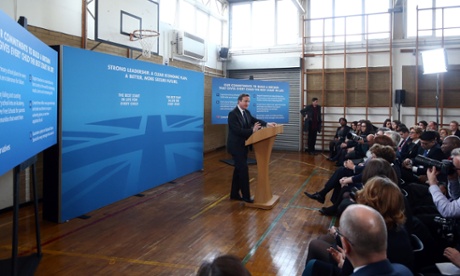
Cameron takes the final question from a pupil.
Q: Why did you come to this school?
Cameron says he wanted to find a school that showed that, if you set high expectations, pupils will perform well.
He is at Kingsmead school in Enfield.
He says inner city schools can perform better than schools with more prosperous intakes.
Cameron does not mention the election, but this tweet from earlier perhaps provides a better answer.
Cameron in Enfield North constituency of @nickdebois giving schools speech. Just for info: 2010 majority was 1692 (or 3.8%) over Labour.
— Chris Ship (@chrisshipitv) February 2, 2015
The Cameron Q&A is over. I’ll post a summary shortly.
Q: [From BuzzFeed] House of Commons library figures show the tuition fees policy is costing more than expected. Was it a good idea?
Cameron says it was a good idea. He wants young people to be able to go to good universities. That costs money, he says.
Universities were given a good spending outcome, he says.
Labour said four years ago they would cut tuition fees. But they still can’t say how.
That illustrates the “utter chaos” that Labour would bring, he says. It shows “chaos” is an adequate description of what Labour policies involve.
Q: Can you confirm that “flat cash” means a real-terms cut for schools?
Camerons ays this means the cash sum that follows children into schools will not be cut. Because the number of children going to school is rising, that will mean an increase.
But he says he accepts that this will involve a challenge for schools.
But it is sensible and realistic, he says. It won’t put too much pressure on the budget.
Q: What other departments will be cut?
Cameron says the government has been able to demonstrate that it can make difficult decisions. In some areas of government spending, you can do more for less.
The Tories have said they want to cut £30bn. And, in some areas, like welfare, they have given more detail of what they would cut than the other parties, he says.
Q: Why are you so convinced that academies work when the evidence does not back this up?
Cameron says there is evidence they work. And he thinks having sponsored academies would make a real difference to schools that need improvement.
Q: What is 9 times 8?
Cameron jokes that he only does times tables in the car, on the way to school with this children. He won’t do them on TV.
Sam Freedman, a former adviser to Michael Gove, says Cameron’s plans to ringfence the schools budget actually amounts to a cut.
Which is a 7-10% cut over Parliament RT @helenwarrell: Cameron says Tories will preserve schools spending ringfence - "flat cash per pupil"
— Sam Freedman (@Samfr) February 2, 2015
Q: Will you admit that ringfencing the schools budget will lead to cuts in other departments?
Cameron says he is doing the same in the next parliament as he did in this. He is saying that money that follows children will not be cut. So that means spending will go up, he says.
Here are some more excerpts from the speech so far.
Best start in life starts with a strong family, says Cameron. A good education shouldn't be a luxury. pic.twitter.com/cxTuSus2hw
— Frances Perraudin (@fperraudin) February 2, 2015
Cameron says the evidence is that free schools "work" & that they're "more likely to be good or outstanding than other schools"
— Helen Warrell (@helenwarrell) February 2, 2015
"This is the country of Alan Turing, Stephen Hawking and Tim Berners-Lee,"says @David_Cameron as he talks up plans for sciences.
— David Hughes (@DavidHughesPA) February 2, 2015
Cameron saying that school leavers should "earn or learn" and that they shouldn't be able to start adult life on welfare.
— Frances Perraudin (@fperraudin) February 2, 2015
Cameron has made a fresh announcement in his speech.
-
Cameron announces that the Conservatives would ringfence the schools budget.
Cameron says a future Conservative government will preserve schools spending ringfence -- "flat cash per pupil" in Treasury terms
— Helen Warrell (@helenwarrell) February 2, 2015
David Cameron's education speech
David Cameron is giving his education speech in north London now.
Here is an extract from the press notice Number 10 sent out overnight about the plans to force more schools to become academies that Cameron is proposing.
David Cameron will today unveil new powers to force up to 3,500 coasting schools to accept new leadership under Conservative plans to ensure all children get the best start in life. Any school judged by Ofsted as ‘requires improvement’ will be taken over by the best headteachers, backed by expert sponsors or high-performing neighbouring schools, unless it can demonstrate that it has a plan to improve rapidly. The policy represents a turbo-charging of existing coalition government policy which currently allows only schools judged ‘inadequate’ to be converted into sponsored academies.
1,200 inadequate schools have so far been converted to academies, the vast majority of these under the coalition government. Children in sponsored academies on average improve their results faster than children in local authority schools. In the next parliament David Cameron wants to raise the bar on intervention so that more children are in good or outstanding schools. Under a Conservative government, any school judged as ‘requires improvement’ will automatically be considered to become an academy. Only if they can set out a clear plan for rapid improvement, as judged by their Regional Schools Commissioner, will they remain under their current leadership. Any school judged as ‘requires improvement’ that is already an academy or a free school may be forced to accept a new sponsor.
And here’s a quote from Cameron from the news release.
As parents we’re hardwired to want the best for our kids. No one wants their child to go to a failing school – and no one wants to them to go to a coasting school either. So this party is clear. “Just enough” is not good enough. That means no more sink schools – and no more “bog standard” schools either. We’re waging an all-out war on mediocrity, and our aim is this: the best start in life for every child, wherever they’re from – no excuses.
Q: Following the Greek election, should the British people be looking for alternatives to austerity?
Miliband says the government wants to take public spending back to 1930s levels. Labour is opposed to that. It would make common sense reductions to spending.
Wages have to go up, so tax revenues can increase too, he says.
And that’s it. Miliband’s Q&A is over, although he is meant to be answering more questions on Facebook now.
I’ll switch to David Cameron in a moment - he’s speaking now - but I will post a summary of Miliband later.
Miliband says we are going to have to work longer as a society.
But changes to pension rules were introduced by the government without people being given enough notice.
The Sun’s Tom Newton Dunn suggests Miliband’s aides are, actually, quite keen on influence what is written in the Sun.
Ed Miliband: "It's not for me to say what The Sun should write". Amen to that - hope he shares with his angry spin doctors #AskTheLeaders
— Tom Newton Dunn (@tnewtondunn) February 2, 2015
Q: Will you bring back the educational maintenance allowance?
Miliband says he cannot promise to bring it back, because he needs to control the deficit.
Politicians should only make promises they can keep, he says.
Q: These messages are put out by papers that you are in charge of.
Miliband says that, if he were in charge of newspapers, they would not be writing what they do write about him.
But that is part of a free society, he says. It is not for him to say what the Sun should write.
He says all of us, journalists and politicians, have a duty to speak responsibly.
We should speak out about racism and anti-semitism at every opportunity, he says.
Q: What should we be doing about Islamic State?
Miliband says the government needs to do more to prevent radicalisation. The Prevent programme is led by the police. Instead, it should be led by community groups.
He says he has changed his party’s policy. On the Iraq war, he says that was a mistake.
Q: Did it promote the rise of extremism?
Miliband acknowledges that that was a factor.
Q: Have you thought about making your manifesto accessible to young people?
Miliband says he is going to have a manifesto for young people.
He wants to give the vote to 16 and 17-year-olds. Why is that important? George Osborne abolished the education maintenance allowance in one line in a budget. He would not have done that if 16 and 17-year-olds had had the vote.
Miliband says he sometimes says politics is too important to be left to politicians. By that, he means that change happens because people press for change.
Take gay rights; that happened because people pushed for change. What Tony Blair’s government did was important, but he was responding to change.
Miliband says he is in politics because he thinks it makes a difference.
His parents came to the UK fleeing persecution.
If you told his mum that politics does not matter, she would think you were being ridiculous. Her father was killed by the Nazis.
Q: How can people in Scotland support you when you sided with the Tories over independence?
Miliband says there is a different choice at the election. Labour and the Conseratives are offering different policies. There is a big choice facing voters.
Miliband says people in Britain will not take kindly to be lectured by people like Stefano Pessina, the Boots boss who criticised Labour. He is avoiding his taxes in this country, he says.
Frankly, I think he should be paying his taxes.
Q: Will you make companies like Amazon and Google pay their taxes?
Absolutely, says Miliband. This issue has to be addressed.
And small firms are as angry as anyone about firms not paying their taxes.
Q: Aren’t the laws in place already?
But they are not working, he says. The tax gap is going up.
Q: Why are the laws not working?
Miliband says there is a view in this country that, if large companies object to something, change cannot happen.
That’s not right, he says. He says he challenged Rupert Murdoch.
Q: What about firms leaving the UK?
That’s what they say, he says. And that’s what the banks said. But the banks needed more regulation before the crash. He says he does not “buy” the argument the multinationals are using.
His is a pro-business position, he says. Small firms support this view.
Q: What would you do about the rise of rightwing parties like Ukip?
Miliband says he is very proud of the fact that we are an open country. He is the son of immigrants. But we have got to confront areas where things are not working; for example, with immigrant workers being exploited, driving wages down for everyone.
Q: How would you encourage graduate jobs outside London?
Miliband says he is an MP in Doncaster, and knows this is a big issue.
We know what makes a successful town. Having a successful college is part of it. Having good transport links is also a factor. And we need more devolution to local towns, he says.
Q: What can be done to ensure that people like me [a young black woman on a training scheme to promote diversity in the media] can get proper, full-time jobs.
Miliband says he wants to look at placing a limit on unpaid internships.
He says he also wants to incentivise firms to stop using zero-hours contracts.
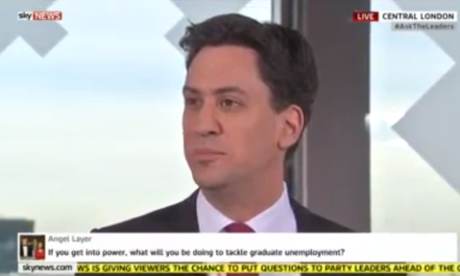
Miliband says he wants a race to the top, in high-skilled jobs.
Q: What will you do about the extent of children’s exposure to over-sexualised content in the media?
Ed Miliband says this is a really important issue. Advertisers have to be responsible. There is a role to be played with default settings. And parents have to be responsible.
Q: How can you do this?
It is hard, says Miliband. His own children are too young for this to be a problem, but he knows how difficult it is.
That said, the internet is a good thing.
Q: How do you make a difference?
Miliband says there is a question of balance.
Q: You don’t want the government to enforce rules.
Education and empowerment of parents are most important, says Miliband.
Ed Miliband on Ask the Leaders
Ed Miliband is about to be questioned at the Ask the Leaders event.
I’ll be covering it in detail until we get a clash with David Cameron.
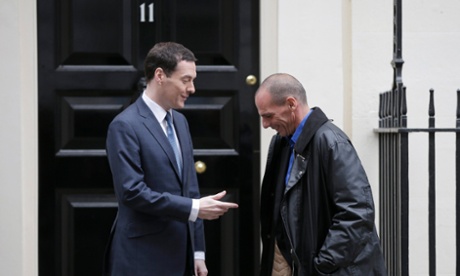
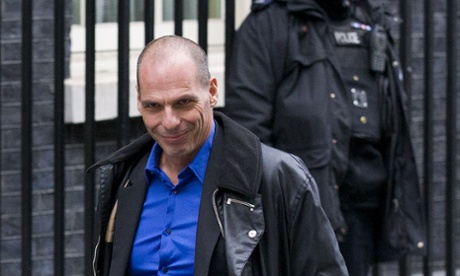
Yanis Varoufakis, the new Greek finance minister, has been meeting George Osborne, the chancellor, in Number 11. My colleague Graeme Wearden has been covering this in detail in his business live blog.
The new Greek government doesn’t do ties.
Earlier I said Nick Clegg was on Ask the Leaders at 12pm, and then Ed Miliband at 2pm. But I was given wrong timings. Sky says Miliband will now be on at 12pm.
Natalie Bennett on Ask the Leaders - Summary
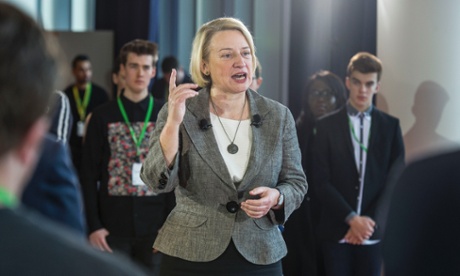
Here are the key lines from Green leader Natalie Bennett’s appearance on Sky News’ Ask the Leaders event.
It included a conspicuous U-turn. Often the term U-turn is used to describe a rather modest policy change, but this was a full 180-degree job. You could almost smell the stench of rubber.
-
Bennett rejected official Green party policy saying membership of a terrorist party on its own should be treated as a crime. This was one of the issues that Andrew Neil challenged her on in his interview last week, and eight days ago she defended official Green policy. But today she said supporting a group like al-Qaida should remain a crime. She said:
Obviously [Islamic State] and al-Qaida are hideous terrorist organisations that advocate and support violence. If you are involved in them, support them in any way, then you are participating in inciting violence, that’s a crime, rightly, and should be pursued to the full extent of the law.
-
She said that, even if people did not like any of the election candidates, they should still register a protest vote.
I would like you to vote Green, I would like you to vote for someone you believe in. But If there is no one on the ballot paper who you think represents your views, still go to the polling station and if you want to write a rude word on the ballot paper.
Because if you don’t vote, if you don’t turn up, if you don’t register, you are counted with the ‘I’m happy enough with how things are’ part of the group, and I don’t think most people actually are.
-
She said first-past-the-post led to people voting for candidates they did not really want.
[First-past-the-post has] actually given us the kind of politics we have now. What we have done is we have seen, particularly the two largest parties, focus all their policies on the swing voters in the swing seats. They have ignored their core vote, they have ignored the whole issue of what’s best for the country, but thought ‘what do we say to get those swing voters?’. If voters keep voting the same way, you will keep getting the same politics.
-
She explained that she became a feminist at the age of five - even though she did not know the meaning of the word - because of an issue of fairness.
I became a feminist at age five. I didn’t know the word then, but at age five I was told ‘Because you’re a girl, you are not allowed to have a bicycle’ and I thought ‘That’s not fair or reasonable’. That sense of fairness and the sense that so many people are stopped from realising their potential and doing what they want to do because of unfair rules and society imposing restrictions on them - that’s what drives me.
-
She said she backed the idea of a constitutional convention.
Natalie Bennett backs idea of a constitutional convention - leading Labour policy - and says councils need more powers. #AskTheLeaders
— Ben Riley-Smith (@benrileysmith) February 2, 2015
-
She said people should stop blaming immigrants for problems like low wages, housing and pressure on public services. These were down to government failings, she said.
First applause for Bennett is when she says society needs to stop blaming immigrants #AskTheLeaders
— Isabel Hardman (@IsabelHardman) February 2, 2015
- She said the Greens would cancel HS2.
-
She said that the unpaid internships offered to many young workers were “unfair and unreasonable and shouldn’t happen”.
We have a minimum wage that is not enforced,” said Ms Bennett. “If you have a contract with a company that says you are going to turn up nine-to-five for six months, that is a job and it should be covered by the minimum wage.
Updated
Sky News has just announced that David Cameron will be taking part in its Ask the Leaders event.
I’m sorry the blog has been quiet for a bit; I was tied up with some office stuff. But I’ll post some highlights in a moment from Natalie Bennett’s Ask the Leaders event.
We have some very exciting news! Guess who's joining us for #AskTheLeaders today?! Yes, it's @David_Cameron! pic.twitter.com/mS7chgRoE5
— Stand Up Be Counted (@SkySUBC) February 2, 2015
Updated
Lucas signals that citizen's income is not a priority for the Greens
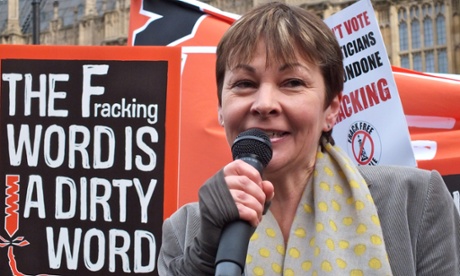
Here are the main points from Caroline Lucas, the Green MP’s, interview on the Today programme earlier.
As I said earlier, part of the interview was devoted to repairing the damage done by Natalie Bennett’s interview with Andrew Neil last Sunday. Bennett was left floundering when asked about the detail of some Green policies, such as the citizen’s income. A subsequent Guardian story also highlighted fresh flaws in the citizen’s income idea. Greens probably approve of long grass, and so, appropriately, that is where Lucas left the policy.
Here are the main points from her interview.
-
Lucas signalled that the citizen’s income was not a priority for the Greens. She said the idea was a long-term aspiration, not something that it would be advocating for immediate introduction in its manifesto.
The citizen’s income is not going to be in the 2015 general election manifesto as something to be introduced on May 8. It is a longer term aspiration, we are still working on it.
-
She suggested that the party would be focusing on other issues instead in its election campaign.
[The citizen’s income] is not a policy for the next general election. What is is lifting the living wage to £10 an hour by the end of this parliament. What is is challenging the austerity of the other parties, so that we would say that what we need to be doing is investing in jobs rather than cutting jobs.
-
She said that Greens’ aim was not to win the election, but to be able to exercise a progressive influence, particularly on Labour. Winning was not a realistic goal, she suggested.
We are a small party. We have grown very fast just recently. We are now larger than the Lib Dems or Ukip. But up until six months ago we were a small party with a shoestring staff. We are not saying we are going into this election going to win and become the next government. What we are going to do is put forward some radical ideas, some visionary ideas, which this political system needs so badly. And what we’re also going to do, with a handful of MPs, is to push Labour in particular to be far more progressive. Why won’t Labour, for example, have the courage of its convictions and bring rail back into public ownership.
-
She said she was hopeful of keeping her seat in Brighton Pavilion.
I am certainly not taking for granted that it’s in the bag but I hope people will judge me on my record. I was really honoured to be named MP for the year last year for my work with deprived communities in the area, I have got a track record that I am proud of ... [The Ashcroft poll] puts us ten points ahead, but that’s one poll; we’re working hard.
- She defended the record of the much-criticised Green council in Brighton. It was left a “poisoned chalice” by the previous administration, she said, and the bin strike unpopular with residents was triggered by the councils desire to ensure female workers are paid the same as men. She also said that recycling rates were now going up in Brighton.
-
She said she was “very comfortable” with Natalie Bennett speaking for the party in the leaders’ debates, not her.
Balls says Labour's plans are more 'pro-business' than the Tories'
In the interview, Ed Balls also responded to the attack on the party yesterday from the Boots boss Stefano Pessina.
-
Balls said that voters would dismiss Pessina’s comments because he was a tax exile.
In the next three months we going to have a number of people brought forward by the Conservatives, whether it’s Gary Barlow or Mr Pessina saying ‘don’t vote Labour’. The idea that somebody who doesn’t pay tax in Britain telling people how to vote will stick in the craw.
-
He said the only specific policy ideas that Pessina was criticising in his interview was leaving the EU - an idea promoted by Tory politicians, not Labour ones.
Even though he’s a tax exile in Monaco and even though he’s moved Boots’ domicile to Switzerland, the only tangible thing he said in the Telegraph on Saturday was his fear of Britain leaving the European Union and that’s what I hear from businesses up and down the country all the time ... We have at the moment an anti-European sentiment, the rise of people saying ‘leave the EU’, the rise of Ukip, the Conservative party gambling with our future.
-
He said that when he was in Washington recently American policymakers said they were alarmed at the prospect of the Tories taking Britain out of the EU.
When I was in Washington the big fear of American policymakers is a Tory government taking Britain out of the EU.
-
He claimed Labour’s plans were more pro-business than the Tories’ were.
Do you have a [Conservative] plan to devolve power to the regions, to invest in infrastructure, to keep us in the EU and reform it? That is the Labour agenda, fairness and prosperity going hand in hand and I have to say it’s a much more pro-business agenda than what we’ve heard from David Cameron and George Osborne.
I’ve taken the quotes from PoliticsHome.
Balls says he and Miliband still attracted by graduate tax idea
On the Today programme Ed Balls, the shadow chancellor, was asked about a letter to the Times written by Professor Sir Christopher Snowden, president of Universities UK and vice-chancellor of the University of Surrey, and other members of the Universities UK board attacking Labour’s plans to cut tuition fees.
Here’s an extract from the letter (paywall).
Sir, There is speculation that the Labour party may propose reducing university tuition fees in England from £9,000 to £6,000. Were this to happen, at least £10bn of additional public funding would need to be found and ring-fenced over the course of the next parliament to close the gap. Given the many pressures on public finances, and with all political parties committed to further public spending cuts, it is implausible that any incoming government would be able to do this.
And here are the key points on this from Balls’s interview.
- Balls says that he “totally understood” why universities wanted to maintain the status quo, but that the current system was unsustainable.
-
He said the current system did not work for students, taxpayers or the government.
The universities are hugely important but the status quo is not working well at the moment for the students, for taxpayers and the government for a clear reason. We were told that the increase in fees to £9,000 would save money for taxpayers, save billions and deliver a good deal. What we’ve seen is graduate contributions go up by over 50%, graduates paying for their fees, we’ve seen money for universities go up by 28%, but it turns out its costing taxpayers more not less, and the truth is we’re now in a position where almost half of students aren’t repaying fees because they don’t earn enough in their lifetime. There is a huge looming charge for taxpayers in the future.
- He refused to give details of how Labour would achieve its aim of cutting maximum tuition fees to £6,000, but he said the party wanted a system “which is fair for students, which doesn’t stop students going to universities which protects the taxpayers and is also good for universities”.
-
He said he and Ed Miliband were still attracted by the idea of a graduate tax.
Personally, both I and Ed Miliband have always preferred the option of moving way from a fee/loan system to a graduate tax, and currently we have a system in which half of students aren’t repaying these loans at all. This is money upfront to the universities which students aren’t repaying, and the taxpayer is bailing them out. It’s costly, it unsustainable, it’s not working, and we’re going to come up with [an alternative].
After the Balls interview, the BBC’s Nick Robinson speculated that Balls might try to resolve this dilemma through some accounting wheeze.
Is @edballsmp planning to use "accounting wheeze" to "pay for" £3k tuition fee cut costing approx £2bn? Needs big change to Treasury rules
— Nick Robinson (@bbcnickrobinson) February 2, 2015
Labour swiftly denied this.
Labour source insists tuition fee cut will be fully funded not paid for by "accounting wheeze". So @edballsmp still has £2bn to find
— Nick Robinson (@bbcnickrobinson) February 2, 2015
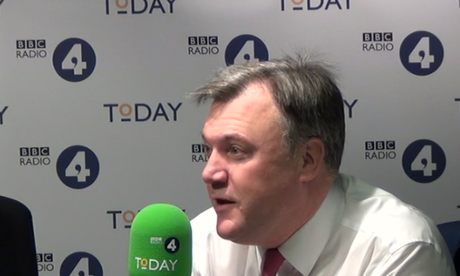
Ed Balls, the shadow chancellor, was on the Today programme this morning, confirming Labour’s opposition to the current tuition fees system, but refusing to spell out details of how the party would fund its plan to cut maximum fees from £9,000 to £6,000. And Caroline Lucas, the Green MP, has given a big interview to the programme too, much of which was taken up with repairing the damage done by Natalie Bennett’s interview with Andrew Neil last Sunday. I’ll post details of both interviews soon.
And then we’re into what may be a fairly hectic day. Here’s the agenda.
9.30am: Nicola Sturgeon, Scotland’s first minister, and Alistair Carmichael, the Scottish secretary, attend an oil summit in Aberdeen.
10am: Natalie Bennett, the Green leader, attends the Sky News Ask the Leaders event.
12pm: Nick Clegg attends the Sky News Ask the Leaders event.
Around lunchtime: David Cameron gives his education speech.
2pm: Ed Miliband attends the Sky News Ask the Leaders event.
3pm: Peers begin debating the report stage of the counter-terrorism bill. At some point a vote on a “snooper’s charter” amendment is due.
4pm: Lord Ashcroft publishes his latest polling, including polls from individual seats in Scotland.
As usual, I will be also covering all the breaking political news from Westminster, as well as bringing you the most interesting political comment and analysis from the web and from Twitter. I will post a summary at lunchtime and another in the afternoon.
If you want to follow me on Twitter, I’m on @AndrewSparrow
Updated