Afternoon summary
-
A poll for Lord Aschroft puts the Conservatives six points ahead of Labour.
Ashcroft National Poll, 9-11 January: CON 34%, LAB 28%, LDEM 8%, UKIP 16%, GRN 8%. Full details on @ConHome, 4pm
— Lord Ashcroft (@LordAshcroft) January 12, 2015
If you were about to bet on LAB following Populus 5% lead poll HOLD ONTO YOUR MONEY. @LordAshcroft has blues 6% ahead pic.twitter.com/UNz5Ln4SoK
— Mike Smithson (@MSmithsonPB) January 12, 2015
-
A Populus poll has put Labour five points ahead of the Conservatives.
Latest Populus VI: Lab 37 (+3), Con 32 (-1), LD 10 (+2), UKIP 13 (-1), Oth 8 (-3). Tables here: http://t.co/BL98r2QdK9
— Populus (@PopulusPolls) January 12, 2015
-
Three Labour MPs have announced that they are suing Jane Collins, a Ukip MEP, for slander. At Ukip’s party conference Collins suggested they knew details of child abuse happening in Rotherham. In a joint statement, Sarah Champion, John Healey and Kevin Barron said:
It is sickening that Ukip could use such an important issue for party-political point-scoring, and we will challenge these defamatory accusations through every means available to prove they are untrue and to stop Ukip exploiting the terrible abuse for their own political gain.
-
The Ministry of Defence has said that it is reviewing the decision not to pay operational allowance to reservists tackling Ebola in west Africa during their deployment. Julian Brazier, the defence minister, made the announcement at defence questions in response to a question from Labour’s John Woodcock.
(In the light of the Ashcroft poll, it is worth recalling a saying attributed in our office to my old Guardian colleague, Julian Glover; if a poll is interesting, it’s wrong. What that means is that the polls that attract most interest are the outliers. The average tends to be more reliable, but a poll in line with the average is always rather dull in news terms.)
That’s all from me for today.
Thanks for the comments.
Updated
Ed Miliband had dinner with George Clooney and his wife Amal, the human rights lawyer, at the home of Geoffrey Robertson QC, the Telegraph reports. They discussed the case for a “Magnitsky law”, based on the US law banning those Russian implemented in the death of Sergei Magnitsky from entering the country. Miliband is said to be keen on the idea.
Here is a short afternoon reading list.
In April 1998 long dated gilts yielded 5.71%. A decade later that was 4.5%. By April 2012 it was 3.31% and in April 2014 this had little changed at 3.46%, but now it is 2.62%. If we had a debt crisis very clearly risk would have increased and so interest rates would have risen. But they haven’t. Interest rates have fallen, significantly, and not just to reflect inflation.
So first of all we have no gilt crisis.
Second, we have no affordability crisis.
And third, we have a lost opportunity to invest at rates lower than we have almost ever known, which lost opportunity is why we have an economic crisis.
It’s very hard to see how one man can get as much wrong as David Cameron can in the repeated sentiment he has to offer to the UK. But the evidence is clear: every single word of what he has to say is deeply misleading because it is so wrong.
Updated
Alex Salmond has got a new job as a newspaper columnist.
Catch my new column in @Pressjournal & @thecourieruk every Monday. Today: an agenda for oil jobs https://t.co/HqrAMasH7V
— Alex Salmond (@AlexSalmond) January 12, 2015
Here’s Matthew Goodwin, the academic and Ukip specialist, on David Cameron’s decision to omit immigration from his list of Tory priorities.
A major gamble for Cameron. The number one issue in British politics -immigration- has just been ceded to an insurgent.
— Matthew Goodwin (@GoodwinMJ) January 12, 2015
Three Labour MPs are suing a Ukip MEP, Jane Collins, over comments she made about their record on sex abuse, the BBC is reporting.
rotherham MPs Sarah Champion, John Healey and Kevin Barron are to sue UKIP MEP Jane Collins for libel and slander after conf speech claims
— Robin Brant (@robindbrant) January 12, 2015
A couple of birthdays.
A very happy 99th birthday to Mary Wilson, poet and widow of Prime Minister and Leader of the Labour Party Harold Wilson
— Labour History Group (@LabourHistory) January 12, 2015
Happy birthday, Edmund Burke! pic.twitter.com/jprzyQAFdv
— Students For Liberty (@sfliberty) January 12, 2015
Labour has produced a Twitter graphic (or whatever they are called - is there a proper word for them?) about David Cameron’s decision to omit the NHS from his list of six election priorities.
David Cameron on the NHS, then and now pic.twitter.com/zmJBTpGQaC
— Labour Press Team (@labourpress) January 12, 2015
Lunchtime summary
-
David Cameron has said that the Conservatives are committed to “comprehensive” legislation to extend internet surveillance laws after the election. In a Q&A session after his speech on the deficit (see 12.52pm,) he said that it was vital to ensure “we do not allow terrorists safe space to communicate with each other”. Later Simon Hughes, the Lib Dem justice minister, said he did not accept that new leglisation was needed. Hughes told BBC News:
We must be very careful not to do is to think we need to answer the problems by further legislating and taking away people’s liberties any further. If you take away people’s liberties in order to deal with terrorism like this, unless it’s justified, proportionate and necessary, you’re giving up liberty too far. We’ve got the balance right. It sounds as if it hasn’t been a lack of power in the authorities, it’s been a failure, possibly, of sharing the information and using the powers that exist.
-
Cameron has described the Fox News commentator who said that Birmingham was a “no-go” zone for non-Muslims as “a complete idiot”. Cameron told ITV News:
When I heard this I choked on my porridge and I thought it must be April Fool’s Day. This guy is clearly a complete idiot. Now he has started with an apology, that’s not a bad start, but what he should do is look at Birmingham and see what a fantastic example it is of bringing people together of different faiths, different backgrounds and actually building a world-class, brilliant city with a great and strong economy.
- The SNP has welcomed a poll showing that a majority of British voters think Nicola Sturgeon, the Scottish first minster, should be included in UK televised debates. The YouGov poll found that 53% of people think she should take part. The figures for other leaders are: Cameron and Miliband, both 84%; Nick Clegg, 78%; Nigel Farage, the Ukip leader, 71%; and Natalie Bennett, the Green leader, 62%.
-
A Sinn Fein member has been elected Speaker of the Northern Ireland Assembly for the first time. Mitchel McLaughlin was appointed after receiving cross-community support from Sinn Fein, the DUP and the Alliance Party. He takes over from the DUP’s William Hay who stood down in October due to ill health.
At the Number 10 lobby briefing this morning the prime minister’s spokesman was asked about Sajid Javid’s comments yesterday about the role Muslim communities play in tackling extremism. My colleague Nicholas Watt has sent me this.
David Cameron has endorsed the remarks by Sajid Javid, the culture secretary, that Muslim communities face a special burden to help to track down Islamist extremists.
Downing Street said the government would continue to work closely with members of Britain’s Muslim communities through the Prevent strategy to tackle the “extreme Islamist ideology” that is perverting their religion.
Javid, Britain’s only Muslim cabinet minister, said that all communities could do more to confront extremists as he spoke of a special burden on Muslims.
Speaking on the Murnaghan Programme on Sky News on Sunday, Javid said: “All communities can do more to try and help deal with terrorists, try and help track them down. But I think it is absolutely fair to say that there is a special burden on Muslim communities because whether we like it or not these terrorists call themselves Muslims. It is no good for people to say they are not Muslims, that is what they call themselves. They do try to take what is a great peaceful religion and warp it for their own means.”
The prime minister’s spokesman said: “The prime minister would agree with the points that the secretary of state for culture, media and sport was making. When the government works with communities to deal with and to try to help tackle extremism, tackling extreme Islamist extremism means working particularly closely with the Muslim community. That is an important part of the Prevent strategy. That in no way detracts from the fact that Islamist extremism is a perversion of the Muslim faith.”
The No 10 stopped short of accepting a suggestion that Javid was saying that Muslim communities had not done enough to tackle extremism. The culture secretary chose his words with care in this sensitive area and said “all communities” could do more before saying Muslims face a special burden.
Asked for the prime minister’s response to the apparent claim by Javid that Muslim communities were not doing enough, the spokesman indicated that the government did not accept this interpretation of his remarks.
The No 10 spokesman said: “In terms of what the secretary of state said: I would associate the PM with his words. Do we already work with the Muslim community in this area? Absolutely. It is that community whose religion is being warped and twisted, it is families in that community who are having to face the fact that a small number of their relatives – often strongly against their wishes – are maybe travelling to join radical groups. So it is important to continue working very closely with the Muslim community when we are dealing with how we tackle together the challenge of this extreme Islamist ideology.”
Ed Miliband's Q&A - Summary
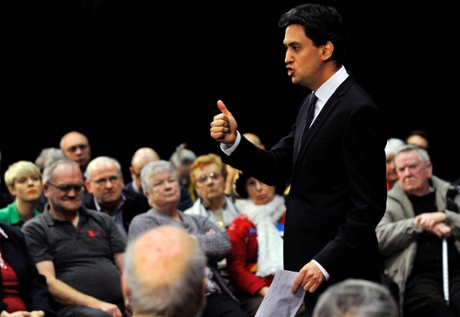
Ed Miliband’s Q&A in Stevenage wasn’t broadcast. But the Press Association were there, and journalists were tweeting from it, and some key lines have emerged.
-
Miliband refused to say that repealing the Health and Social Care Act would be a “red line” in any possible coalition talks.
Audience member: will repealing Health and Care Act be a "red line" in coalition negotiations? EdM: You're asking me things I can't answer
— Tom Barton (@tombarton) January 12, 2015
-
He suggested that pulling out of the EU would put security at risk.
Membership of the EU is vital to stopping attacks like those in Paris, says Ed M. "We are much better working across borders."
— Laura Pitel (@laurapitel) January 12, 2015
Miliband said:
Think about terrorism and counter-terrorism. We are much better working across borders to do that. Think about our economy ... I just think we are much, much better working within the EU than not.
-
He accused David Cameron of being afraid of campaigning on the NHS. Referring to the fact that the NHS is not one of the six election themes chosen by the Conservatives, Miliband said:
David Cameron has gone from saying the NHS were the three most important letters to him to the health service becoming the subject that dare not speak its name.
- Miliband said the Conservatives had failed to tackle the deficit because they had not addressed the living standards crisis.
The reason David Cameron and George Osborne have failed on the deficit is because they have failed on living standards.
Unless we have higher wages and living standards, we won’t get the revenue to reduce the deficit.
Their plan will keep failing on living standards and therefore keep failing on the deficit.
And now they want to go even further: back to the 1930s on public spending.
No wonder David Cameron has gone from saying the NHS were the three most important letters to him to the health service becoming the subject that dare not speak its name
According to the BBC’s Tom Barton, Miliband said that audience was not just made up of Labour members.
Miliband says audience not just made up of Labour voters and party members, but people he wants to persuade to vote Labour.
— Tom Barton (@tombarton) January 12, 2015
But BuzzFeed’s Jamie Ross says he could not find any non-Labour members there.
Spoke to a dozen audience members post-show. All Lab members, all approved of the answers. Although one is upset immigration didn't come up.
— Jamie Ross (@JamieRoss7) January 12, 2015
Updated
Cameron's speech and Q&A - Summary
David Cameron’s speech did not go much further than what was briefed out overnight. (See 9.41am.) But his Q&A was revealing - not least because, too his credit, he took a succession of hard-edged questions from journalists, instead of trying to pad them out with questions from supporters or members of the public, as often happens at events like this. (Non-journalists can ask tough questions too, but more often they don’t - partly because they have less experience anticipating what the likely reply will be.)
In content terms, what was most interesting was Cameron’s decision to slap the proposed “snooper’s charter” very loudly on the table as an election issue.
And, in presentational terms, what was striking was how well he did it. Internet surveillance is a complicated issues, and the arguments for and against the snooper’s charter are highly nuanced. Yet he put the case for it with remarkable clarity.
Here are the key points.
-
Cameron said he was committed to “comprehensive” legislation to extend the law on internet surveillance if he won the election. Referring to the draft plans for the so-called snooper’s charter, which has been blocked by the Lib Dems, he said:
Will we be able to access the content of communications as the internet and new ways of communicating develop? Now, I have a very simple principle to apply here which should be at the heart of the legislation that will be necessary. The simple principle is this: do we want to allow a means of communications between people which, even in extremis, with a signed warrant from the home secretary personally, that we cannot read? Up until now governments of this country have said no, we must not have such a means of communication. That is why, in extremis, it’s been possible to read someone’s letter. That is why, in extremis, it’s been possible to to listen in to someone’s telephone call ... This cannot happen unless the home secretary personally signs a warrant. We have a better system for safeguarding this very intrusive power than probably any other country I can think of. The question remains, are we going to remain a means of communication where it simply isn’t possible to do that? And my answer to that is, no, we must not. The first duty of any government is to keep out country and our people safe ...
The powers that I believe we need, whether on communications data or on the content of communications, I’m very comfortable that those are absolutely right for a modern, liberal democracy ...
Cameron pointed out that the emergency legislation on data retention passed last summer would lapse in 2016.
The next government, and I hope it’s a government I lead, will have to legislate again in 2016. What I can say, if I am prime minister, I will make sure it’s a comprehensive piece of legislation that makes sure we do not allow terrorists safe space to communicate with each other. That is the key principle.
-
He said that Ed Miliband’s refusal to deny yesterday talking about “weaponising” the NHS showed Labour’s “disgraceful” approach to this topic.
Having watched that exchange on Andrew Marr, where he was wriggling like an eel, it is absolutely clear to me that he did say those words and that is why he wouldn’t deny it. And I think in one moment we learnt more about Labour’s attitude to the NHS than we’ve learnt perhaps for five years; they just see it as a political weapon. Well, frankly, I think that is disgraceful.
- He claimed that Labour and the Lib Dems were opposed to his position on TV debates because they were “running away” from a debate with the Greens. (This was utterly misleading, because Labour and the Lib Dems are not refusing to debate with the Greens.)
- He would not commit himself to taking part in the proposed Guardian/Telegraph/YouTube online debate, but he said he would be happy to look at any proposals.
- He rejected claims that his choice of six election priorities meant that he did not see the NHS or immigraion as important. “The NHS is at the heart of this commitment for Britain to live within her means,” he said. And he pointed out that he had recently given a major speech on immigration.
-
He did not renew his call for EU migrants to be stopped from coming to the UK if they do not have a job. This proposal did not feature in the list of four demands he set out summarising his policy on immigration. (See 11.47am.) Cameron also omitted this demand at his news conference with Angela Merkel last week, suggesting he now accepts that banning EU migrants from coming to the UK if they do not have a job offer is probably unachievable.
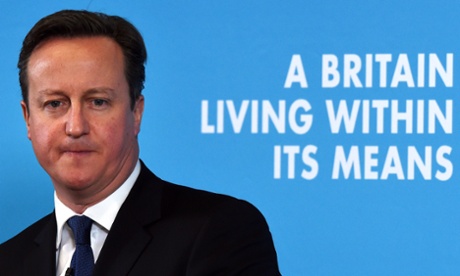
And this is worth pointing out too.
No reference in PMs speech on the deficit to that "deficit halved" claim
— Faisal Islam (@faisalislam) January 12, 2015
Updated
Q: Voters put the NHS and immigration at the heart of their concerns. Why are you not including them in your six themes for speeches?
Cameron says he does not accept that. As he said in his speech today, controlling the deficit is necessary to ensure that the NHS can be protected.
This is the foundation on which everything else is built, he says.
And that’s it. The Q&A is over. I’ll post a summary shortly.
Q: Would you be happy to take part in the digital debate being proposed by the Telegraph and the Guardian?
Cameron says he would be happy to look at any proposal for a debate.
Q: Do you agree that the Duke of York made a mistake with his friendship with Jeffrey Epstein?
Cameron says he will not comment on that.
Q: Why don’t you want TV debates to go ahead?
Cameron says he does not want to pass up the opportunity of talking to millions of people. He would like to have them again. But there must be rules. If one minor party, Ukip, can participate, the Green should be allowed to join in too. He can see why Labour and the Lib Dems are running away from this; it is because they are afraid of the Greens.
Q: What do you think of Ed Miliband’s comment yesterday when he would not deny saying he wanted to “weaponise” the NHS?
Cameron says he watched Miliband’s Marr interview yesterday. Miliband was wriggling like an eel. It is obvious he did say this. It is a disgraceful thing to say.
Updated
Cameron’s speech is over. He is now taking questions.
Q: After the events in Paris, you seemed to suggest that there was a division in Britain over legislating to give more powers to the security services to monitor the internet.
Cameron says there are two issues.
First, what do to about communciations data. This is not about the content of communications; it is about who spoke to who. He says he wants more legislation to ensure that the security services can get this.
The second issue is to do with content, he says. He says he applies a simple principle: Do we want to allow a means of communication to exist that, in extremis, cannot be intercepted? In the past the answer has been no. That is why letters can be intercepted, and phone calls monitored. This only happens if the home secretary signs a warrant. Cameron says his view is that the state should always have this power in extremis.
He says the powers that the government needs, on data and communciations, are appropropriate for a modern, liberal democracy.
The last legislation on this falls away in 2016.
He says that, if he is prime minister after the election, he will introduce comprehensive legislation on this. We should not allow a safe space for terrorists to communicate.
Q: Why is immigration not on the list of your priorities?
Cameron says the issues he has highlighted directly affect people’s lives. He will address other issues through the prism of these issues. For example, he will address the issue of immigration in terms of what it means for jobs.
He says he set out his policy in a speech recently. And he sums it up in four points: Stopping migrants coming to the UK to claim unemployment benefits; making them leave if they do not have a job after six months; making them contribute for four years before they can get tax credits or other benefits; and stopping them sending child benefit abroad.
Updated
Meanwhile, at the Ed Miliband event, we’ve had this revelation.
Ed Miliband tells us he spent Friday night at the YMCA.
— Jamie Ross (@JamieRoss7) January 12, 2015
I will post a summary of the main points from it later.
David Cameron is delivering his speech now.
A large extract was published in advance (see 9.41am), but I will post a summary of any interesting lines not pre-released when I’ve seen the full text.
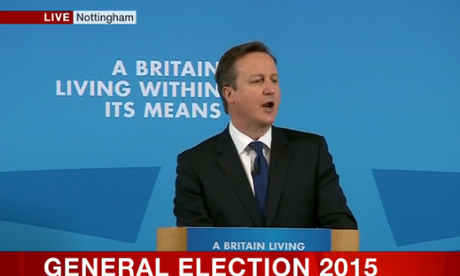
And here is the scene at the venue where David Cameron is giving his speech.
Slogan for Cameron speech today: a Britain living within its means pic.twitter.com/lPCtAveRlA
— Ross Hawkins (@rosschawkins) January 12, 2015
Ed Miliband’s People’s Question Time in Stevenage is just getting underway.
#Stevenage event with @Ed_Miliband now starting. He's expected to talk about NHS and cost of living. pic.twitter.com/skKcU5gCAD
— Tom Barton (@tombarton) January 12, 2015
If you were wondering why @Ed_Miliband's in #Stevenage, here's why: 3,578. That's the 2010 Tory majority that Labour want to overturn here.
— Tom Barton (@tombarton) January 12, 2015
Stevenage is 58th on Labour’s list of target seats, according to this list that Lewis Baston compiled for Progress (pdf).
According to a poll Lord Ashcroft conducted in December, Labour is on course to win here.
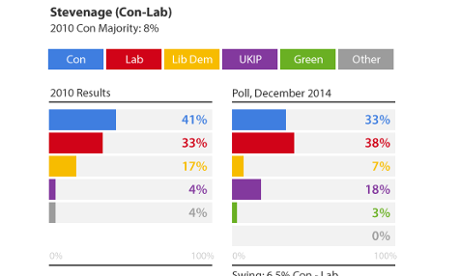
http://www.progressonline.org.uk/wp-content/uploads/2014/01/Battleground-Briefing.pdf
Labour is criticising David Cameron for not including the NHS in his list of six topics that will be Tory election priorities. (See 8.54am.) This is from Andy Burnham, the shadow health secretary.
At the 2010 Election, @David_Cameron said the NHS would be his top priority. This time, it doesn't feature in his top 6 themes. Says it all.
— Andy Burnham (@andyburnhammp) January 12, 2015
But the Tories reject this claim. “As our press notice said, one of the key reasons Britain needs to live within its means is so we can ‘increase spending on the NHS so everyone gets the care they need’,”, one aide said.
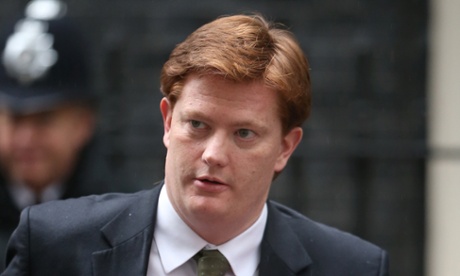
Danny Alexander, the Lib Dem chief secretary to the Treasury, has issued this statement ahead of David Cameron’s speech. (See 9.41am.)
The Tory approach to the nation’s finances in the next parliament is an extraordinary about turn from the balanced, fair and successful economic policy Liberal Democrats have insisted on up to now.
By pledging that there will be no tax rises on the wealthy, the Tories are committed to putting all of the remaining burden on the working people of this country. That is unfair and wrong.
There is no need to carrying on cutting spending after the books are balanced. It is public services and the people who use them whose future opportunities would be limited by the Tories ideological drive for an ever smaller state.
Most people understand that we have to finish the job of balancing the books. But there should be light at the end of the tunnel - the Tories have confirmed that they want to switch it off!
Outcome from Cameron's security meeting about Paris attacks
Number 10 has released a briefing on David Cameron’s security meeting this morning. Here it is in full. It’s from a spokesperson
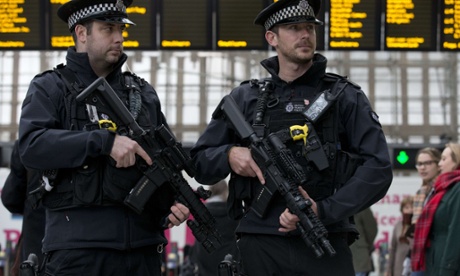
The prime minister held a security meeting in Downing St this morning to review the Paris attacks and the risks to the UK of a similar attack.
Following an intelligence update, they discussed the UK’s preparedness for similar incidents. The relevant police and agencies regularly carry out exercises to test their response to a terror attack, including scenarios similar to the incidents in Paris. The meeting agreed that for future exercises, the relevant agencies should identify whether there are any further specific elements of the Paris attack that should be built into the exercise scenarios.
The prime minister also asked the police and military to continue to work closely together to ensure that the police can call on appropriate military assistance when required across the country.
They also discussed the risk posed by firearms, agreeing that our existing tough firearms laws are a very important part of the protections we have and that we should step up our efforts with other countries to crackdown on the illegal smuggling of weapons across borders.
And here it is, translated into headlines.
- Cameron calls for measures to be taken to ensure that army are on standby to help police deal with terror attacks in the UK.
- Lessons from Paris attacks to be incorporated into future police and MI5 training exercises relating to terrorism incidents.
-
Britain to intensify efforts to tackle the smuggling of weapons into the UK.
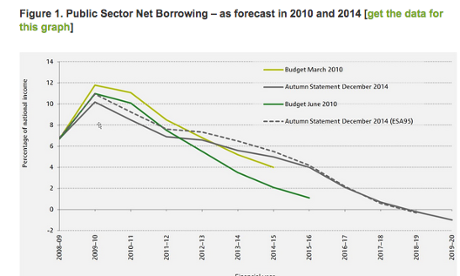
This is a service to the nation. The Institute for Fiscal Studies has launched an election website, where it is publishing authoritative analysis of what has happened to taxation, spending and the economy generally over the last five years, and what the parties’ election plans would mean for the future.
Unfortunately for David Cameron, whose speech today is about the Conservatives having a “proven record” on handling the economy and tacking the deficit, the item at the top of the site today is about the claim that the deficit has been halved. Here’s an excerpt.
A hole in the public finances opened up from 2008, after the financial crisis and associated recession. As national income fell, tax receipts fell even faster. Spending that was fixed in cash terms shot up as a share of national income. In 2009–10 government borrowing was 10.2% of national income. Worse still, most of the resulting increase in borrowing was thought to reflect a permanent hole in the public finances, i.e. borrowing that would not disappear as the economy recovered. With no policy action, debt would have been on an unsustainable path.
As a share of national income, by 2014–15 the deficit was half that in 2009–10, and the latest forecasts suggest that the government will be running a surplus of 1.0% of national income by 2019–20. However, as shown in Figure 1, things have not gone completely to plan. Back in June 2010 the Coalition expected borrowing to fall much more quickly after 2011–12 and the deficit this year is projected to be more than twice as high as was forecast in June 2010.
And here’s the IFS chart illustrating this.
Updated
Does anyone know if voters, or focus group participants, actually believe the Conservative line about Labour plans leading to “economic chaos”? (See 9.41am.) I would love to see some evidence on this because it strikes me as hyperbole. There are plenty of negative arguments that you could make against Labour’s economic plans with varying degrees of plausibility (higher borrowing, higher taxes for some, more regulation, a less flexible labour market), but the idea that any of this would tip Britain into chaos sounds implausible. I would love to see some research on this.
(That said, I also said last week that I found Ed Miliband’s claim that the NHS as we know it won’t survive another five years of David Cameron’s too far-fetched. “As we know it” implies free at the point of delivery and it is hard to imagine Cameron abandoning that. But this YouGov research (pdf) subsequently found that 48% of people do believe this, against 32% who don’t, so what do I know? Perhaps the 48% are just replying yes because they think the NHS would get a lot worse under Cameron. But an underfunded NHS is not something we’ve never seen before.)
Cameron's economy speech - Extracts
For the record, here are some more extracts from David Cameron’s economy speech. They were released overnight by Number 10.
-
Cameron will say that Labour’s policies would lead to “economic chaos”.
It’s election year, and the choice is clear: staying on the road to recovery - or choosing the path to ruin. Competence or chaos.
With the other parties, all you get is confusion.
Uncosted plans. The spectre of more debt. The shadow of more taxes on your family, your home, your business.
With the Conservatives, you get the opposite. A strong and competent team, a proven record, and a long-term economic plan that is turning our country around ...
We cannot overstate how important this is.
If we fail to meet this national challenge, the writing is on the wall.
More borrowing – and all the extra debt interest that brings, meaning there is less money to spend on schools and hospitals and all the things we value as a country.
More spending, and the higher taxes that will require – hardworking people thumped to pay for Government wastefulness.
And higher interest rates too – punishing homeowners, hurting businesses, losing jobs.
In short, economic chaos.
-
He will say that reducing the national debt is essential.
This isn’t just about the straightforward economic arguments.
It is about the values of this country, whether we as a nation are going to pass on a mountain of debt to the next generations that they could never hope to re-pay.
To every mother, father, grandparent, uncle, aunt – I would ask this question.
When you look at the children you love, do you want to land them with a legacy of huge debts?
-
Cameron will say that the Conservatives’ long-term economic plan can be summed up in one sentence.
The goal of that plan can be summed up in a sentence.
Securing a better future for you, your family and Britain.
(Actually, without a subject, that doesn’t really count as a proper sentence in my book, but never mind.)
And David Cameron has now been tweeting about this morning’s meeting.
I've had a full briefing from security chiefs. We discussed ensuring the UK is properly protected from the terrorist threat. #CharlieHebdo.
— David Cameron (@David_Cameron) January 12, 2015
115 days to #GE2015
— Alberto Nardelli (@AlbertoNardelli) January 12, 2015
David Cameron’s meeting with security officials is over.
The BBC’s Robin Brant posted these tweets earlier.
Home sec arrives for security chiefs meeting at no. 10 https://t.co/IqrIjOEfCH
— Robin Brant (@robindbrant) January 12, 2015
Home sec & met comm hogan Howe at no.10 for security meeting
— Robin Brant (@robindbrant) January 12, 2015
And he posted these a few minutes ago.
Looks like security meeting at no.10 over, def sec Fallon just departed
— Robin Brant (@robindbrant) January 12, 2015
PM appears to have departed no.10 for journey to next appointment https://t.co/9MrvDVRDH4
— Robin Brant (@robindbrant) January 12, 2015
David Cameron is giving a speech on the economy and the deficit this morning. Tackling the deficit will be one of the Conservatives’ six election manifesto priorities. The others are: jobs, taxes, education, housing and retirement.
Some extracts have been released in advance and the core message is familiar. My colleague Nicholas Watt has written a preview story.
Britain will be on the “path to ruin” if Labour takes charge of the public finances, David Cameron will say on Monday as he warns parents and grandparents of the dangers to future generations if the country fails to deal with its debts.
As Miliband accused the Tories of adopting “gimmick” tactics on the public finances by staging a Commons vote on their plans on Tuesday, the prime minister will accuse Labour of threatening higher interest rates after failing to set a date for the elimination of the deficit.
In a speech to party supporters, Cameron will say: “The choice is clear: staying on the road to recovery – or choosing the path to ruin.
“If we fail to meet this national challenge, the writing is on the wall. More borrowing, and all the extra debt interest that brings, meaning there is less money to spend on schools and hospitals and all the things we value as a country. More spending, and the higher taxes that will require – hardworking people thumped to pay for government wastefulness. And higher interest rates too – punishing homeowners, hurting businesses, losing jobs. In short, economic chaos.”
Cameron will be on his feet roughly at the same time as Ed Miliband, who is doing another of his People’s Question Time sessions. I’ll be covering both in detail.
Here’s the full agenda for the day.
Morning: David Cameron chairs a meeting with security officials to discuss the ramifications of the terror attacks in Paris.
11am: Ed Miliband holds a People’s Question Time event in Stevenage.
Morning: Cameron gives a speech on the economy.
3.15pm: Sir Michael Wilshaw, the head of Ofsted, and Chris Wormald, permanent secretary at the Department for Education, give evidence to the public accounts committee about children in care.
As usual, I will be also covering all the breaking political news from Westminster, as well as bringing you the most interesting political comment and analysis from the web and from Twitter. I will post a summary at lunchtime and another in the afternoon.
If you want to follow me on Twitter, I’m on @AndrewSparrow.