Afternoon summary
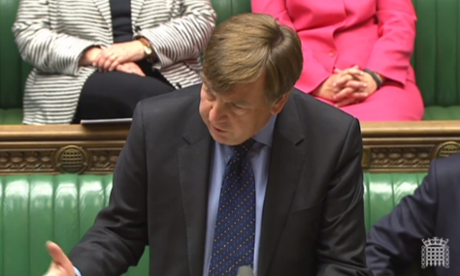
- John Whittingdale, the culture secretary, has hinted that the government could back England hosting an alternative World Cup in 2018 in the light of the ongoing scandal at Fifa. (See 3.43pm.) In response to a question about whether firms could be prosecuted in the UK under the Bribery Act in relation to Fifa corruption, he also told MPs the Serious Fraud Office was assessing information.
- Philip Hammond, the foreign secretary, has said withdrawal from the European convention on human rights is “not the proposal on the table” for the government. (See 4.19pm.)
-
Jean-Claude Juncker, the European commission president, has said that David Cameron wants to use the EU referendum to “dock” the UK permanently into the 28-nation bloc. Juncker told a German newspaper:
Brexit is also a question that does not arise, it is not what the British are seeking. Cameron wants to dock his country permanently to Europe.
Nigel Farage, the Ukip leader, hit back at Juncker. He said:
The British people are fed-up to the back teeth with Eurocrats telling us what we want, what is good for us, how to run our businesses and how we organise our society.
-
A senior German politician has said Cameron’s plans to change the EU’s treaties as part of his renegotiation are “not realistic” before the end of 2017. As the Press Association reports, Norbert Roettgen, the chairman of the Bundestag’s foreign affairs committee, spoke at a briefing in London, Roettgen, a former minister in Angela Merkel’s government, said:
I can’t see treaty change as a realistic option within the course of two years.
He said there was not an “atmosphere” within Europe for change, which would require lengthy procedures in each of the 28 member states, with some legally obliged to put the proposals to a public referendum.
This leads me to conclude that one should be realistic. Treaty change, to have a consensus about the contents and then to have the procedure of treaty change within two years, I would venture to say this is simply not realistic.
He also said any plan to limit the access of EU migrants to benefits would “imply discrimination against workers of other member states” and would be “a violation of a fundamental principle of the European Union which would not only require treaty change, but which would not be approved of by the other member states because we want to preserve this liberty of workers within the European Union”. He suggested that the UK instead may have to change the way its citizens qualify for benefits, moving to a contributory system, in order to avoid breaking anti-discrimination rules.
That’s all from me for today.
Thanks for the comments.
Updated
A Labour leadership round-up
Here’s a Labour leadership round-up.
-
Stephen Bush at the Staggers says Andy Burnham has become the first leadership candidate to have declared support from more than 35 named MPs, meaning that he will definitely be on the ballot paper. But his rivals about been briefing against him, Bush says.
His main rivals, Liz Kendall and Yvette Cooper will certainly both qualify - the Cooper campaign has already moved into its campaign headquarters outside Parliament - and sources close to both have already moved to belittle Burnham’s achievement in amassing 35 signatures.
“Andy still waiting for an MP from south of Warrington,” texted one. “Yvette has support from the Midlands, London, Wales and the North. Andy has support from Wales and the North. Still sure he’s the frontrunner?” An MP who has yet to declare a preference notes: “These new endorses are hardly surprising. A Merseyside MP. A Cheshire MP. A bunch of ex-union officials, and a mate of Owen Smith.”
Liz Kendall has talents that are little known to party members. Her roots are unambiguously working-class and her commitment to the century-long ideals of the party is absolute. She has intellectual depth, an enviable aplomb in dealing with the media and is powerfully combative in the political fray. Liz is not burdened by damaging baggage from past roles and she is not tainted by previous Labour Party divisions. On a personal level I admire her natural friendliness and kindness. As our Leader she will rapidly endear herself to all individuals and groups in our movement.
Where others hedge, Ms Kendall and her team describe the recent election as “catastrophic”. She urges her party to ditch the “fantasy” that Britons are left-wing. Raised in the middle-class, southern suburb of Watford, she well knows the people Labour must target if it is to win again and exudes the sort of hard-headed practicality that appeals to such voters—mostly avoiding the jargon and circumlocutions that alienate them yet infect the speech of many politicians.
What’s more, she has the makings of an answer to the existential question before Labour (and struggling centre-left parties across Europe): how to make society fairer when money is tight? Ms Kendall’s solution, honed during her career in think-tanks, as an adviser to the Blair government and in a series of recent essays, is reform of the state. She envisages decentralised public services run by employees, citizens and voluntary groups, and is relaxed about private-sector involvement. Speaking to her, your columnist’s impression was of a sceptical social democrat with a liberal’s doubts about central government: she pooh-poohs Westminster’s fusty rituals and mocks politicians’ and civil servants’ faith in the power of speeches, regulations and dictats to get things done.
Ed Miliband has been sitting in the Commons chamber this afternoon.
Ed Miliband seems to be enjoying life on the backbenches during #FIFA UQ pic.twitter.com/L7OaFtpbjo
— Mark Smith (@marksmith174) June 1, 2015
Salmond says that, in his speech earlier, Hilary Benn, the shadow foreign secretary, would not support EU citizens being allowed to vote in the EU referendum. But Benn’s stance on this is different from Kezia Dugdale’s, Salmond says. Dugdale is Scottish Labour’s deputy leader, and tipped to take over as its leader in the forthcoming leadership election.
Updated
Salmond turns to the European convention on human rights.
He says that, at the end of the debate on Thursday, Michael Gove, the justice secretary, gave three different evasive replies when asked if the government would withdraw from the European convention on human rights.
Yet Philip Hammond, the foreign secretary, gave a clearer answer this afternoon, he says. (See 4.19am.)
Salmond says he remembers meeting Michael Gove when he was a striking young journalist on the Press and Journal in the early 1990s. Gove was literally striking; the journalists were on strike.
At the time Gove was eloquent on the subject of workers’ rights, he says.
He says there would be huge opposition in Scotland to withdrawal from the European convention on human rights.
Most MPs won’t know this, he says, but there is a framed copy of the Declaration of Arbroath at the European court of human rights. He says most European court judges know more about the Scottish legal system than MPs.
Salmond says at the end of this debate the minister winding up should say when the Iraq inquiry will report.
And the minister should explain whether the long delay has prevented legal action being taken against any of the participants, he says.
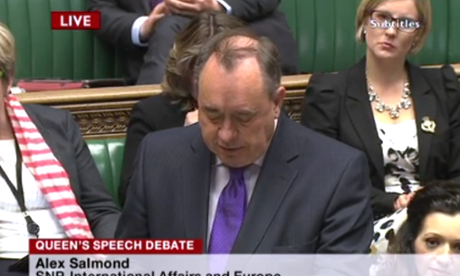
Alex Salmond's foreign affairs speech
Alex Salmond, the former Scottish first minister, is speaking now in the foreign affairs debate. He is the SNP’s foreign affairs spokesman.
This is is his first major speech in the Commons since the election, although he did speak in an adjournment debate on Trident safety on Thursday.
MPs are still debating the Queen’s Speech, and today they are focusing on foreign affairs. Philip Hammond, the foreign secretary, opened the debate.
Alex Salmond, the former Scottish first minister, asked Hammond if he supported withdrawal from the European convention on human rights. Hammond told him this was “not on the table”. He said:
That is not the proposal on the table - the proposal as you know is to ensure that our obligations in respect of compliance with the human rights agenda are overseen by judges in this country in the context of what is happening in this country.
As Guido Fawkes reports, Hammond also came out with a gentle put-down for Boris Johnson.
Whittingdale hints government could back England hosting alternative 2018 World Cup
Here is a summary of the main points from John Whittingdale’s response to the urgent question on Fifa.
-
Whittindale hinted that the government could back England hosting an alternative World Cup in 2018 in the light of the ongoing scandal at Fifa. But he said that Britain would have to act with countries from Europe and elsewhere.
If there were any serious attempt to organise an alternative to the existing World Cup, that could only be done if there were a strong agreement across the European nations, and preferably with other football associations from around the world. So the first thing that needs to be done is for that to be discussed within Uefa.
He said there was no point England boycotting the 2018 World Cup on its own. Asked about England hosting an alternative tournament, he said it had been in a very credible bid for the 2018 tournament. But he stressed that this was an issue on which the football associations had to take the lead, he said. He said he had spoken to Greg Dyke, chair of the Football Association, and would be meeting him later this week. Dyke will be talking to Uefa colleagues about this, he said.
-
Whittingdale said that Sepp Blatter’s credibility as Fifa president had been “utterly destroyed” and that he should resign.
Fifa’s voting system is designed to support the incumbent and it returned a predictable result but there is no doubt that what remained of Sepp Blatter’s credibility has been utterly destroyed.
Whittingdale said that Blatter had presided over a “culture of kickbacks and corruption that risk ruining international football for a generation”. Chris Bryant, the shadow culture secretary, said that Blatter was a “tainted leader of a corrupt organisation” and that he only survived last week because of his “Mafioso cronyism”.
-
Whittingdale said that pressure on Blatter was growing and he urged others to support the campaign to force him out.
The mere fact that more than 70 national associations felt able to back a rival candidate shows that momentum against [Blatter] is building. We must now increase that pressure still further. It is up to everyone who cares about football to use whatever influence they have to make this possible. I am sure that fans the world over will be increasingly vocal in their condemnation of the Blatter regime and Fifa’s sponsors need to think long and hard about whether they want to be associated with such a discredited and disgraced organisation. For the good of the game we must work together to bring about change. For the good of the game it is time for Sepp Blatter to go.
-
Whittingdale said sponsor should go “much further” in terms of putting pressure on Fifa for change.
Visa has already made a strong statement. Other sponsor have indicated their unhappiness, but certainly we would like them to go much further.
Updated
Here is Channel 4 News’s Paul Mason on the Fifa exchanges.
This #HoC exchange - with Whittingdale - unprecedented: clear alignment of DCMS and FA towards organised boycott of #WC2018
— Paul Mason (@paulmasonnews) June 1, 2015
Labour’s Mike Gapes says it was Uefa that blocked a proposal to impose term limits on the Fifa presidency.
Whittingdale says he does know know whether that is true.
And that’s it.
I will post a summary shortly.
Labour’s Barry Gardiner says England would be the best place to host the 2018 World Cup.
Whittingdale says we are not yet at that stage.
But England put in an extremely convincing bid for the 2018 World Cup, he says.
Asks if he is confident that England’s bid for the World Cup was honest, Whittingdale says it only received one vote, which suggests that the incentives for voting for England weren’t very strong.
Labour’s David Hanson says Whittingdale should talk to the culture ministers from Scotland, Wales and Northern Ireland and “start the ball rolling” in Europe.
Whittingdale says he will help the FA do what it wants to do.
Peter Bone, a Conservative, asks if England could boycott the World Cup.
Whittingdale says a boycott by England on its own would be self-defeating. England would have to act with other countries. But the threat of a boycott could make a difference, he says.
Labour’s Graham Jones says France and Spain reportedly voted for Blatter. Has Whittingdale spoken to his EU counterparts about this?
Whittingdale says it is not clear how France and Spain voted. He says he would be happy to speak to fellow EU ministers if the FA thinks this would be helpful.
Gareth Johnson, a Conservative, says fans are the biggest losers from this.
Whittingdale agrees. In many ways this is the tragedy of what is unfolding, he says.
Labour’s Jeremy Corbyn asks about the migrant workers who have died about Qatar. Fifa is to blame, he says, because of their “lamentable failure” to put pressure on the Qatari government.
If we hold a minute silence for each migrant worker killed in Qatar, kick-off will be delayed 20 hours. #FifaCongress pic.twitter.com/ORaJMQlrmk
— banksy (@originaIbanksy) May 31, 2015
Whittingdale says he understands the concerns about this. The government has made its concerns known to the Qatari government.
UPDATE: The graphic above came from the Washington Post’s Wonkblog. On Twitter Primly Stable questions its accuracy.
@AndrewSparrow The stat for deaths in Qatar is for ALL migrant worker deaths since 2010, not just those on World Cup duty.
— Primly Stable (@PrimlyStable) June 1, 2015
@AndrewSparrow ...and nobody died building London 2012 venues - the one fatality was on the Westfield shopping centre site.
— Primly Stable (@PrimlyStable) June 1, 2015
Updated
Asked how much the BBC has paid to Fifa for broadcasting rights, Whittingdale says he does not have that figure. But, clearly, people in the UK want to watch the games, he says.
Stuart McDonald, the SNP MP, asks if Whittingdale will consult the Scottish FA.
Whittingdale says, as far as he knows, the football associations from all four home nations are agreed on this.
Nigel Evans, a Conservative, says sponsors will be associated not with the beautiful game, but with a corrupt organisation.
Whittindale agrees. If it become clear Fifa is identified with corruption and sleaze, they will think twice about sponsoring the World Cup.
Whittingdale says the International Olympics Committee has shown how international bodies like Fifa can clean up their act.
Whittingdale says he will be meeting Greg Dyke later this week to discuss this further.
He says the concerns about Blatter extend way beyond Europe. Most of South America voted against him.
John Bercow says 56 MPs have said they want to ask a question. But he will only run the session until 2.55pm, he says.
Whittingdale is responding to Bryant.
He says he agrees with what Bryant said about Blatter.
He says he has spoken to Dyke about the possibility of an alternative World Cup. That could only happen with the strong agreement of European countries, and other countries too. Dyke will discuss this with other Uefa colleagues later this week.
He says he agrees with Bryant about the sponsors. They need to go much further, he says. But we might not have much luck with Gazprom.
He says the Serious Fraud Office does have information that it is investigating.
Chris Byrant, the shadow culture secretary, accuses Blatter of “mafioso cronyism”.
He says Blatter’s opponents need to consider setting up an alternative football tournament.
Will the Foreign Office ensure that that British territories used for Fifa kick-backs comply fully with the American investigation?
Why is it the American authorities who are investigating, not British ones?
And, if British authorities are investigating, do they need extra resources?
John Whittingdale, the culture secretary, says Fifa’s support for Sepp Blatter was extremely disappointing.
Fifa needs to change, he says.
He says he has just spoken to Greg Dyke, head of the Football Association. He told him the government would support the FA in its attempt to change Fifa. Nothing should be ruled out.
Britain will also cooperate with the American investigation, he says.
He says Blatter’s credibility has been “utterly destroyed”.
Some 70 football organisations voted against him. Momentum for change is building.
Sponsors need to consider what they do, he says.
For the good of football, Blatter needs to go.
Chris Bryant, the shadow culture secretary, asks what further actions the government will be taking following the re-election of Sepp Blatter as Fifa president.
Commons urgent question on Fifa
John Whittingdale, the new culture secretary, is about to answer an urgent question about Fifa.
Urgent questions normally start at 3.30pm, but there are no departmental questions, so it is starting at 2.30pm.
We had one on this subject on Thursday. But John Bercow, the Commons Speaker, is always on the lookout for anything that will get the Commons on the news, and so has granted another one.
Lunchtime summary
-
Number 10 has not challenged reports saying that David Cameron has ruled out withdrawing from the European convention of human rights. But George Osborne, the chancellor, has dismissed claims that ministers are split over this. At an event in the Midlands this morning he said:
There is no dispute or division in our party about the policy because the policy is set out in our manifesto and that is what we’ll do. We’ll create that bill of rights, we’ll bring powers back to this country and give the British people the final say over the decisions that affect our lives.
On the basis of Joshua Rozenberg’s account of what the government is planning (see 9.15am), the Conservative’s British bill of rights may end up looking remarkable similar to Labour’s Human Rights Act, which it will replace (and which, arguably, is a British bill of rights anyway), with only relatively incremental changes. Diane James, the Ukip justice and home affairs spokeswoman, said the latest reports showed “the inconsistencies and dishonesty” of the Tory position. She went on:
The plain facts are, while we are members of the EU, the UK must be signatories of the ECHR and our supreme court is subservient to the European court in Strasbourg on human rights matters. Before the election, David Cameron claimed he would reform Britain’s relations with the ECHR. Once again, Mr Cameron was not occupying the landscape of fact but of PR and spin.
-
David Cameron has admitted it will “take time” to implement the government’s plans to double the provision of free nursery care. Speaking on ITV, he said:
It is going to take time to get this right, because obviously we need an expansion of the childcare sector. We need them [providers] to expand and so we are going to start talking to them immediately about what is the best way of making sure they are being paid properly for the level of childcare they provide.
Yvette Cooper, the shadow home secretary, said Cameron’s proposal was not properly funded.
David Cameron must not try to pull the wool over parent’s eyes again by making promises without the funding to deliver, and cutting the child benefit and tax credits parents depend on to pay their childcare costs.
So far all the government has promised is £350million for 30 hours of free childcare for 3&4 year olds - yet that is just £600 a child, and far less than Labour’s funded plans. Childcare providers are right to call him out on it.
Ministers need to explain urgently who will cover the massive gap between the government’s pledge and the available funding - and whether parents will end up paying more.
- Downing Street has ruled out cutting child benefit. (See 12.28pm.)
- The BBC is to be investigated over a news bulletin that featured a child saying he backed Ukip “to get all the foreigners out”. As Mark Sweney reports, the child’s comments were broadcast by BBC regional news programme East Midlands Today during an item on Labour MP Tristram Hunt’s visit to a primary school in the runup to the general election.
-
Nicola Sturgeon, Scotland’s first minister, has said she favours more devolution to Scotland’s island communities. A consultation document will be published in the summer.
Updated
There is an urgent question in the Commons today about Fifa and Sepp Blatter.
UQ granted at 3.30 to @RhonddaBryant to ask S/S @DCMS for statement on what further action govt will take following election of Sepp Blatter
— Labour Whips (@labourwhips) June 1, 2015
I will be covering that in detail.
Cameron rules out child benefit cuts properly, not just for two years
David Cameron is not just ruling out cutting child benefit for the next two years. He is still committed to what he said during the election about not cutting it while he remains prime minister.
Number 10 has been in touch to clarify the “two years” line. (See 11.53am and 12.38pm.)When the prime minister’s spokeswoman talked about that at that lobby briefing, she was referring to the child benefit freeze lasting two years. But that was not clear, and I and other reporters got the wrong end of the stick.
Number 10 lobby briefing - Summary
Downing Street has appointed a new official spokesperson for the prime minister and today was her first lobby briefing in her new role.
It's terrific news that Helen Bower is the Prime Minister's new official spokesman. A real supporter of the Lobby: https://t.co/6OUPHb91Wd
— Christopher Hope (@christopherhope) June 1, 2015
Here are the key points.
- Number 10 has ruled out cutting child benefit. Iain Duncan Smith, the work and pensions secretary, has reportedly been drawing up plans to limit child benefit to two or three children. But, when the prime minister’s spokeswoman was asked about this, she said David Cameron said during the election campaign that “there should be no cuts to child benefit” and that this was still his view. When pressed for how long, the spokeswoman said she thought Cameron’s election comments covered the first two years of this parliament. But, actually, during the election Cameron did not time-limit his “no child benefit” cuts promise. He said:
We are not cutting child benefit, we are keeping child benefit … It is an absolutely crucial benefit and with me as prime minister, it stays.
Conceivably the spokeswoman’s reference to “two years” is indicative of some covert plan to cut child benefit after 2017, but it is much more likely to be a mis-remembering. UPDATE AT 12.45PM: It wasn’t a mis-remembering, but a mis-understanding. Number 10 is ruling out cutting child benefit properly. See 12.45pm. I’ve amended the first sentence of this paragraph to reflect this.
- Cameron is setting up 10 implementation taskforces to ensure improve the delivery of government policy. They will be chaired by senior ministers. Priti Patel, the employment minister, announced this morning that she would chair the one on childcare. (See 10.04am.) The others will cover: housing, health and social care, earning and learning, immigration, tackling extremism, troubled families, exports, digital infrastructure and inclusion, and Syrian returnees. These taskforces will report to the prime minister and to cabinet on a regular basis. The spokeswoman said the taskforces were being set up because Cameron believes “there is more that can be done to get policy through Whitehall and make sure it is delivered”.
- Downing Street would not deny that Cameron has ruled out withdrawing from the European convention on human rights. Echoing what Number 10 said earlier, the spokeswoman said that Cameron’s position was set out clearly in the Conservative party’s manifesto. (See 8.56am.) But, when it was pointed out that a Tory policy document in 2014 did raise the possibility of ECHR withdrawal, she said that the manifesto (which does not mention the idea) was “absolutely” the best guide to the government’s stance.
-
Number 10 rejected concerns raised by the American defence secretary, Ashton Carter, that not keeping defence spending at 2% of GDP could lead to the UK becoming “disengaged” internationally. The spokeswoman said that defence spending currently met the 2% target and that decisions about future defence spending would be taken in the spending review. As for being “disengaged”, she said Cameron would be “absolutely clear that the UK plays a lead role in a number of international issues”.
Updated
Number 10 rules out cutting child benefit
I’ll post a full summary from the Number 10 lobby briefing in a moment, but two lines are worth flagging up now.
- Number 10 has ruled out cutting child benefit. Iain Duncan Smith, the work and pensions secretary, has reportedly been drawing up plans to limit child benefit to two or three children. But, when the prime minister’s spokeswoman was asked about this, she said David Cameron said during the election campaign that “there should be no cuts to child benefit” and that this was still his view. When pressed for how long, the spokeswoman said she thought Cameron’s election comments covered the first two years of this parliament. UPDATE AT 12.45PM: I’ve amended the headline, and the first sentence of this paragraph, because Number 10 subsequently clarified what the “two years” reference meant. See 12.45pm.
-
Cameron is setting up 10 implementation taskforces to ensure improve the delivery of government policy. They will be chaired by senior ministers.
Updated
David Cameron's ITV interview - Summary

Here are two lines from David Cameron’s ITV interview.
-
Cameron said there was no need to “rush” his EU renegotiation.
This may have been an attempt to correct the impression Philip Hammond, the foreign secretary, gave last week when he suggested it could be finished by early next year. Cameron said:
Obviously, if I can complete this work earlier, and hold the referendum earlier, that would be good, but I don’t have to rush this. We’ve got a mandate from the British people to go and make this negotiation, to get it right. And that’s what I made a start with last week.
-
Cameron refused to condemn the Mail on Sunday for publishing pictures of his wife, Samantha, in a bikini yesterday. It was not clear if the presenter was trying to get him to criticise the Mail on Sunday, but if she was, she failed. Asked what he thought when he saw the pictures, Cameron just said he was “very luck to have such an amazing wife”. He also said she was better at watching her weight than he was.
I’m off to the Number 10 lobby briefing now. I will post again after 11.30am.

Updated
Q: What do you want to achieve in your EU renegotiation?
Cameron says he wants to get Britain out of the commitment to ever closer-union. He wants the EU to be more competitive, and to cut regulation. And he wants to tackle immigration, he says.
He says he is not going to rush this.
Q: What did you think when you saw the Mail on Sunday pictures of your wife on holiday in a bikini?
Cameron says he wishes he could have been on holiday with his family too. But he was doing his EU tour.
He says his wife is better at watching her weight than he is. He is not so good at controlling what goes in.
And that’s it. I will post a summary in a moment.
Updated
Q: Why should people who do not have children have to contribute to this?
Cameron says the whole country benefits if people who want to work can work.
Q: What about parents who choose not to go to work?
Cameron says that group benefits from the married couples tax allowance.
Q: How confident are you that you will get the bill through parliament?
Cameron says he has a small majority, 10 or 12, depending on how you count it. But he hopes this will have all-party support.
Q: You are doubling the amount of free childcare. How will you pay for that?
David Cameron says the money will come from the removal of some pension tax privileges for people earning more than £150,000 a year.
Q: Will single parent families benefit?
Yes, says Cameron, if they are working. It will benefit all parents who are working.
Q: But childcare providers say they need more funding.
Cameron says the government will be talking to providers about how it can increase the funding.
The government will pilot the measure in 2016, and roll it out in full in 2017, he says. Originally it was not due to start until 2017.
David Cameron's ITV This Morning interview
David Cameron is about to appear on ITV’s This Morning to talk about the government’s plan to double the provision of free childcare. (See 10.04am.)
I will be covering the interview in detail.
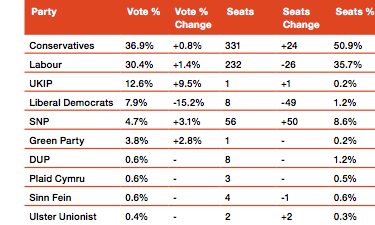
The Electoral Reform Society has published a report showing how disproportionate the election result was, in terms of seats in the House of Commons. This is not a novel observation, although the ERS does say that the election was the most disproportionate ever and that, as a result, first-past-the-post is exaggerating divisions in the United Kingdom.
Here is the ERS’s news release and here is the report in full (pdf).
This is from Katie Ghose, the ERS chief executive.
This report shows definitively that our voting system is bust. May 7th was the most disproportionate election in British history – and it’s about time we had a fairer system for electing our MPs.
That nearly three quarters of votes were wasted this election shows that we have a democratic crisis on our hands, with most people’s votes not counting. We have an archaic and divisive voting system that leaves millions disenfranchised and forces millions more to feel that they have to vote for a ‘lesser evil’ – instead of who they really support. The Greens and Ukip won 5m votes and just two seats between them. This is simply unsustainable – and can only end badly.
First Past the Post is artificially dividing the UK – giving the SNP nearly all Scottish seats on half the vote, while excluding Labour from the South of England and over-representing them in Wales and under-representing the Conservatives in the North of England and Scotland. At the same time, cross-community parties in Northern Ireland got a tenth of the vote and no seats, yet the DUP received nearly half the seats on just a quarter of the vote. This situation is unsustainable if the prime minister truly wants a ‘one nation’ Britain. Our voting system is breaking up Britain.
But on the Today programme Dame Margaret Beckett, the Labour MP who chaired the No to AV campaign in 2011 and who is now chairing the Labour taskforce investigating why it lost the election, said she did not accept the case for electoral reform. She told the programme:
Not long before the election, I saw a very small poll - somebody who had a readers’ panel asked their readers, irrespective of how you intend to vote, what is your preferred outcome? To my recollection, by a very substantial margin, they said their preferred outcome was a majority government. That was close between a majority Labour or a majority Conservative government.
All the commentators had been saying ‘The people no longer want these old-fashioned parties, the people do not want a majority government’. Well, actually they did. And to me, one of the virtues of our present system is that the British people understand it, they know how to work it.
In 2010, they didn’t like any of us and didn’t give any of us a majority, but in 2015 they said ‘Hang on a minute’, they’d rather have a majority government of one or the other than a mess.
Joshua Rozenberg’s article has stirred things up in the legal world. Lawyers are hitting back at the notion that ministers need to curb “judicial activism”. (See 9.15am.)
From Dinah Rose QC, the human rights barrister
Troubling suggestion from @JoshuaRozenberg that Govt wants to tame judicial "activism". or shld that be independence? http://t.co/GLsgShR8pO
— Dinah Rose (@DinahRoseQC) June 1, 2015
Term "judicial activism" is just a pejorative description of proper judicial task of holding Govt to account. https://t.co/8xy7WDrN1c
— Dinah Rose (@DinahRoseQC) June 1, 2015
From Matthew Stanbury, a barrister and legal blogger
Interesting piece by @JoshuaRozenberg. Tories deluded re activist judges. Should spend a morning in the Admin Court. pic.twitter.com/8zsC3Dn9TW
— Matt Stanbury (@thepubliclawyer) June 1, 2015
From David Allen Green, the lawyer and legal blogger
Judicial Activism (noun): term for when judges make decisions inconvenient to the Executive.
— Jack of Kent (@JackofKent) June 1, 2015
The 'cure' for 'judicial activism' is for parliament to make clearer, more precise laws, and not to restrict judicial independence.
— Jack of Kent (@JackofKent) June 1, 2015
From Michael Reed, legal officer at the Free Representation Unit
@DinahRoseQC @JackofKent We should coin ‘Parliamentary Activism’ -- When politicians meddle in things better left to judges eg sentencing.
— Michael Reed (@reedmj) June 1, 2015
Ministers are today promoting their plans to double the provision of free childcare for three and four-year-olds. David Cameron will be talking about it on the ITV sofa within the hour.
You can see me on @itvthismorning at 1030 - talking about 30 hours free childcare for parents of 3 and 4 year olds. pic.twitter.com/gAGjniHW2v
— David Cameron (@David_Cameron) June 1, 2015
On the Today programme this morning Neil Leitch, chief executive of the Pre-School Learning Alliance, which represents childcare providers, said the 15 hours of free childcare already provided by the government was “grossly underfunded” and that if funding did not increase, many providers would withdraw from the free childcare system.
But Priti Patel, the employment minister, told the same programme the hourly subsidy would go up.
I will be chairing a government-led taskforce on the delivery of this and we will be working with providers on the point about funding, to review the overall funding model, so that we can bring an uplift to the hourly rate for childcare entitlement which strikes the right balance.
As part of our commitment to improve and support families with childcare and ensure that the sector helps to deliver on that, we have pledged to increase funding rates for providers in different parts of the country, and we will be starting a review of the rates across the country before the summer. We know that funding rates need to increase, which is why we are going to have this consultation.

When I ask about the Telegraph story, a Number 10 source repeats the point about all cabinet ministers being signed up to the manifesto and also insists that Michael Gove is still working on the details of his plans to replace the Human Rights Act with a British bill of rights.
Paul Goodman, the ConservativeHome editor, has also been speaking to Number 10. He says the Telegraph may be wrong when it says that Gove wants to keep open the option of leaving the European convention on human rights.
Downing Street distancing itself from today's Telegraph ECHR story, claims Gove hasn't made up his mind on leaving Convention.
— Paul Goodman (@PaulGoodmanCH) June 1, 2015
But Number 10 is not challenging the claim that ECHR withdrawal is off the table.
And, even if Michael Gove is happy about this, it is probably safe to assume that Theresa May, the home secretary, isn’t. She is the cabinet minister who first publicly floated the idea of ECHR withdrawal before the general election. And yesterday, in an article in the Sunday Telegraph, Nick Timothy, May’s most senior political adviser until the general election, said that Britain should leave the ECHR because repealing the Human Rights Act while remaining signed up to the convention (which is the government plan - see 9.15am) would be too problematic.
If you want to find out what the government is planning to do about the Human Rights Act and the European convention on human rights, you probably won’t find a better guide than this Law Society Gazette article by the legal expert Joshua Rozenberg. Rozenberg seems to have had a very detailed briefing from someone familiar with Michael Gove’s plans.
Rozenberg effectively confirms the Telegraph story, saying withdrawal from the ECHR is “firmly off the agenda” (although, unlike the Telegraph, he does not claim that Gove objects to this stance).
So what would the government hope to achieve by scrapping the Human Rights Act, and replacing it with a British bill of rights, without leaving the ECHR? Rozenberg says ministers’ main aim is to curb “judicial activism”, both in Strasbourg and London, and his article sets out some of the legal changes that could be introduced to encourage this. Here’s an extract.
Section 2 of the Human Rights Act 1998 says our judges ‘must take into account’ judgments of the Strasbourg court. The government is thinking of changing ‘must’ to ‘may’, allowing UK judges more leeway.
Other clauses now under consideration would follow the example of section 12 of the Human Rights Act – under which courts must have ‘particular regard’ to freedom of expression – and section 13, under which they must have particular regard to freedom of thought, conscience and religion. I have never thought that those sections meant very much, but a similar provision might require the courts to have particular regard to the need for public safety when considering whether terrorists can avoid deportation. And there is talk of enhancing press freedom – presumably at the expense of private and family life.
This sort of tinkering poses a problem for the government. The more that UK judges can diverge from past decisions of the European court, the more likely it is that Strasbourg will find the UK in breach of the convention. But it’s a risk that ministers are willing to take. They hope the European judges will be persuaded to follow well-reasoned decisions by the UK Supreme Court, even if those rulings are out of line with Strasbourg jurisprudence.
Updated
Gawain Towler, the Ukip communications chief, says that abolishing the human rights act without withdrawing from the European convention on human rights would be “pointless”.
As the ECHR is justiciable in The ECJ, abolishing the Human Rights Act without EU withdrawal is pointless. There is no half-way house
— Gawain Towler (@GawainTowler) June 1, 2015
Downing Street has not challenged the Telegraph story about David Cameron ruling out withdrawal from the European convention on human rights. Asked to comment, a Number 10 spokesman said:
The government’s policy is as set out in the manifesto, and that is shared by Theresa May, the prime minister and indeed the whole cabinet.
This is significant because the manifesto does not commit the party to withdrawal from the EHCR. This is what it says, in full.
We will scrap Labour’s Human Rights Act and introduce a British bill of rights which will restore common sense to the application of human rights in the UK. The bill will remain faithful to the basic principles of human rights, which we signed up to in the original European convention on human rights. It will protect basic rights, like the right to a fair trial, and the right to life, which are an essential part of a modern democratic society. But it will reverse the mission creep that has meant human rights law being used for more and more purposes, and often with little regard for the rights of wider society. Among other things the bill will stop terrorists and other serious foreign criminals who pose a threat to our society from using spurious human rights arguments to prevent deportation.
David Cameron has ruled out withdrawing from the European convention on human rights, the Daily Telegraph claims. The paper says that Theresa May, the home secretary, and Michael Gove, the justice secretary, both want to retain the option of ECHR withdrawal and that this is the first major cabinet split since the election. The Telegraph has splashed on the story.
Monday's Telegraph front page: May and Gove split with PM in human rights row #tomorrowspaperstoday #bbcpapers pic.twitter.com/Iq4u43NRHL
— Nick Sutton (@suttonnick) May 31, 2015
Here’s an extract.
In the first major cabinet split since the election, Mr Gove and Mrs May believe that pulling out of the convention entirely may be the “only solution” to re-establishing the supremacy of British courts over Strasbourg judges.
The Conservatives last year threatened to pull out of the convention to help free Britain from the edicts of Strasbourg judges, which have seen serious criminals use the human rights laws to avoid deportation.
However, Mr Cameron has now dropped the plans in preference for a “halfway house” which will see Britain remain a signatory to the convention but scrap the human rights act, which incorporates the convention into British law ...
A senior government source told The Telegraph: “Withdrawal is not going to happen. Michael Gove and Theresa May think it’s the only solution but David Cameron’s clear this is off the table.
“The British bill of rights could mitigate the worst excesses of the human rights act but it won’t change the fundamentals.”
I’ll be covering reaction to this as we get it it.
Here’s the agenda for the day.
Morning: George Osborne is giving a speech in the Midlands.
11am: Number 10 lobby briefing.
2.30pm: MPs debate foreign affairs in the Queen’s speech debate. Philip Hammond, the foreign secretary, and Hilary Benn, his Labour shadow, are expected to open the debate.
As usual I will be covering the breaking political news as it happens, as well as bringing you the best reaction, comment and analysis from the web. I will post a summary at lunchtime and another in the afternoon.
If you want to follow me on Twitter, I’m on @AndrewSparrow