Afternoon summary
- The government has signalled that it is prepared to amend a plan to impose a four-year ban on EU migrants claiming in-work benefits, in a move that would allow David Cameron to campaign “with all my heart and soul” to keep Britain in the EU. As Nicholas Watt reports, the European commission warned that the proposed ban was “highly problematic”, the Europe minister, David Lidington, told MPs that the government would happily consider other proposals from EU member states. In a statement to MPs on the government’s EU reform proposals, Lidington said: “Others in the EU have concerns about this. That is why we say to them: put forward alternative proposals that deliver the same result. It is the outcome of the measures – controlled, fair, properly managed migration – that is the end we seek.”
- The Department for Work and Pensions has published the figures used to justify Downing Street’s controversial claim that 43% of EU migrants rely on benefits in their first four years in the UK. Earlier the Centre for European Reform said: “The 43% figure is surprisingly high, and is based upon administrative data, which is not available to the general public. By contrast, data from the official, publicly available Labour Force Survey, puts the figure at 21% in the first quarter of 2015.”
DWP "the home of reliable stats" on no of EU migrants in UK claiming benefits - offered as "a one off analysis". https://t.co/dyok3UvC9y
— Patrick Wintour (@patrickwintour) November 10, 2015
- The government has put on hold its plans to liberalise the Sunday trading laws after the SNP threatened to vote against them. (See 4.08pm.)
-
Opposition MPs have strongly attacked the trade union bill. In a debate in the Commons which is still going on, Chris Stephens, the SNP’s trade union spokesman, said: “This is an ideological attack against the largest group in civic society who stands up against exploitation.” The SNP and Plaid Cymru proposed amendments to ensure the Scottish parliament, Welsh assembly, Northern Ireland assembly, the mayor of London and other public bodies and local authorities would have final sign off on whether the bill should actually be applied. Labour’s Joan Ryan was equally critical. She told MPs:
Trade unionists are real people and it’s not just trade unions and trade unionists who object to this bill. The government has significantly failed to secure any substantial employer support for these proposals.
That’s all from me for today.
Thanks for the comments.
Angus Robertson says Sunday trading decision shows SNP acting as 'the effective opposition at Westminster'
Here’s Angus Robertson, the SNP’s leader at Westminster, on the government’s decision to shelve the plans to liberalise the Sunday trading laws. (See 4.08pm.)
I’m delighted; this is a U-turn by the government to a proposal which may well have been detrimental to workers both in Scotland and the rest of the UK. This is yet another example of the SNP operating as the effective opposition at Westminster; we’re very pleased that they’ve pulled their plans. I think it is possible to reach safeguards and guarantees to make sure that shop workers are not worse off. We are supporters of Sunday trading, we think Sunday trading is a good thing. But it shouldn’t happen on the back of often lower paid shop staff in Scotland and throughout the rest of the UK.
I’ve taken the quote from PoliticsHome.

A Cameron speech reading list
Here are four blogs on David Cameron’s speech worth reading.
Having committed himself to a phoney renegotiation, [Cameron] played out the charade with brio, characterising Britain as a country of cool heads and controlled passions—“natural debunkers” as he only somewhat oddly put it—and himself as its epitome: a rational, moderate type with neither the federal zeal of Europe’s integrationist intellectuals nor the spittle-flecking fury of Britain’s most isolationist Europhobes. He tacitly conceded that he would back membership, come what may; setting out a list of demands variously symbolic and uncontentious and producing a fairly gutsy case for an In vote. Mr Cameron’s most troublesome ask, the four-year benefit freeze, he downgraded from a firm request to an indication of the sort of arrangement he would like to reach. The six-page letter to Mr Tusk, published shortly after the speech, added few details but for a list of bullet points concerning Britain’s role as a non euro-zone country in an EU dominated by that currency. These were essentially reactive, responding to recent continental attempts (all unsuccessful) to secure British contributions to the Greek bailout, force European clearing houses out of London and leave Britain vulnerable to strong-arming by the euro-zone on matters of financial regulation.
We heard again today from David Cameron the argument that voting to stay in Europe is all about national security. One old Europe hand said: “They’re hoping Putin will win this for them.” George Osborne deployed the argument heavily in Berlin last week.
And it sounds like the government has decided to layer another message on as well.
The government’s been weighing up for some time whether to shove the draft British bill of rights reforms the other side of the December EU summit or not. Could it exacerbate David Cameron’s difficulties with his own party as hardline Eurosceptics complain of two reforms that don’t measure up to their hopes – an EU negotiation that’s too light and a justice reform that doesn’t promise withdrawal from the European Court of Human Rights?
Today David Cameron sounded like he’s made the choice to bring forward the justice proposals before the December EU summit in the hope that they can help with the mood music that much is changing – he’s certainly decided to talk them up at a critical moment.
When I was Europe Minister (2002-2005) the UK removed the reference to ‘ever closer union’ (ECU) as part of the negotiations over the then draft constitutional Treaty which was voted down by the French and Dutch. No-one noticed the change of language on ECU and no Tory MP thanked me at the time. The phrase which is in the preamble and has no legal effect has not been a cause of concern between 1957 until a year or two ago. It will easy to draft a declaration that in any future Treaty, the UK can have a protocol added to the treaty saying ECU does not apply.
Reaction to the Cameron speech from Spain
Speaking in Bilbao on Tuesday, Spain’s foreign minister said that the possibility of Britain leaving the EU year could not be ruled out.
“There is a risk that the UK will leave the EU,” said José Manuel García-Margallo as he addressed a conference in the northern Spanish city, adding that it would be “bad news” if it happened.
The UK’s exit would likely trigger a new referendum in Scotland, said García-Margallo, aimed at keeping Scotland in the EU. Britain’s exit could also spur the eurozone to increase the degree of federalisation among its members, he said. “We would have to take a giant leap in terms of federalisation of the 19 countries that share the currency, in order to show that this isn’t a project that is deteriorating but rather one that is advancing.”
Reaction to the Cameron speech from Poland
In a newspaper interview before Cameron’s speech, Poland’s incoming minister for European Affairs, Konrad Szymanski (who will be sworn in on Thursday) told Rzeczpospolita that his government would back Germany’s opposition Brexit.
“No one understands the importance of fighting a British exit better than Berlin and Warsaw,’’ he said. He also said the new Polish government would be ‘’very likely’’ to support Germany’s position on British attempts to renegotiate its membership.
“Reduced freedom of movement would set a precedent that would weaken the union. There is no room for negotiation on the right to work in another EU country and it seems to me Britain is coming round to that view anyway.’’
There are an estimated 700,000 Poles in the UK.
The BBC is saying the plans to relax the Sunday trading laws have been put on hold. But the government is rejecting suggestions that there has been any kind of U-turn.
PM's spokeswoman denying Sunday trading U-turn: "We've had a consultation and will give a detailed response setting out next steps."
— Kevin Schofield (@PolhomeEditor) November 10, 2015
Government puts plans to relax Sunday trading laws on hold after SNP threaten to vote against
That follows the revelation yesterday that the SNP were planning to vote against.
Angus Robertson, the SNP’s leader at Westminster, has said that shows his party playing a role protecting wages in Scotland and the rest of the UK too.
Breaking News: Welcome Sunday trading u-turn by UK govt after pressure from @theSNP to safeguard shop staff pay across Scotland & the UK
— Angus Robertson (@AngusRobertson) November 10, 2015
The Czech prime minister, Bohuslav Sobotka, has said he is opposed to David Cameron’s plans to restrict EU migrants’ access to benefits.
Here is the quote (if you can read it).
Now the #Czech PM @BohuslavSobotka joining criticism of @David_Cameron's #EU letter on internal migration issues. pic.twitter.com/fSJmE6ytKn
— Peter Spiegel (@SpiegelPeter) November 10, 2015
And here is the full sentence.
For the Czech Republic, however, any intrusion into the free movement principle is a very serious problem.
Here’s Charles Grant, director of the Centre for European Reform, on Cameron’s speech.
Contradictory @David_Cameron speech: 'UK needs EU for its security'. But sec not part of renegot. So if renegot fails how can he say quit?
— Charles Grant (@CER_Grant) November 10, 2015
Here’s David Cameron dodging what he described as a “brilliantly constructed” question from my colleague Nicholas Watt.
Nick says the implication is clear.
Here's proof @David_Cameron determined to remain in EU. Dodges my ‘brilliantly constructed' Q on #brexit options https://t.co/z4Mxki15hW
— Nicholas Watt (@nicholaswatt) November 10, 2015
EPP says deal on renegotiation 'should be possible'
The European People’s Party (EPP), the main centre-right group in the European parliament, has now put out a more lengthy statement about Cameron’s speech. It’s more detailed than the tweet earlier from Manfred Weber, the EPP chair (see 12.01pm.) and broadly positive. Weber says:
The EPP wants the UK to remain a member of the EU. We stand ready to work together with the British government to find a deal which is acceptable to all sides. We support the points raised by prime minister Cameron on the need to increase competitiveness and cut burdens on businesses in the EU, which are already part of the Juncker Commission’s programme. Finding an agreement on other points, such as ways to increase the role of national parliaments, should be possible.
Updated
And here is the response to Cameron’s speech from Leave.EU, the other main Out campaign.
It is clear that David Cameron is not asking for anything substantial in this so called renegotiation. In the 45 minutes that he spoke, he made no mention of the issues that our supporters are so passionate about: making our own decisions in parliament, reducing our membership fee and being able to control our borders.
What he did ask for was a series of written confirmations of the status quo, which include Britain not joining the euro as well as remaining exempt from an ever closer union. However, as the Danish will show next month, opt-out can soon become opt-ins if a Europhile government ever comes to power.
The only thing he actually asked them for was the ability to restrict benefits for migrants for four years, however there is absolutely no evidence that this will reduce the pull factor for migrants, especially when you consider poverty levels in the Eurozone and Eastern Europe.
Boris Johnson, the Conservative mayor of London, has said that the EU renegotiations will lead to “blood on the floor” in Brussels. Speaking in Israel, where he is on a visit, he said:
I think it’ll be tough. There will be a long period now of quite scratchy negotiations. I think there will come a great sort of juddering moment - there will be blood all over the carpet at some point in Brussels. I don’t know when that will happen but I hope very much that we will get the deal by the end of next year.
He also said Britain could have a “very attractive and exciting future outside the EU as well”.

Vote Leave, probably the most prominent Out campaign, has published a lengthy briefing document on its website challenging the claims in David Cameron’s speech on multiple grounds.
And here is reaction from its campaign director, Dominic Cummings.
The public wants the end of the supremacy of EU law, to take back control of our democracy and borders, and to spend the money wasted in Brussels on our priorities like the NHS and science. Cameron’s renegotiation isn’t even asking for this - he is only promising to change what he already thinks the EU will give him and people won’t trust his spin. The safest choice is to Vote Leave.
My colleague Ian Traynor has written a good analysis of David Cameron’s letter to Donald Tusk, and how achievable his goals are.
Here is his conclusion.
Privately, EU officials concede that Downing Street’s shopping list is quite modest and easily negotiable, but they do not say so publicly for fearing of stirring resentment among British Eurosceptics.
But the broader concern in Brussels and elsewhere has less to do with Cameron’s demands and the state of the negotiations. Rather, the Europeans are worried about the referendum itself and the distinct possibility that the negotiations will be a waste of time if Britain votes against staying in the EU.
“The real issue won’t be the negotiations. That’s tricky, but we’ll get there,” said a senior EU diplomat. “The real difficulty is quite simply the referendum campaign. The pro-Europeans always appear to be on the defensive.”
Commons statement on the EU renegotiation - Summary
Commons statement on the EU renegotiation - Summary: The phoney war within the Conservative party is over. That is probably the most important thing we gleaned from David Lidington’s 90-minute Commons statement on the EU renegotiation.
Ever since David Cameron announced the EU referendum in his Bloomberg speech in January 2013, the two Tory Euro tribes (it used to be the Eurosceptics and the Europhiles, but they are all Eurosceptics now - the divide is between the Out Eurosceptics and the In Eurosceptics) have been engaged in an uneasy stand-off. Some Outers felt reluctant to commit themselves publicly to voting for withdrawal because it seemed more diplomatic to concede that it was best to wait until the outcome of the renegotiation before taking a final decision.
But now (provided you ignore the token ‘rule nothing out’ platitudes) Cameron is making it clearer than ever that he is politically committed to a Remain victory. (See 10.58am.)
And what we saw in the Commons were Tory Outers abandoning any pretence that they were still in “wait and see” territory and instead denouncing Cameron’s plans robustly and unequivocally. They included Sir Gerald Howarth saying: “Unless we return powers to this parliament this exercise will not be worth the while because it is in this parliament that authority ultimately should reside on behalf of the British people”; Bernard Jenkin saying: “Why we should put up with being a second tier country in an increasingly centralised European Union, paying more and more and losing more and more control?”; Jacob Rees-Mogg saying the plans were “pretty thin gruel”; Sir Bill Cash saying the plans were “a pig in a poke”; and Peter Lilley saying Cameron was only after “symbolic” changes.
Lidington put up with clobbering he was getting with relatively good humour. There seemed to be a sense of relief on both sides. At least now everyone can be clear about where they stand.
(And Labour mostly chose not to intrude on private grief. By comparison with the Tories, Labour is solidly united on this.)
Peter Bone, a Conservative, says he wants to thank Cameron for making it clear that, after the renegotiation, Britain will still be part of a political union and there will still be free movement. Now it is clear that Britain should vote to leave, he says.
Lidington says that he assumed Bone was going to take that view whatever Cameron announced.
And that’s it. The statement is over.
Reaction to the Cameron speech from France
“The poker game has begun,” wrote France’s leading paper Le Monde. “Worried about holding onto the maximum of cards in this game of uncertain outcome, Mr Cameron is putting the minimum on the table.”
The paper said his demands had been known for weeks but he had simply matched them with a “hypothetical promise” to campaign with all his heart and soul to stay in Europe if agreement was met.
“By staying vague on the [referendum] date, Mr Cameron hopes to stay master of the game at home but also to put pressure on Germany and France who fear the British date on ‘Brexit’ could eat into their own general elections in 2017.”
The paper added that after months of UK officials holding their own debate behind closed doors, British authorities had now “at last” realised that the “Brexit battle will also be played in the public opinion of countries ‘on the continent’”.
France has long led a push for more specific details on each of London’s negotiation areas. Paris clearly wants Britain to stay in the EU but it’s not clear how far France would go on concessions. The UK referendum is a deeply sensitive issue in France and timing is everything. There will be a French presidential election in 2017 and François Hollande and the French left — still reeling from the 2005 European constitution that saw France vote no — are not keen to trigger another painful referendum at home by reopening treaties.
All parties in France are guarded against the rise of the far-right Front National in France and Marine Le Pen has already bid to make her own political capital out of the UK referendum. She would style a Brexit as a triumph of her own critical stance on the European Union and drive to exit the euro.
She told Bloomberg today: “I am so happy to see David Cameron doing in the UK what I want to do for France. He’s using the months ahead of the referendum to get what he wants for his country, and we want that too, more sovereignty for France and more freedom.”
James Cleverly, a Conservative, says Britain should form more separate agreements with Commonwealth countries.
Lidington says the Commonwealth countries only account for 17% of world trade. And it is much easier to strike a trade deal as part of a 500m-strong bloc, he says.
Chris Heaton-Harris, a Conservative, asks Lidington what his assessment, given the delays over TTIP, of the EU’s ability to trade deals.
Lidington says, as a large bloc, the EU has much more clout in trade negotiations than a single country.
The Labour MP Paula Sherriff asks if renegotiating the EU tax rules that result in the tampon tax will part of the renegotiation?
Lidington says the Treasury gave a commitment to look at this when it was debated in the Commons recently.
Mark Durkan, the SDLP, says it is said Christopher Columbus did not know where he was going when he went to America, did not know where he was when he was there, and did not know where he had been when he got back. Isn’t Cameron in a similar position? He also says that, by presenting this as “Cameron’s renegotiation”, there is a danger of making the referendum about Cameron.
Lidington says he enjoyed the joke, but that Columbus is now remembered for bringing us into a new age.
Labour’s Steve McCabe asks how quickly the government could hold a referendum.
Lidington says the referendum bill will have to have gone through parliament, and the renegotiation will have to be concluded. Then there will have to be time for the secondary legislation setting up the referendum to go through the Commons and the Lords. Then you need to allow for the 10-week campaign period.
The SNP’s Stuart Donaldson asks what has been included in the plan from Scotland’s agenda for EU reform.
Lidington says the SNP want to deepen the single market and increase EU access to other markets. He says the government always makes the interests of the Scotch whisky industry a priority.
David Nuttall, a Conservative, says there is nothing in the letter about regaining control of immigration, or fishing or farming. Today is the day when it became clear that the renegotiation did not involve power coming back to the UK, he says.
Lidington says Nuttall has understated what is at stake.
Here’s the Ukip MP Douglas Carswell on how Lidington is getting on in the Commons.
Lidington getting hammered repeatedly by his own side
— Douglas Carswell MP (@DouglasCarswell) November 10, 2015
Labour’s Clive Efford asks why Cameron has not said whether he is for or against staying.
Lidington says Cameron will make his view clear at the end of the process. It would be odd to prejudge the renegotiation, he says.
Bernard Jenkin, a Conservative, asks: “Is that it? Is that the sum total of the government’s position in this renegotiation?” Why should we put up with being a “second-tier” country, and losing more and more power.
Lidington says Jenkin underestimates how far-reaching these plans are. He quotes what the Danish prime minister said earlier. (See 12.43pm.)
Hywel Williams, the Plaid Cyrmu MP, asks how the government will distinguish between state subsidies for EU workers, that it says it wants to stop, and tax credits for UK citizens.
Lidington says the renegotiation will address this.
Tom Brake, the Lib Dem MP, asks Lidington to confirm that Cameron won’t insist on getting every single one of his goals before deciding to back remaining in the EU.
Lidington says the government will insist on satisfactory progress in all four areas that are part of the renegotiation.
Sir Gerald Howarth, a Conservative, says it is important to return powers to parliament. How will the plan to allow national parliaments to block EU law actually work?
Lidington says the treaties already allow a group of national parliaments to demand a review of EU proposals. The government would like to turn that into the right to block a proposal; in other words, turning a yellow card into a red card.
Andrew Tyrie, the Conservative chair of the Commons Treasury committee, says the proposals on “ever closer union” will have very little effect unless they are accompanied by fundamental plans to re-allocate powers within the EU.
Lidington says Tyrie’s recent pamphlet on plans for EU reform included some interesting and constructive ideas.
Jacob Rees-Mogg, a Conservative, says Cameron’s plans are “pretty thin gruel” and much less than people expected. Its main aim seems to be to make Harold Wilson’s renegotiation look respectable, he says. There should be more power for the UK parliament, not just national parliaments generally.
Lidington says that approach would mean any one parliament could veto EU measures in the UK national interest.
If Rees-Mogg had set in a council of ministers meeting at Brussels, he would realise how ambitious these plans were, Lidington says.
Back in the Commons Peter Lilley, the Conservative Eurosceptic, says Cameron is just trying to get “symbolic” changes. Changing the wording on “ever closer union” will not make much difference because these words have never been used against the UK in court, he says. He says Cameron should focus on getting the repatriation of important powers.
Lidington says the point about “ever closer union” is that it implies there is only one kind of EU. The government wants to see much better acceptance of the EU’s diversity.
Reaction to the Cameron speech from Germany
The Handelsblatt, Germany’s leading business daily called Cameron’s speech and the letter to Donald Tusk not only a “formal starting signal for negotiations with Brussels” and a “delivery” of “British demands and the reasons for them”, but said they contained “warning shots to all sides”.
To his own people Cameron hoped to show “that he is serious about these negotiations, and that what he wants is manageable and sensible”. But the paper added in its commentary: “It is not completely new.”
The paper advises, given that Britain’s idea of the EU differs considerably from that of France or Germany, and always has done, it would make sense to “let Britons to have their vision of Europe which they have consistently stood by and shaped for decades” and accept that such a Britain with its “many opt outs has long been part of the European reality.”
“Cameron has set the EU on a course,” the paper concludes, “that, regardless of what emerges, will change Europe profoundly”.
Michael Renner of the Pirate party (Die Piraten) tweeted: “For the EU it would be better if GB stays, but an EU according to Cameron’s idea is no longer the EU ...So better that England goes”.
Deutsche Welle, Germany’s flagship broadcaster said: “It was a comprehensive, and long speech that felt longer than War and Peace ... Although David Cameron’s speech is not as existentially important as Tolstoy’s ... lengthy masterwork nevertheless ... the 49-year-old premier was doing nothing more or less than calling into question Britain’s continuance in the European Union.”
Manfred Weber, an MEP from the CSU, sister party to Merkel’s conservative CDU, who also heads the European People’s party, tweeted: “We share Mr Cameron’s view on the need to increase competitiveness & cut red tape”.
Updated
Crispin Blunt, the Conservative chair of the Commons foreign affairs committee, asks Lidington to describe the different legal mechanisms available for ensuring the proposals take effect.
Lidington says he cannot. There is a menu of options, he says. The technical talks that have already taken place have gone into what the options are, such as treaty change, domestic legislation, and secondary legislation.
Sir Bill Cash, a Conservative, says the proposals are a “pig in a poke”. Almost all of the proposals will require treaty change. But that is not on offer, so how will the government get the guarantees it wants.
Lidington says the models offered to Denmark and Ireland (legally-binding protocols, promising to change EU treaties in the future) offer a way forward.
Stephen Gethins, the SNP spokesman, says a year ago Scotland was told that if it voted for independence it would be out of the EU.
Now it is the British government that is threatening to take Scotland out of the EU.
He asks if the Scottish government will be consulted as part of the renegotiation.
Lidington says he spoke to the Scottish government’s Europe minister Fiona Hyslop only this morning about this.
Lidington is responding to McFadden.
He says no one in the government is proposing what McFadden described as “a big bonfire of workers rights”.
But the government does want to keep the working time directive opt-out, he says.
He says Cameron has set out plans to address the EU migrants’ benefits issue. But Cameron is open to other suggestions. What matters is getting a system of fair, properly-managed migration, he says.
EU minister @DLidington confirms @David_Cameron prepared to retreat from 4 year ban on EU migrants claiming in work benefits 1/2
— Nicholas Watt (@nicholaswatt) November 10, 2015
. @DLidington tells @HouseofCommons: EU countries free to put forward ideas that deliver UK objective - better control of immigration 2/2
— Nicholas Watt (@nicholaswatt) November 10, 2015
Here's the full killer quote from David Lidington, confirming Cameron paving way for retreat on 4-year-benefit ban. pic.twitter.com/jfyoAEuYzW
— Paul Waugh (@paulwaugh) November 10, 2015
Updated
Tim Farron says Cameron sounded like Ken Clarke
The Lib Dems have issued a statement from Tim Farron, the Lib Dem leader, saying Cameron’s speech was so pro-European he sounded like Ken Clarke. Farron said:
It looks like the coalition has rubbed off on the prime minister. He has recognised that EU membership is critical to the UK’s security as well as prosperity. In places I thought Ken Clarke had become prime minister.
The prime minister must now stand up to the Europhobes on his backbenches and negotiate an acceptable package of changes and persuade the British public to support it.
We recognise that there are no terms that the prime minister can renegotiate which will satisfy some on his right wing who are determined to leave the European Union. We hope he recognises it too.
His reputation and legacy as prime minister, rests on his ability to negotiate a package which retains our full engagement, cooperation and membership of the European Union. It is the liberal test and one, for all our sakes, he must pass.
Pat McFadden, the shadow Europe minister, says that Tory Eurosceptics are desperate for David Cameron’s renegotiation to fail?
He asks Lidingtonto accept that seeking associate or second-class membership of the EU would be wrong.
He asks for an assurance that workers’ rights will not be watered down?
Is Cameron determined to stop EU migrants accessing benefits for four years? Or is he willing to consider alternative plans? And will he address this through EU legislation, or domestic legislation.
McFadden says Britain’s history means that it does not look at these issues through the same eyes as other EU countries. But that does not mean we want to leave, he says.
He says reform should be an ongoing process.
And he says Labour is committed to EU membership. It has brought many benefits, he says.
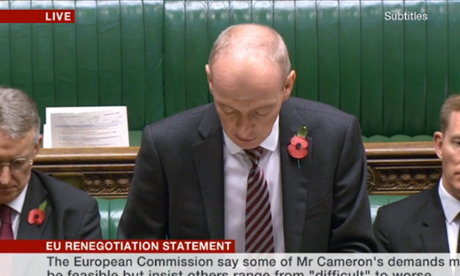
Lidington says there are 12 parliamentary inquiries looking at the EU renegotiation.
The government will not provide a running commentary on the renegotiation, but it will cooperate with the inquiries, he says.
In the Commons David Lidington repeats, almost word for word, what David Cameron said in his speech about being “open” to different ways of tackling the problem of EU migrants’ access to benefits. This is what Cameron said in his speech.
We have proposed that people coming to Britain from the EU must live here and contribute for four years before they qualify for in work benefits or social housing. And that we should end the practice of sending child benefit overseas. Now, I understand how difficult some of these welfare issues are for other Member States.And I am open to different ways of dealing with this issue.
Lars Løkke Rasmussen, the Danish prime minister, has used Twitter to say David Cameron’s speech provides a “good basis for concrete negotiations”.
@David_Cameron Good basis for concrete negotiations. It will be difficult. I hope we will succeed because we need a strong UK in EU. #dkpol
— Lars Løkke Rasmussen (@larsloekke) November 10, 2015
David Lidington's Commons statement about the EU renegotiation
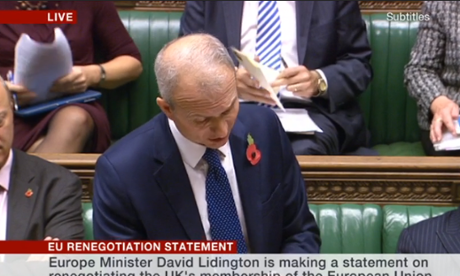
David Lidington, the Europe minister, is making a statement to the Commons now about the EU renegotiation.
At the moment he is just running through some of the points that David Cameron made in his speech. I won’t report comments repeating what we’ve already heard, but will flag up material that’s new.
David Cameron's renegotiation speech and letter - Summary
Here is a summary of the main points from Cameron’s speech and letter.
- Cameron has expressed his desire to restrict EU migrants’ access to inwork benefits for four years - while saying he understands that this will be “difficult” and that he will discuss this further to find a “solution”. This is significant because this is the one demand where getting what he wants will prove most difficult, and the text of the letter suggests he is minded to be flexible. Number 10 are briefing this too. See 11.11am. This is what the letter says:
As I have said previously, we can reduce the flow of people coming from within the EU by reducing the draw that our welfare system can exert across Europe. So we have proposed that people coming to Britain from the EU must live here and contribute for four years before they qualify for inwork benefits or social housing. And that we should end the practice of sending child benefit overseas.
I understand how difficult some of these issues are for other member states and I look forward to dicussing these proposals further so we can find a solution that deals with this issue.
- Cameron says that he wants “legally binding principles that safeguard the operation of the union”. He spelt them out in his letter, as the first of his four principles for reform, under the heading “Economic governance”.
- He has called for measures to boost competitiveness and cut the regulatory buden on business. In his letter Cameron sums up these, his second set of aims, under the heading “Competitiveness”.
- He has called for measures to preserve national sovereignty. These are summed up as his third demand under the heading “Sovereignty” in the letter. Here’s an extract.
First, I want to end Britain’s obligation to work towards an “ever closer union” as set out in the Treaty. It is very important to make clear that this commitment will no longer apply to the United Kingdom. I want to do this in a formal, legally-binding and irreversible way.
Second, while the European Parliament plays an important role, I want to enhance the role of national parliaments, by proposing a new arrangement where groups of national parliaments, acting together, can stop unwanted legislative proposals. The precise threshold of national parliaments required will be a matter for the negotiation.
Third, I want to see the EU’s commitments to subsidiarity fully implemented, with clear proposals to achieve that. As the Dutch have said, the ambition should be “Europe where necessary, national where possible”.
On “ever closer union”, it is worth pointing out that the European Union has effectively already conceded that it is willing to give way on this. It did so last year, in the little-noticed paragraph 27 of the communique issued after the summit in June.
- He has said that net EU migration to the UK is unsustainable. In his speech, and in his letter, he said immigration - his fourth area of concern - was a particular problem for Britain. And he said other EU countries had an interest in cutting the level of migration from poor countries to rich countries because the poor countries were losing skilled workers. In his letter he said:
The UK believes in an open economy. But we have got to be able to cope with all the pressures that free movement can bring - on our schools, our hospitals and our public services. Right now, the pressures are too great.
The issue is one of scale and speed. Unlike some other Member States, Britain’s population is already expanding. Our population is set to reach over 70 million in the next decades and we are forecast to become the most populous country in the EU by 2050. At the same time, our net migration is running at over 300,000 a year. That is not sustainable. We have taken lots of steps to control immigration from outside the EU. But we need to be able to exert greater control on arrivals from inside the EU too.
Britain has always been an open, trading nation, and we do not want to change that. But we do want to find arrangements to allow a Member State like the UK to restore a sense of fairness to our immigration system and to reduce the current very high level of population flows from within the EU into the UK. These have been unplanned and are much higher than forecast - far higher than anything the EU’s founding fathers ever envisaged. These very substantial flows of population have, of course, also had a significant impact on a number of Member States, many of whose most highly qualified citizens have departed en masse. So this is a shared challenge.
- He has said he is not proposing “precise means, or detailed legal proposals, for bringing the reforms we seek into effect”.
That is a matter for the negotiation, not least as there may, in each case, be different ways of achieving the same result.
- He has said that he wants to “reform our relationship with the European court of human rights by scrapping Labour’s Human Rights Act and introducing a new British Bill of Rights.” This was in the speech, not the letter, because the ECHR is not an EU body.
- He has said he wants to use UK law to limit the impact of the EU charter of fundamental rights. Again, this was in the speech but not the letter. Here is an extract from the speech.
We will enshrine in our domestic law that the EU charter of fundamental rights does not create any new rights. We will make it explicit to our courts that they cannot use the EU charter as the basis for any new legal challenge citing spurious new human rights grounds.
We will also examine whether we can go one step further.We need to examine the way that Germany and other EU nations uphold their constitution and sovereignty. For example, the Constitutional Court in Germany retains the right to review whether essential constitutional freedoms are respected when powers are transferred to Europe. And it also reserves the right to review legal acts by European institutions and courts to check that they remain within the scope of the EU’s powers or whether they have overstepped the mark. We will consider how this could be done in the UK.
Updated
Here is some Twitter comment on the speech from journalists.
From the Economist’s Jeremy Cliffe
Context: over a decade since proportion citing the EU as one of most important issues facing Britain exceeded 13% (Ipsos Mori/Economist).
— Jeremy Cliffe (@JeremyCliffe) November 10, 2015
Speech verdict: preposterous logic ("rule nothing out" yet minor/uncontroversial changes) but probably the right pitch ahead of referendum.
— Jeremy Cliffe (@JeremyCliffe) November 10, 2015
Cameron's basic gambit: if nonsensical objections to the EU from Eurosceptic MPs and tabloids demand a nonsensical renegotiation, so be it.
— Jeremy Cliffe (@JeremyCliffe) November 10, 2015
From Peter Spiegel, the FT’s Brussels bureau chief
Econ principles in @David_Cameron #Brexit letter to @DonaldTusk. Nothing jumps out as particularly controversial pic.twitter.com/9GCdAfy1LR
— Peter Spiegel (@SpiegelPeter) November 10, 2015
From Alex Barker, the FT’s European diplomatic editor
Curious line in Cameron EU letter. Means no more EU-wide centralisation on fin serv - eg no EU markets regulator pic.twitter.com/utQtndgz6W
— Alex Barker (@alexebarker) November 10, 2015
Dominic Cummings, campaign director of Vote Leave, says the most significant thing about David Cameron’s speech was what he had to say about the European Court of Justice and the charter of fundamental rights. (See 9.35am.)
1/ News in speech is undeliverable promise on Charter. NB. Big error to assume DC team understands the constitutional niceties...
— odysseanproject (@odysseanproject) November 10, 2015
2/ Can only stop Charter having effect in UK courts via primary lgsltn 'notwithstanding ECA1972'. Wd be in fundamental conflict with m/ship
— odysseanproject (@odysseanproject) November 10, 2015
3/ ECJ & our courts have already ruled Charter has direct effect in UK. DC is snookered & policy will be spin like on ECHR
— odysseanproject (@odysseanproject) November 10, 2015
4/ DC will get his 4 trivial demands. Who cares. Doesn't solve anything significant. Shallow speech unfit for scale of UK/EU challenges
— odysseanproject (@odysseanproject) November 10, 2015
5/ What happens after we #VoteLeave isn't up to Cameron - it'll be up to his successor, about which he'd be smart to stop speculating
— odysseanproject (@odysseanproject) November 10, 2015
NB. DC's letter to Tusk does NOT mention his spin on Charter of Fundamental Rights this morning! Why? See earlier tweets. Classic UberPundit
— odysseanproject (@odysseanproject) November 10, 2015
Here is some Labour reaction to David Cameron’s speech.
From Stewart Wood, Ed Miliband’s former policy adviser
Cameron's EU speech Part 1: Unless things change I don't rule out leaving EU Part 2: Our national interest clearly points to staying in EU
— Stewart Wood (@StewartWood) November 10, 2015
From Andy Burnham, the shadow home secretary
Disappointing that @David_Cameron's EU shopping list fails to mention rules to protect wages & prevent under-cutting. Business before people
— Andy Burnham (@andyburnhammp) November 10, 2015
This is from Manfred Weber, a Germany MEP from the CSU (which is in alliance with Angela Merkel’s CDU) who heads the European People’s Party (EPP), the main centre-right group in the European parliament (the one the Tories left).
We share Mr Cameron's view on the need to increase competitiveness & cut red tape, already in the @JunckerEU programme #CHspeech @EPPGroup
— Manfred Weber (@ManfredWeber) November 10, 2015
Updated
European Commission says Cameron's plan to restrict EU migrants' benefits 'highly problematic'
The European Commission said this morning that David Cameron’s call for restrictions on the right of EU migrants to claim benefits in the UK is “highly problematic”. Asked at a news conference for the commission’s initial reaction to the letter, chief spokesman Margaritis Schinas said:
Prima facie we see a number of elements which appear to be feasible, like finding ways to increase the role of national parliaments, some issues which are difficult, like ever closer union and relations between the euro ins and outs, and some things which are highly problematic as they touch upon the fundamental freedoms of the internal market. Direct discrimination between EU citizens clearly falls into this last category.
- European Commission says Cameron’s plan to restrict EU migrants’ benefits ‘highly problematic’.
The TUC says it is worried that David Cameron’s EU renegotiation may undermine workers’ rights. This is form its general secretary, Frances O’Grady.
The prime minister has gone quiet on rhetorical threats to the paid holidays and family-friendly rights that Europe brings, but we need to see the small print.
David Cameron must spell out his position on workers’ rights. People are more likely to vote to stay in a Europe that balances benefits for business with strong rights and protections for workers.
If Cameron’s renegotiation turns out to be a way to roll back rights for agency workers or to remove protection from excessive working hours he risks boosting the leave campaign, which would be bad news for investment and jobs.
This is from Jenny Hill, the BBC’s Berlin correspondent.
Here's what one senior German me re Cameron: Germany will do its utmost to keep uk in eu. Whether that's enough is up to the uk
— jenny hill (@jennyhillBBC) November 10, 2015
Tusk says he will start bilateral talks on Britain's renegotiation demands next week
Donald Tusk, the president of the European Council, says he will begin talks with EU member states next week on the EU demands.
Next week, I will launch bilateral consultations with Member States as well as EP on topics to be addressed in #UKinEU negotiations
— Donald Tusk (@eucopresident) November 10, 2015
Cameron's letter to Tusk - Full text
Here is the full text of David Cameron’s six-page letter to Donald Tusk
No 10 has sent out the letter in a form that doesn’t make it easy to copy. So I will be writing it up the old-fashioned way. I’m just going through it now.
Journalists have got the letter too.
Here’s how it starts.
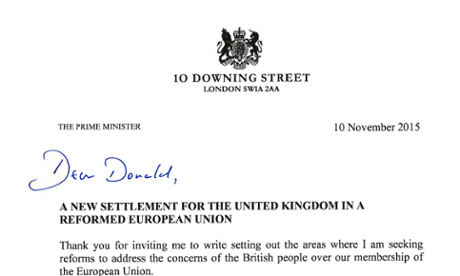
Tusk says he has now received the letter from Cameron
Donald Tusk, president of the European Council, has received the letter from David Cameron setting out the UK’s renegotiation demands.
The renegotiation is now officially underway, he says.
Acknowledgement of receipt. With @David_Cameron's letter, negotiations on #UKinEU can now begin
— Donald Tusk (@eucopresident) November 10, 2015
The Times’s Sam Coates says Number 10 seem to be on the retreat on the issue of restricting EU migrants’ access to benefits for four years.
No10 now say the goal of Tory manifesto is reducing scale and speed of migration, 4yr benefit ban only a preferred means but open to others
— Sam Coates Times (@SamCoatesTimes) November 10, 2015
Caroline Lucas, the Green party MP and a member of the Britain Stronger in Europe board, has put out a statement saying Cameron’s speech was “deeply depressing”. She said:
Cameron’s vision for an EU based on little more than an increasingly deregulated free market is deeply depressing.
The EU has given us so much – free movement and the right to make a living across a continent, protections at work and key environmental laws – yet the prime minister wants to reduce our relationships with neighbouring countries to little more than business transactions. That’s not a vision I share.
Britain must remain a part of the EU because we’re better off when we work together on cross-border challenges we face: from climate change to bank regulation. The EU will only succeed if it’s much more than just a market.
Cameron's speech - Snap verdict
Cameron’s speech - Snap verdict: It is hard to write a story about the “tone” of a speech, but that maybe what was most significant about what David Cameron had to say today. The full text of his speech is not yet available (it will be here later). Listening to it, nothing leapt out as particularly novel about his negotiating position, although once we’ve had a chance to pore over the text, and read the letter to Donald Tusk, doubtless the EUologists will find some nuances of significance.
Cameron seemed much more interested in the overall impression he was creating; in asserting that his demands were far-reaching and significant, but at the same time reasonable; and in proving that he was prepared to be constructive and cooperative with EU partners, but that at the same time he was determined to get what he wanted. And in this respect the speech was probably quite effective. He did make it sound as if his renegotiation would be meaningful, and not doomed to fail. He made this point particularly well in the Q&A, when the BBC’s James Landale asked him what you could summarise as the Nigel Farage question (‘Isn’t this all a bit feeble?’ - see 10.26am). Cameron said people could not claim that his goals were insubstantial, but also tell him he had no chance of getting what he wanted. (See 10.03am.) The prime minister may not be the best strategist or negotiator in UK politics, but he is one of the best communicators. It was interesting to hear him repeatedly refer to his general election mandate, and he sounded like someone who has given a great deal of thought to how to articulate public opinion on this issue.
The renegotiation may be just getting underway, but Cameron’s mind is probably already on the EU referendum. For all the rhetoric about ruling nothing out, this speech marked the opening of his Remain campaign.
Updated
Farage says Cameron's speech shows he's not aiming for anything 'substantial' in renegotiation
Nigel Farage, the Ukip leader, is out of the blocks with his reaction.
Clear that Mr Cameron is not aiming for any substantial renegotiation. No promise to regain the supremacy of parliament. Nothing on ending the free movement of people. And no attempt to reduce Britain’s massive contribution to the EU budget.
His speech was an attempt to portray a new ‘third way’ relationship with Brussels that is simply not on offer.
- Farage says Cameron’s speech shows he’s not aiming for anything ‘substantial’ in renegotiation.
Q: Are you worried an Out vote could lead to the break-up of the UK?
Cameron says this is a decision for the whole of the UK. He is sure this is the right process to follow, a renegotiation followed by a referendum.
This is “do-able”, he says.
So he would appeal to fellow EU leaders to “work with me and do it”, he says.
And that’s it.
I will post a summary and reaction soon.
Q: [From my colleague Nicholas Watt] You are ruled out the Norwegian option and the Swiss option for live outside the EU. That leaves the Turkish customs union option, or the WTO option? You have not ruled out leaving. So which would you prefer?
Cameron says that is a brilliantly-constructed question. But at this point he wants to stay in. If he does not get what he wants, and decides to leave, at that point he will answer the question.
Q: Can you put a figure on by how much you would reduce EU migration?
Cameron says he tested public opinion on this at the election. People think that the changes he specified earlier (see 9.40am) are the ones they want.
At the moment someone like a nurse can leave a skilled job in a poor EU country and get more doing an unskilled job here. That is wrong.
Q: Lord Lawson said last night you had been “disappointingly unambitious” and that your demands, in fishing terms, were “tiddlers”. Are you hoping to get something better?
Cameron says, with the renegotiation, “what you hear is what you are going to get”.
He wants action in all four areas. These are the issues that matter to the British people, he says.
As for Nigel Lawson, he cannot make everyone happy. But in Lawson’s time were were more closely tied to the euro, because we went into the ERM, than we are today.
Since then, there has been a massive repatriation of powers.
He listens “respectfully” to his “elders and betters”. But he is putting in place safeguards, he says.
Cameron says the changes he wants require a mixture of things: legislative changes, treaty change, technical changes.
On the subject of treaty change, he wants a commitment to legally-binding changes, such as those set out in the Danish protocol.
Q: Can you confirm that you don’t want changes to the working-time directive?
Cameron says preserving the opt-out is part of the competitive agenda he wants to address.
Q: What do you say to business leaders who might decide, having seen the CBI protest yesterday, not to speak out?
Cameron says if business leaders are worried about two people holding a banner and saying the same thing over and over again, they probably cannot stand the heat in any kitchen.
He wants people to speak out.
For example, the debate on TTIP is dominated by NGOs, he says. He would like to hear from small firms who cannot get access to the US market.
Q: Is it clear this is not as substantial as you originally thought? There is no emergency brake, there is no repatriation of power of labour laws, there is no treaty change.
Cameron says the BBC cannot have it both ways: saying this is impossible to achieve, but also insubstantial. The truth is somewhere in between, he suggests.
Q: Has any other EU country said it will back you on EU migrants’ benefits?
Cameron says other EU countries have a lot of concerns.
Countries like Romania and Bulgaria are concerned about their people leaving. They are coming to help build our country, “which is great”, but that means their home country is losing out.
Cameron's Q&A
Cameron is now taking questions.
Q: Is there any prospect of getting the renegotiation finished soon?
Cameron says these are substantial problems. Is he in a hurry? He wants to get on with it. As well as wanting to get on with it, he will be persistent. He hopes to make “really good process” in December. The referendum does not have to take place until 2017, but he would like to get on with it.
With reference to yesterday’s Times story (saying he wanted the referendum in June next year), he says the press can write what they like, but they will only find out when the referendum will be when his renegotiation is over.
Q: Do you rule out addressing the benefit problem by cutting benefits for all people in the UK?
Cameron says he is not just going to address three parts of his renegotiation, but ignore the fourth, difficult one.
(He does not address the point about Britons potentially losing access to benefits too, as a way of enabling Cameron to meet his election pledge.)
Cameron says “with patience, goodwill and ingenuity” this can be done.
And it will make Britain, and the EU, safer and more prosperous for years to come.
And that’s it.
Cameron says getting his changes will not be impossible
Cameron says getting these changes will be a big task.
But they are not impossible.
There will be those who say – here and elsewhere in the EU – that we are embarked on mission impossible. I say: ‘Why?’ I do not deny that seeking changes which require the agreement of 27 other democracies, all with their own concerns, is a big task. But an impossible one? I do not believe so for a minute.
Cameron says there will not be a second vote; this is the final choice.
- Cameron rules out a second referendum.
He says he wants his EU colleagues to consider this; it means they have just one chance to get this right, he says.
Cameron says it is a matter of judgment whether Britain would be more secure inside the EU or outside.
And ultimately it will be the judgment of the British people in the referendum that I promised and that I will deliver.
You will have to judge what is best for you and your family, and for our country.
It will be your decision whether to remain in the EU on the basis of the reforms we secure, or whether to leave.
Your decision.
Nobody else’s.
Not politicians’.
Not Parliament’s.
Not lobby groups’.
Not mine.
Just you.
You, the British people, will decide.
At that moment, you will hold this country’s destiny in your hands.
This is a huge decision for our country, perhaps the biggest we will make in our lifetimes.
And it will be the final decision.
I am not saying for one moment that Britain couldn’t survive outside the European Union.
Of course we could.
We are a great country.
The fifth largest economy in the world.
The fastest growing economy in the G7 last year.
The biggest destination for FDI in the EU.
Our capital city a global icon.
The world, literally, speaks our language.
Cameron says leaving the EU could pose security problems.
When he gave his Bloomberg speech, Islamic State (he calls it Isil) was not a problem, he says.
Cameron says Britain’s allies want Britain to remain in the EU.
And being in the EU has its uses. For example, it was the EU that pushed for sanctions against Russia after Ukraine. And it pushed for the sanctions that brought Iran to the negotiating table over its nuclear programme.
It would be much harder to do these things outside the EU, he says.
Cameron says those who advocated British withdrawal say Britain could be like Norway.
But that would mean Britain would have to comply with regulations it could not help write. Single markets have rules, and to have access to the single market, you have to conform with the rules.
And getting trade deals would be harder; a league of one has less clout than a league of 28.
Cameron says there are real problems with the status quo.
Those who advocating staying at all costs have serious questions to answer.
But those who are in favour of leaving at all costs also have serious questions to answer.
The question is whether we would be more successful in than out?
Whether being in the European Union adds to our economic security or detracts from it?
Whether being in the European Union makes us safer or less safe?
Cameron says he has achieved changes in the EU before. He has used the veto, insisted on budget cuts, and, by exercising the justice and home affairs opt-outs, achieved “the largest repatriation of power” since Britain joined the EU.
Cameron says, if he gets what he wants, he will campaign vigorously for Britain to stay in the EU.
But if he does not get a satisfactory deal, he rules nothing out.
Cameron says he has “every confidence” he will get a deal
Cameron says being “reasonable” should not be mistaken for lacking resolve.
Britain is one of the most powerful countries in the EU.
It gains from the EU. But it bring a lot to it too, he says.
A country that has raised concerns for years is entitled to have those concerns address.
Is the EU flexible enough to address these concerns? The answer must be yes, he says.
He says the EU has reached “a decisive moment”.
It must ensure that it works for eurozone countries and non-eurozone countries.
That is “eminently reasonable’, he says.
He says he has “every confidence” he will get a deal.
- Cameron says he has “every confidence” he will get a deal.
Cameron says his proposals are not “outlandish or absurb”.
They are reasonable, he says.
Cameron says these are his four main demands.
How these are achieved will be a matter for negotiation, he says.
Cameron says he put forward four ideas to tackle “benefit tourism” (my phrase, not his) at the election.
Two have already been introduced: Stopping EU migrants getting universal credit while looking for work, and ensuring that after six months without a job, EU jobseekers lose their right to stay.
But he also wants to stop EU migrants claiming benefits until they have paid into the system for four years.
And he wants to stop the UK paying child benefit for children living abroad.
He acknowledges that getting these changes will be difficult.
Cameron says the government needs more power to control immigration from inside the EU.
The principle of free movement of labour is fundamental, he says. Many Britons take advantage of it.
But it has never been an unqualified right.
Britain has always been an open, trading nation.
But the government wants to restore “a sense of fairness”.
First, it wants to ensure free movement does not apply to countries joining the EU until their economies have converged much more with the EU average.
He wants address flaws, such as the rules that make it easier for an EU citizen to bring a non-EU spouse to the UK than a British citizen to do the same.
But the government also needs to reduce the “draw” that the benefit system provides.
He reads out some of the statistics flagged up by the Times. (See 8.47am.)
Cameron says Britain will legislate to curb power of European court of justice to create new rights
Cameron says the government will reform Britain’s relationship with the European court of human rights by introducing a British bill of rights.
And the government will make it explicit that the European court of justice (the EU body, unlike the ECHR which is not part of the EU) cannot create new rights, he says.
- Cameron says Britain will legislate to curb the power of the European court of justice to create new rights.
PM: we will look at how GErmany uses constitutional court -- to make sure EU judgements compatible with UK (supreme court?)
— Faisal Islam (@faisalislam) November 10, 2015
Updated
Cameron says he wants groups of national parliaments to be able to block EU laws
Cameron says national parliaments must be given more say.
They are the bodies to which prime ministers like him are accounable.
He is not proposing a veto for any one national parliament, he says. That would lead to “gridlock”.
But he does want national parliaments to be able to join up to block EU laws.
- Cameron says he wants groups of national parliaments to be able to block EU laws.
Cameron: "I can tell you today..." Lobby perks up. "....I'm asking for legally binding irreversible agreement.. " Lobby perks back down.
— Paul Waugh (@paulwaugh) November 10, 2015
Updated
And he turns to his third point, the legitimacy of the EU.
It must be established that Britain is exempt from the “ever closer union” obligations in the EU treaties.
Cameron says he is asking for a clear, legally-binding assurance that this will no longer apply to the UK.
Cameron says more most be done to make the EU competitive.
Cameron says some principles must be established to achieve this. These include:
- Establishing that the EU has more than one currency.
- No discrimination against countries outside the euro.
- Protecting the integrity of the single market.
- Any eurozone initiatives, such as a banking union, must be voluntary for non-eurozone countries.
- Non-eurozone taxpayers should not have to bail out eurozone countries.
Cameron says UK will not stay in the EU if it becomes 'a single currency club'
Cameron turns to the eurozone.
The EU and the eurozone are not the same thing.
So we need a model that allows the EU to work for countries in the euro and outside, he says.
The EU needs “flexibility” to embrace both groups.
If the EU were to evolve into “a single currency club ... it would no longer be a club for us”.
- Cameron says UK will not stay in the EU if it becomes “a single currency club”.
Cameron says, in his Bloomberg speech, he said the EU faced three real problems:
1 - A crisis in the eurozone.
2 - Problems with competitiveness.
3 - A crisis of legitimacy.
These three problems are as serious now as they were then, he says.
But today he would add a fourth - the crisis created by immigration.
(Famously, the Bloomberg speech did not mention immigration, which has now become possibly the most important issue in the renegotiation.)
Cameron says Britain has always been an “engaged nation”, because that is the best way to protect the national interest.
And then he goes into a passage pre-briefed in advance.
I am in no doubt that for Britain the European question is not just a matter of economic security, but of national security too – not just a matter of jobs and trade but of the safety and security of our nation.
Cameron says he wants to be “practical, not emotional” when considering EU
Cameron says he comes to this question “with a frame of mind that is practical, not emotional, head not heart”.
Some Europeans may be disappointed by this, he says.
But that is what the British are like. They are practical, and they are “natural debunkers”.
We understand there is a relationship between the prosperity of the continent, and our prosperity he says.
- Cameron says he wants to be “practical, not emotional” when considering EU.
Cameron says his focus is on doing what is right for Britain.
And “more Europe” is not always right for the country, he says.
Cameron says case for EU reform even stronger than in 2013
Cameron says the challenges facing the EU have grown since he gave his Bloomberg speech committing himself to a referendum in January 2013.
If anything, the case for reform is even stronger, he says.
- Cameron says case for EU reform even stronger than when he gave his Bloomberg speech in 2013.
David Cameron's speech
David Cameron is speaking now.
He says he has honoured his promise to legislate for an EU referendum.
And the renegotiation is now entering its formal phase, having already gone through a phase focused on technical discussions, he says.
Here is more from Jonathan Portes on the “benefit tourism” figures.
Alternative headline: PM to say EU new arrivals 1% of non-retired population, 0.5% of benefit spending.. https://t.co/yfJscNkiyU
— Jonathan Portes (@jdportes) November 9, 2015
Here is a useful Q&A he has published on the subject. And here is his one-paragraph summary.
So the bottom line is that there are indeed lots of EU migrants claiming tax credits (but not other welfare benefits); this isn’t much of an economic problem from an economic perspective, although it does raise issues of “fairness”; the government’s proposals will be difficult (although perhaps not impossible) to negotiate; and the impact on immigration flows would be fairly small.
Jonathan Portes, the former chief economist at the Department for Work and Pensions and head of the National Institute of Economic and Social Research, is a persistent critic of government’s claims about so-called “benefit tourism”. He is not impressed by the figures released by Number 10 overnight. (See 8.47am.)
This is a preliminary analysis from @jdportes of Niesr on the migrant figs methodology. pic.twitter.com/zm7BSRwGvo
— Sam Coates Times (@SamCoatesTimes) November 10, 2015
David Cameron is at Chatham House. The hashtag for his speech is #chspeech.
Here is the scene where David Cameron is due to speak.
The global (and European) stage is set for David Cameron's Big Speech on the eu referendum pic.twitter.com/4GRE1Fexrh
— Paul Waugh (@paulwaugh) November 10, 2015
What does David Cameron want to achieve in his EU renegotiation? Today we’re going to get a definitive statement, in a speech from David Cameron, and then in a letter he is sending to Donald Tusk, president of the European Council. In truth, the letter will be more of a one-document compilation of everything that has gone before, rather than a detailed wishlist that breaks new ground, but this is an important moment in the renegotiation process and - given the distinct possibility that the referendum could leave to Britain leaving - in the history of Britain’s relationship with the EU generally.
Here is Nicholas Watt’s preview story for the Guardian. And this is what he says about the key four demands.
Cameron will say that the changes must “tackle abuses of the right to free movement, and enable us to control migration from the European Union, in line with my manifesto”.
This refers to the section of the Tories’ general election manifesto which said: “Changes to welfare to cut EU migration will be an absolute requirement in the renegotiation. We have already banned housing benefit for EU jobseekers, and restricted other benefits, including jobseeker’s allowance. We will insist that EU migrants who want to claim tax credits and child benefit must live here and contribute to our country for a minimum of four years.”
Poland has rejected any restrictions on in-work benefits on the grounds that this would discriminate against non-UK EU citizens in general and against eastern European citizens in particular, who overwhelmingly choose to work in the UK ...
The three other reforms, to be outlined by the prime minister in his letter to Tusk, are seen as less controversial than the change to the benefits system:
Protection for the UK and other countries outside the eurozone to ensure that they cannot have rules for the single market imposed by eurozone countries. The prime minister will say: “What I mean by that is a set of binding principles that guarantee fairness between euro and non-euro countries.
To “write competitiveness into the DNA of the whole European Union … This includes cutting the total burden on business.”
Exempting Britain from the EU’s founding principle to forge an ever closer union of the peoples of Europe and to instead bolster the role of national parliaments. He will say this cannot be achieved “through warm words but through legally binding and irreversible changes”.
And it is significant that overnight Downing Street has released some new figures to justify its call for curbs on the right of EU migrants to claim benefits (the one goal where Cameron will find it hardest to get what he wants). The statistics are in the Times. Here’s an excerpt from their story.
[Cameron] will say that 43 per cent of EU migrants rely on the support of the UK benefits system during their first four years in the country. This represents 224,000 EU nationals out of 526,000 new arrivals.
About 148,000 of these claimants, some 66 per cent, receive tax credits, housing benefit and other welfare handouts available to people in work.
Downing Street said that EU migrants entitled to so-called “in-work” benefits claimed an average of £5,000 per family, costing UK taxpayers £530 million in 2013. Under the government’s planned reforms, none of these claims would be permitted for migrants in their first four years.
No 10 also said that the figures suggested that more than 10,000 recently arrived EU families claimed over £10,000 through in-work welfare in 2013. A government source said that the new analysis made clear the need for changes to the welfare rules, and the four-year benefit ban will reduce the financial incentive for EU migrants to come to Britain in the first place.
I will be focusing mostly on this story today.
Here are the key timings.
9am: David Cameron gives his speech.
Around 11.30am: The government publishes the letter to Donald Tusk.
12.30pm: David Lidington, the Europe minister, gives a statement about the EU renegotiation demands to the Commons.
If you want to follow me on Twitter, I’m on @AndrewSparrow.
Updated