Summary
Well, that was reasonably revealing, despite the best efforts of some of the MPs on the committee to keep the proceedings in Dullsville. The worst offender was Sir Alan Beith, the committee chairman, who tried to shut David Cameron up when Cameron tried to make a party political point. Thankfully, Cameron ignored him. And these MPs wonder why their select committees never make the news?
Here are the key points.
-
Cameron said that English MPs should accept that scrapping the Barnett formula would not release “a pot of gold” for England. Later this afternoon MPs will debate backbench motion calling for, among other things, a review of the Barnett formula. It has been enthusiastically supported by Tories. But Cameron said getting rid of the Barnett formula would not help England much. He also said that the Barnetta formula would become less important as Scotland got more tax-raising powers, which would lead to the size of its block grant shrinking.
If Scotland and England were exactly the same size and the same scale, and there was a radically different distribution, I think [arguments against Barnett] would have more power. I would say to English colleagues, who say the Barnett formula is so unfair, and [Scotland gets] so much extra money, if you took all the extra money that Scotland gets from the Barnett formula and distributed it amongst the the 55m people in England, it’s not a pot of gold ... We should not kid our constituents that there’s some pot of gold called the Barnett formula which if we only got rid of it, and distributed all the money, we’d have lots more money. It’s not true. Because there are 55m English people and only 6m Scots. So don’t over-estimate the size of this thing. And also recognise that it will shrink in significance as we devolve fiscal power.
He also said that getting rid of the Barnett formula was “not on [his] horizon”
-
He signalled that he favoured a version of “English votes for English laws” (Evel) that would ensure that votes on the detail of government bills would only involve English MPs. He said there were three models for Evel available. First, there was a proposal from Lord Norton, who chaired a Tory commission on strengthening parliament in 2000, saying all votes on English-only bills should involve just English MPs, which Cameron described as the “purest and simplest” model. Second, there were the plans in the recent McKay commission report, which Cameron described as the “gentlest” version. And, third, there were proposals drawn up by the Conservative party’s Democracy taskforce before the 2010 election. The taskforce, chaired by Kenneth Clarke and involving Andrew Tyrie, said all MPs should vote on English-only bills at second reading, but that only English MPs should take part in the report stage votes on the line-by-line detail of the bills. If there was disagreement, there would have to be negotiation, Cameron said. Talking about the Clarke/Tyrie plan, he said:
I think that’s got a lot of attractions ... My view that that there are three good models, and I want to look at taking elements from each of them.
-
Cameron criticised Labour for not having any plans to address Evel. Speaking to the Labour MP Clive Betts, he said:
If I might say Mr Betts, your party is very happy to have discussions with other parties about devolution in Scotland, you’ve very happy to have discussions about devolution in Wales, you’re very happy to have discussions about devolution in Northern Ireland, but somehow, when it comes to England, the Labour party seems completely unwilling to have any discussion about English votes for English laws ...
The point I’m making is that you want equivalence for England, as you’ve got for Scotland and Wales, which is something the Labour party doesn’t seem to accept.
-
Cameron said he would be happy to see Scotland take power over housing benefit. And it would not matter if universal credit operated differently in Scotland, he said. He said he was opposed to control over pensions being devolved. But he went on:
I can’t get particularly religious about other aspects of welfare. I think that arguments about things like housing benefit and what have you, there’s a strong case for saying you could devolve those things and have greater local decision-making ...
Given that universal credit is taking within it so many different benefits, I think you can’t rule out - you can’t say anything involving universal credit can’t be subject to devolution. If you are saying ‘Might universal credit work differently in Scotland from the rest of the United Kingdom?’, then that would be a consequence of that. But I don’t want to go any further.
- He said the government would not rule out changing the proposals for draft legislation on further Scottish devolution published by the Smith commission. But he said that he hoped this would not be necessary.
- He said there was a “strong” case for the Northern Ireland government getting control over corporation tax. An announcement about this would be made next month in the autumn statement, he said.
-
He said he was opposed to giving councils new powers to levy tax. There were enough taxes in this country, he said.
That’s all from me for now.
For all the latest from Rochester, do follow our Rochester polling day live blog. I’ll be doing a new blog tonight from the count.
Updated
Sir Alan Beith wraps up by saying the committee will question Cameron again on Tuesday 16 December.
“Soon soon”, says Cameron, concealing his excitement at the prospect very effectively.
And that’s it.
I’ll post a summary soon.
Updated
Andrew Miller, the Labour chair of the science and technology committee, goes next.
Cameron says he was very struck by how strongly committed the science community was to the union during the referendum. They felt the current funding system works.
Cameron says there will be more about the long-term infrastructure plan in the autumn statement.
Louise Ellman, the Labour chair of the transport committee, goes next.
Q: Is there a policy on transport devolution?
Yes, says Cameron. We’re in favour of it.
Q: Do you think a constitutional convention, starting before the election, would be helpful? And do you approve of codification?
Cameron says he does not think codifying the constitution is something that is going to excite people.
He is in favour of ways of engaging people, he says.
Q: So you would like our committee’s paper on running a convention.
I can hardly wait.
Graham Allen goes next.
Q: Have we missed the opportunity provided by the Scottish referendum to push through major devolution all round?
Cameron says he does not accept that.
The government has made considerable progress on devolution, he says.
We should take it in stages, he says.
Q: You seem very relaxed about this. Nine weeks ago we were within 400,000 votes of the union collapsing. An extreme right party has come from nowhere and is at 25%. Isn’t devolution part of the answer?
Cameron says he was anything but relaxed about the referendum.
He felt incredibly strongly about this. He went up to Scotland and said it would break his heart for Scotland to leave the UK.
The lesson from Scotland is that, when people feel there is an important decision to be made, people do turn up to vote.
Devolution to people is as important as devolution to institutions, he says.
Updated
PM uncomfortable for 1st time as nitpicker-in-chief Andrew Tyrie demonstrates he knows more about West Lothian Question than him #liaison
— James Chapman (Mail) (@jameschappers) November 20, 2014
Tyrie: would be quicker if Cameron photocopied and handed round his crib sheet. Cameron, indignant: 'They're *my* scribbles' #liaison
— James Chapman (Mail) (@jameschappers) November 20, 2014
Q: So what is required to deliver that consent? Do we use legislative consent motions? Or do we just empower English MPs at report stage? It could not occur before report stage, because otherwise the bill could be amended back using UK votes.
Cameron says that is what he wants to achieve.
Andrew Tyrie goes next.
Q: You said the McKay plan was for English MPs to provide consent. That is not quite right, is it?
Cameron says English MPs would vote on an English bill after the report stage, but before the third reading.
Q: He provides a voice for the English. It could be over-ruled at third reading.
Cameron says he was trying to make the point that the Norton model was the most “full-throated”, McKay the weakest, and Tyrie/Clarke in between.
Q: Do you agee the phrase “English votes for English laws” will be taken the mean the English can veto a measures being imposed on them.
Basically, yes, says Cameron.
Where there is a distinct effect on England, the consent of English MPs should be required.
Cameron says he does not think Labour has engaged in this debate.
But “decision time” is coming soon, he says.
He says he is convinced he will have a clear plan for the manifesto.
Charles Walker, the Conservative chair of the procedure committee, goes next.
Q: I hope you don’t feel in any need to rush constitutional change.
Cameron says there is no need to rush. But there is a timetable.
The legislation for Scotland will be for the next government.
He says he has increasingly come to the view that the devolved settlements will only work if they have power to raise and spend their own money.
On Evel, a lot of work has been done. There is a menu of options out there, he says.
Q: You say you don’t want another tier of government, an English parliament. One idea is for a fourth reading of a bill, where English MPs only would vote. Do you support that?
Cameron says Lord Norton’s proposal was the purest version of Evel. A bill would be designated as English, and then only English MPs would vote on it.
The gentlest version was in the McKay commission, where English MPs would have to grant consent.
And there was a third proposal in between, proposed by Andrew Tyrie and Kenneth Clarke. An English bill would start off being considered by the whole house, but the detail would be considered just by English MPs.
That has a lot of merit, he says.
But you could take elements from all three models.
Updated
Margaret Hodge goes next.
Q: Tax in the UK is very centralised. Crossrail was an issue when I first got involved in politics 40 years ago. Yet London does not have the ability to raise money for projects like this.
Cameron says he is very proud of the fact that, as prime minister, he gave the green light to Crossrail.
It is the biggest engineering project in Europe. There is no way London would be able to fund it on its own without support from central government.
London is doing extremely well, he says.
Updated
Q: Isn’t there a problem campaigning in national elections, when you are not in charge of the NHS in Scotland?
Cameron says people have to understand this.
But we should not “shy away” from having a lively debate about the performance of public services in different parts of the UK.
Q: What influence does England have on Scottish health policy?
Good question, says Cameron. He says it is a shame no one from the SNP is here, because if they were, “we could have a really good fight”.
The idea that keeping the UK would damage the NHS in Scotland was “nonsense”, he says. And the people of Scotland saw through that.
Cameron says, if you took all the extra money that Scotland gets from the Barnett formula and distributed it amongst 55m English people, it would not go very far. It is not a “pot of gold”, he says. There are 55m English people and only 6m Scots.
Sarah Wollaston, the Conservative chair of the health committee, goes next.
Q: How can it be right that Scotland gets more money to spend on health than England?
Cameron says he does not accept that the differences are as big as that.
If the Barnett formula did not operate, there would have to be another formula.
Q: But Barnett creates “an accident of geography”. People are treated differently, depending on whether they are five miles on side of the border or another.
Cameron says, without Barnett, there would still be a formula, and there would still be “an accident of geography”.
Cameron says pensions are a cornerstone.
There is a solidarity aspect to the union, he says.
That is why pensions should not be devolved.
Dame Anne Begg, the Labour chair of the work and pensions committee, goes next.
Q: What aspects of welfare should be devolved?
Cameron says he does not want to create problems for his team negotiating with the Smith commission.
But he would not like to see pensions devolved. There is an element of solidarity there. Everyone in the UK should get the same.
With other issues, like housing benefit, he is less worried about devolving control.
Q: That would mean universal credit being different in Scotland, because housing benefit is covered by that.
Cameron says that would not be an argument for not devolving housing benefit. If universal credit evolves differently in Scotland, he could accept that. But he does not want to go any further, in cases he causes trouble for Smith.
Q: What about just being transparent, making it clear where income tax goes?
Cameron says he thought Allen was proposing actually handing over income tax to councils.
Q: What about just making it clear where the money comes from?
Cameron says he is not sure what the point of that would be.
(Cameron and Allen are using different definitions of assignment.)
Graham Allen, the Labour chair of the political and constitutional reform committee, goes next.
Q: Would you accept assigning income tax to an English body as part of a solution?
Cameron says he does not think assignment is the right answer. He does not want to set up a new body, an English parliament.
He thinks the solution involves looking at how MPs vote.
If Scotland can change income tax rates, English MPs have to be able to avoid income tax being set by MPs whose constituents have already had their income tax set by another body.
Assignment is difficult if you do not go to an English parliament, he says.
The English votes for English laws problem is solvable, he says.
Q: Are you saying the people of Scotland can be trusted with tax, but not English councils?
Cameron says he’s the one who is prepared to say that the people of England should have a say over English laws. Labour is prepared to give devolution to Scotland, Wales and Northern Ireland. But it won’t offer anything to England.
Sir Alan Beith interrupts, saying that he is getting too political. Those remarks don’t belong here, he says. Cameron disagrees.
He says he finds it “mysterious” why Labour won’t engage in this debate.
Clive Betts, the Labour chair of the communities committee, goes next.
Q: There is agreement devolution should happen in England, to councils or combinations of councils. But the measures taken so far have all been about devolving spending powers, not tax-raising powers.
Cameron says Betts is ignoring the English votes for English laws question.
Sir Alan Beith says they will come to that topic later.
On the Betts question, he says his answer is no. We’ve got enough taxes in this country, he says. He does not want to see reams of more taxes.
Q: It doesn’t have to be extra tax. It’s a question of who controls tax. Councils only control 2% of tax, council tax, and that’s capped.
Cameron says he has tried to ensure there is a better connection between local decision-making and tax. The new homes bonus ensures that councils are rewarded for building more homes.
Q: Do you accept our major cities are far more contrained than their counterparts in Europe over tax?
Cameron says the city deals have transferred real power and real money to cities.
Q: Apart from the power to raise tax. Our committee found strong support for cities having tax powers. It received cross-party support.
Camerons says Betts is being “churlish”. City leaders have welcomed the city deals.
If you have a plan for giving cities the power to whack up council tax, that’s fine. Put it in your manifesto, he says.
Cameron says there have been “real issues” in Northern Ireland in terms of the government there sorting out its budget.
Laurence Robertson, the Conservative chair of the Northern Ireland committee, goes next.
Q: What are you going to do about giving Northern Ireland control over corporation tax?
Cameron says the government will set out its plans in the autumn statement.
He says Northern Ireland politicians make two arguments for Northern Ireland being able to cur corporation tax.
First, they say Northern Ireland has a land border with the Republic.
And, second, they say the Troubles have left the public sector too large in Northern Ireland compared to the private sector. So they want to give the private sector a boost.
Politicians from all side say this, he says.
But, he says, devolving a tax power is a serious matter.
Q: Do you accept that if more devolution is granted, there will be more volatility on tax? So shouldn’t Scotland get more power over borrowing?
The short answer is yes, says Cameron.
He says the Scotland Act represents the biggest act of fiscal devolution to Scotland in 300 years.
And the limits on borrowing are going up to £2.2bn.
Q: In practice will the UK government end up as the lender of last resort?
Cameron says in the end the sovereign entity, the UK government, is the lender of last resort.
He is not letting the devolved governments borrow without limit. That would be a “dangerous and bad” idea.
Q: So UK borrowing as a whole will go up?
Yes, but within a limit, Cameron says.
Andrew Tyrie, the Conservative chair of the Treasury committee, goes next.
Q: Everyone agrees Barnett is over-generous to Scotland. So shouldn’t there be a grand commission of the nations to consider this?
Cameron says he has made a commitment that changing Barnett is not on his horizon, and he is sticking to that.
Q: So the answer is no?
Cameron says he has said clearly it’s not on his horizon.
Margaret Hodge, the Labour chair of the public accounts committee, goes next.
Q: Sir Nick Macpherson told our committee that, if we keep the Barnett formula but give the Scots control of income tax, the Scots could benefit from a rise in English income tax without having to put tax up themselves. How are you going to square that circle?
Cameron says Macpherson is right. If England spends more on the NHS, there is a knock-on Barnett consequential that leads to Scotland getting more money.
But if you did not have Barnett, you would need another formula.
Barnett, for all its faults, has worked.
As you devolve tax-raising powers, the size of the block grant gets smaller. So Barnett matters less, he says.
Q: The system must be seen to be fair.
Cameron says it will be seen as fair, because the size of the block grant will get smaller.
Q: Scottish spending will count towards UK public expenditure totals. So, if Scotland spends more, England will have to spend less.
Cameron says that is easier to solve.
No government would cut English spending if Scotland increased spending. What would happen is that the overall spending total would increase.
There would be a problem if overall borrowing went up.
Under the Scotland Act, Scotland is getting borrowing powers. But there are limits to that, he says.
Q: If what you are saying is that total spending limit do not matter, that’s worrying.
Cameron says there are limits to how much Scotland can borrow.
But if Scotland wants to tax more and spend more, that’s fine.
There are also limits in “political actuality”. If Scotland raised taxes too much, businesses would leave. So there will be constraints.
Q: Has the time come to look at the Barnett formula? It appears to under-fund Wales by £300m a year.
Cameron says the government is still stabilising the public finances.
If tax-raising powers are devolved to Scotland and Wales, the importance of Barnett will reduce, because they will get smaller block grants.
In 2013 he said he did not think reform of Barnett was on the horizon. He still thinks that, he says.
To English MPs, he says they should not think there is a “pot of gold” to be had from Barnett reform.
Cameron says he supports getting rid of the “lock-step” mechanism in Wales (which imposes conditions on the assembly exercising certain powers).
Cameron says, if he becomes prime minister, he hopes there will be further moves on Welsh devolution.
But that would depend on the Welsh assembly.
He thinks there should be a referendum on the assembly getting tax-raising powers. But that is in the hands of the assembly, he says. It has to request it.
As for the assembly getting more powers, he has concerns about some issues, like policing.
We have to keep defaulting back to the big picture. What will make the UK a strong entity, he asks.
Then we can spend more time on the things that matter.
This is from the Sunday Post’s James Millar.
Good work from @IanDavidsonMP trying to pin PM down on Smith Commission. Cameron seems to have not ruled out govt amending Smith proposals
— James Millar (@PoliticalYeti) November 20, 2014
Q: What will you do if the Smith commission (which is producing plans for further devolution) proposes ideas you don’t like?
Cameron says he hopes that will not happen.
Q: What if the Smith commission cannot produce a consensus. Will the government back the majority view?
Cameron says he does not think that will happen.
Q: Who takes responsibility for this in government?
Cameron says he is in overall charge. But William Hague has been chairing a committee on this.
Sir Alan Beith, the committee chair, welcomes Cameron.
Ian Davidson, the Labour chair of the Scottish affairs committee, goes first.
Q: After the referendum you seemed to link extra powers to Scotland to English devolution. Do you accept that Scottish devolution should take place on its own?
Effectively yes, says Cameron. Scotland has a guarantee of further devolution. All the parties have agreed to that.
But, Cameron says, he has said that he also wants a solution to the English issue.
But one is not dependent on the other, he says.
If he wins the election, you get both.
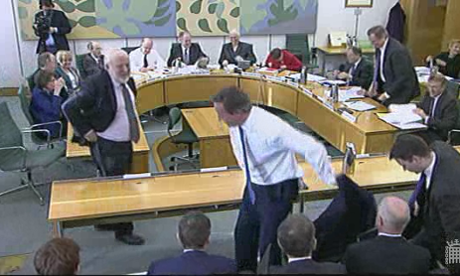
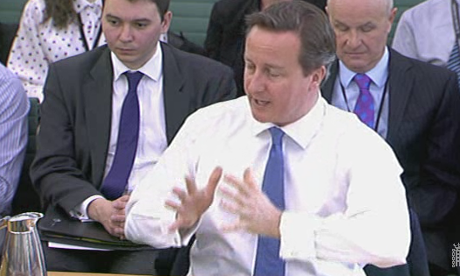
David Cameron is arriving now and taking his jacket off.
Earlier I said that Scotland is going to be a crucial issue in the election and beyond. A report on Newsnight last night illustrates why. Newsnight highlighted some figures from electionforecast.co.uk, an academic consortium, suggesting that the SNP could have has many as 29 MPs after the elections.
Here are the electionforecast.co.uk figures, which don’t include Northern Ireland.
Conservatives: 286
Labour: 284
Lib Dems: 25
SNP: 29
Plaid Cymru: 2
Greens: 1
Ukip: 4
It’s only one forecast. But it does illustrate how the next election could leave us with a parliament where even a two-party coalition (Con/Lib Dem, or Labour/Lib Dem) could fail to possess a majority. In these circumstances the SNP could be very powerful indeed (which is one reason why Alex Salmond seems so keen to get a Westminster seat.)
The liaison committee is made up of the chairs of all the Commons select committee.
Here are the members who are expected to be taking part today, with alongside the name of the committee they chair.
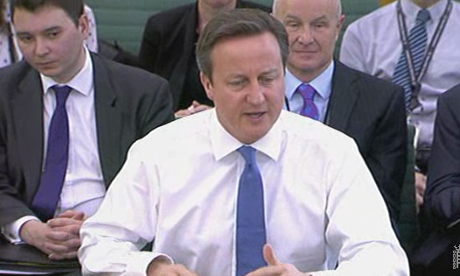
David Cameron is giving evidence to the Commons liaison committee at 10.30am. These hearings can be a bit of a yawnathon, but today’s will be about the Scottish independence referendum, devolution, the Barnett formula and English votes for English laws (Evel) - topics which are going to be at the centre of political debate until the election and beyond - and so it should definitely be worth tuning in. I’ll be covering it in detail.
At the every least we might found out more about the vote that the government is planning to hold on Evel before the end of November.
The committee has released this list of topics it wants to cover.
The lessons from the Scottish referendum and the timetable for further Scottish devolution The Government’s plans for further devolution to Wales and to Northern Ireland Tax devolution and the Barnett formula Proposals for devolution to cities and regions within England The merits of “English votes for English laws” and the implications for Parliament at Westminster The impact of devolution on UK policy making on social security, health, transport and science The case for a constitutional convention