
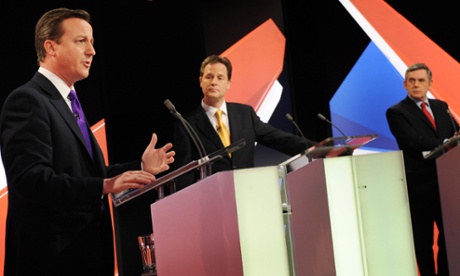
Afternoon summary
- Broadcasters are expected to press ahead with the planned televised general election debates, despite David Cameron saying he will only appear in one of them. As Tara Conlan reports, the BBC, Channel 4, ITV and Sky are discussing the latest offer from No 10 and thinking carefully about its implications. Sources say they are bound by impartiality rules but are determined that no one party will dictate the grounds. One source said that the current thinking among the broadcasters is that they “will hold the debates” and if specific people do not want to turn up then that will be their decision.
That’s all from me for today.
Tomorrow I will be blogging from the Green party conference in Liverpool.
Here are two blogs on the debate story I found interesting.
Whatever happens next, we in the media will ramp the story up – since there are few stories more important to us than those about ourselves – and Downing Steet will cross its fingers and hope that it fades away. In the meantime, the voters will stifle a yawn, if they can be bothered to do even that. They are not marching in the streets to demand more politicians on their TV screens. The reverse, if anything.
-
Iain Dale, the broadcaster and former Conservative candidate, says Cameron should take part in the debates. He imagines what would happen if it were Ed Miliband trying to duck out of them.
Following that last post, Guido Fawkes got in touch.
@AndrewSparrow Am told Tories believe that the presenter or similar would have to read out their manifesto policy in answer to questions.
— Guido Fawkes (@GuidoFawkes) March 5, 2015
@GuidoFawkes We need to nominate a candidate. Boris?
— AndrewSparrow (@AndrewSparrow) March 5, 2015
@AndrewSparrow Paxman.
— Guido Fawkes (@GuidoFawkes) March 5, 2015
Updated
What BBC and Ofcom guidelines say about 'empty chairing'
A reminder: as I have explained on this blog before, the BBC’s editorial guidelines would allow the BBC to “empty chair” David Cameron if he refuses to attend a debate.
Anyone has the right to refuse to contribute to our output and it is not always necessary to mention their refusal. However, the refusal of an individual or an organisation to make a contribution should not be allowed to act as a veto on the appearance of other contributors holding different views, or on the output itself.
When our audience might reasonably expect to hear counter arguments or where an individual, viewpoint or organisation is not represented it may be appropriate to explain the absence, particularly if it would be unfair to the missing contributor not to do so. This should be done in terms that are fair. We should consider whether we can represent the missing contributor’s views based on what we already know.
And here are the BBC’s election guidelines (pdf). They also allow “empty chairing”. This is what they say in the “Fairness to candidates” section.
Candidates or parties declining to take part in constituency/ward reports or debates cannot, by doing so, effectively exercise a veto over such coverage.
However, this does not weaken in any way the BBC’s obligations of fairness in ensuring the audience is informed of all main strands of argument.
Ofcom, which regulates the commercial broadcasters, has its own broadcasting code. This does not specifically address the issue of what to do it a politician refuses to take part in a debate, but two principles are relevant. It says that broadcasters should be impartial. And it says that “due weight” must be given to the major parties in coverage.
Ofcom does not give out guidance on what broadcasters should or should not do in the event of someone refusing to take part in a debate. But, when I inquired a few weeks ago, an industry source said the code would make it hard to justify a broadcaster “empty chairing” Cameron. However, if a broadcaster were to choose a proxy to speak on Cameron’s behalf, that would be acceptable, the source suggested. That would ensure the Conservative case was given “due weight”.
Stephen Coleman, professor of political communications at Leeds University, carried out research on the impact of the TV debates in 2010. On the World at One he said they had a remarkable impact in terms of helping first-time voters decide how to vote.
They were remarkably popular ... Two thirds of people in our surveys said that they did in fact learn something new about what the parties stood for. 87% said they talked to other people after the debates. But I’ll tell you the really surprising thing was first-time voters. 74% of them said that after watching the debate they knew something more about what the parties were standing for than they did before and 50% of them - half of all first-time voters who watched it, and a very large number did - said it helped them to decide how to vote. That is quite unique in the history of British political communication at election time in terms of reaching large numbers of people, particularly those who are the least reachable by the usual political discussion.
And here’s a link to the research that Coleman produced for the Reuters Institute for the Study of Journalism.
.@AndrewSparrow Evidence is TV debates reach, engage & help 1st-time & young voters. http://t.co/5s8ue4n6F5 pic.twitter.com/YRK5d9RO2n
— Rosemary Sutcliff (@rsutcliff) March 5, 2015
Updated
Farage says Cameron 'sabotaged' the planned TV debates
Nigel Farage, the Ukip leader, has been on ITV’s Loose Women today. During the conversation, he claimed David Cameron had “sabotaged” the planned TV debates.
Ofcom, the regulator, said there were four major parties in British politics – Lib, Lab, Con and us – and on that same day he said ‘well, surely the Greens have to be involved’. And now there’s going to be actually, a debate – if it happens at all – with more people than we’ve got sitting on this panel now. How is it going to work?
Had it been a four-headed debate, there were one or two conversations I wanted to have with the prime minister that I don’t think he would have been able to answer and I suspect that’s why they’ve sabotaged them. It would have been: ‘Mr Cameron, you promised to control immigration, which is a key issue in this country, how can you do that when we’re members of the European Union and we have an open door to half a billion people?’ I don’t think he wanted to be asked that question.
During the programme Farage also claimed that Ukip would have at least 10 MPs after the election. Asked how many seats he expected to win, he replied:
It’ll be more than a handful … It will be in double figures.
Here’s the Guardian’s Politics Weekly podcast. It features Alberto Nardelli, Heather Stewart, Michael White and Tom Clark talking about the proposed TV debates, the polls and how the palace of Westminster is falling into disrepair.
Here’s a Guardian video of Ed Miliband challenging David Cameron to commit to a head-to-head debate with him.
Lunchtime summary
- Labour has urged Britain’s main broadcasting organisations to face down David Cameron and press ahead with their plans for the three televised leaders’ debates during the election campaign which Cameron has now rejected. After Cameron produced a counter-offer overnight, involving just one, 90-minute, seven-party debate, Miliband sent his first ever tweet directly to Cameron accusing him of “running scared”. (See 10.47am.) Miliband is suggesting is suggesting he will attend all three proposed debates, even if Cameron refuses to turn up, although he has not quite given a cast-iron commitment. (See 12.22pm.) If Cameron refuses to attend the planned head-to-head with Miliband, Miliband could be interviewed on his own by Jeremy Paxman, Labour suggests. Some sources are suggesting that the broadcasters will hold firm, stick to their original plans, and press ahead without Cameron if he won’t turn up. (Some people are describing this as “empty chairing” Cameron, but proper empty chairing would involve having an actual empty chair on set. This seems unlikely.) The broadcasters are meeting, and are expected to respond later today. Cameron has defended his stance, saying he was just trying to “unblock the logjam”.
-
Women working in the intelligence and security agencies are being held back by a “permafrost” of conservative men, an inquiry has found. As the Press Association reports, a strand of middle managers in MI5, MI6 and GCHQ have a “very traditional male mentality and outlook” and the services need a culture change, according to an Intelligence and Security Committee (ISC) report (pdf). Across the three intelligence agencies, women make up 37% of the workforce but only 19% of the most senior roles, it found. Labour’s Hazel Blears, who sits on the ISC, said:
I believe there is a strong business imperative for greater diversity in the agencies. They should reflect the population they serve but, more importantly, they cannot fulfil their mandate without drawing on the broad range of talent and skills that a diverse workforce can offer.
If all intelligence professionals are cut from the same cloth - sharing similar backgrounds and similar characteristics - then they are likely to share unacknowledged biases which will circumscribe both the definition of problems and the search for solutions. Diversity will therefore result in better intelligence analysis and a better response to the range of threats that we face to our national security.
- The Lib Dems have said they would offer the people of Cornwall a legislative assembly which would get new powers to run local services. The option of a Cornish Assembly, similar to the one in Wales, would be put to a referendum.
-
Harvey Proctor, the former Conservative MP, has strongly denied suggestions that he was involved in any form of Westminster rent boy circle. He spoke to Today as it emerged his home has been searched as part of a police investigation into historic abuse allegations.
Updated
Leanne Wood, leader of Plaid Cymru, has also condemned David Cameron’s decision not to take part in the debates.
People want these debates to go ahead so that they have the opportunity to hear from the parties that they will be voting for in May. Plaid Cymru is ready for these debates and we look forward to setting out our plans for an alternative to Westminster’s austerity agenda. The prime minister’s efforts to manipulate the broadcasters are unacceptable and arrogant and it would seem that he is running scared of his record being open to scrutiny.
In the Commons earlier, at business questions, William Hague, the leader of the Commons, said that Ed Miliband was only calling for a TV debate because he was desperate, and that David Cameron was being more generous than Tony Blair.
I have my own translation, I think, of what the leader of the opposition was saying yesterday when he was calling for a debate, which means ‘I am desperate because the election is slipping away from me and I have nothing else to ask about at all’. That is the translation of that.
And indeed when I recall asking Tony Blair when I was leader of the opposition in 2001 for a television debate, there was not even an offer of a debate from Tony. Not even the pretence of a debate. There was a very clear no debate whatsoever and this prime minister is offering a debate and that is an offer that should be taken up that was never offered by Tony Blair in similar circumstances.
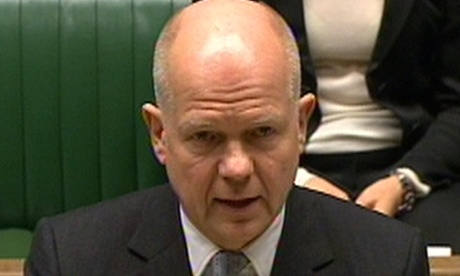
On Sunday, in an interview with Sky’s Dermot Murnaghan, Grant Shapps, the Conservative chairman, said that there should be a debate between David Cameron and Ed Miliband.
There are only two people who are likely to walk into Downing Street, David Cameron or, God forbid, Ed Miliband with all he’ll do to take us back to square one, repeat all the old mistakes, so certainly I’d like to see the two of them debate ... We want debates to happen. We think that certainly a debate between Ed Miliband and David Cameron certainly makes sense.
Today he seems to have had a change of heart. Speaking on the Daily Politics earlier, he was asked about what he said on Sunday, and he said the broadcasters had failed to come up with a proposal. He went on:
What we don’t have on the table from the broadcasters or haven’t had on the table from the broadcasters is a clear sense of what they want to do. It’s been a mess. We’re cutting through the chaff. The prime minister has said: ‘Here is a format where everybody gets to take place so we don’t start to exclude people arbitrarily’; we can then have that debate, it will include Ed Miliband and the prime minister.
Polly Toynbee has filed a “first thoughts” piece for Comment is free (as we still think of it) on David Cameron’s decision not to debate Ed Miliband head to head. Here’s an extract.
The Lynton Crosby calculation is that chicken, frit and hiding behind the sofa insults will do less damage to Cameron than a straight one-to-one debate in front of the cameras. But they will find that whenever they try to run the “weak” Ed line, Labour will have a caustic comeback – if Ed’s so weak, why is Cameron so afraid?
Six reasons why David Cameron is so keen to scupper the debates
In the comments petercs has asked this.
It’s a fair question. Here are some answers.
1 - Tory folklore has it that David Cameron failed to win a majority in 2010 because of the debates. Like most folklore, this is only partly true, but it still has a powerful grip on the party’s psyche. The 2010 debates certainly gave Nick Clegg and the Lib Dems a huge boost, and after the first ones their poll ratings soared. But, by the final debate, support for Clegg had fallen somewhat and on polling day the Lib Dems actually lost seats. Perhaps they might have lost even more without Cleggmania. The exact impact of the debates is still a matter of dispute, but the Tories are right to think they certainly didn’t help.
2 - Having debates would disrupt the kind of campaign the Tories plan to run. Their strategy is relatively straightforward: focus as much as possible on the economy, and Labour’s supposed threat to it, and Ed Miliband’s alleged inadequacies as a potential prime minister, and minimise everything else. The problem with having debates is that, as Cameron repeatedly say, they would become “the story” and consume the attention of the media. The ability of the Tories to control the campaign narrative would be constrained. (Also, any more that boosts the relative influence of the pro-Tory press relative to the legally-impartial broadcasters would be a bonus.)
3 - Cameron would find it hard to win the debates. It’s not that he’s a poor debater; he isn’t, and he regularly gets the best of Ed Miliband at PMQs. But he would be handicapped by two factors. First, expectations matter as much as performance, and he would find it hard to outperform those (because people would assume he would do well). Second, debates tend to favour outsiders rather than incumbents.
4 - Miliband, however, could benefit from the debates. At the moment public perceptions of Miliband are very poor. The Tories are worried that, if a head-to-head debate with Cameron did take place, people would realise that he is not quite the hapless incompetent that the CCHQ pretends.
5 - Other parties could also benefit too, most notably Nigel Farage. Clegg did well in 2010 because he was perceived as the outsider, and this time round Farage would be well place to benefit in the same way. Also, his two debates with Clegg during the European elections illustrated how hard it is for any politician committed to EU membership to win an argument about controlling immigration.
6 - Cameron could stymie the debates without paying too heavy a price. There is strong public support for debates (70% in this YouGov poll). But, although voters are notionally in favour, they are quite used to taking part in elections which don’t involve debates and, in truth, they probably care about this quite a lot less than we journalists do. Also, strong as the case is for debates, political leaders are subject to intense media scrutiny at election time. It would be hard to argue that, without debates, people would be deprived of the information they need to decide who to vote.
Updated
Cameron says he is trying to make the TV debate happen
David Cameron gave a clip to broadcasters a few minutes ago saying he was trying to “unblock the logjam” affecting the debates.
I want us to have a debate and so what I have done is unblock the logjam that I think I’m afraid the broadcasters helped to create, and said, right let’s get on, let’s have the debate that I think matters the most, which is the one that gives everybody a say, and let’s get on with it before the campaign, so hopefully, by putting forward this proposal for a debate, we will actually see one take place.
I haven’t put hurdles in the way. The broadcasters came up with a series of proposals, that other people as well realised were flawed, not having the Greens and then deciding to have other parties without consulting anyone. But what I have done is put up front and centre the need to hold a debate, so I am unblocking the logjam.
Miliband suggests he will attend all debates - (plus, why he might not)
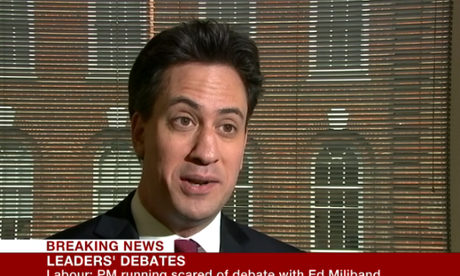
Ed Miliband has renewed his challenge to David Cameron to take part in the debates. This is what he told BBC News.
The British public deserve this debate. I will debate him, any time, any place, anywhere. He should stop ducking and weaving and he should name the date.
Asked if he was committed to taking part in the multi-party debates too, as well as the head-to-head with Cameron, Miliband replied.
We have always said we will do the seven-way debate, and when it is is a matter for the broadcasters. But we also need the debate between me and David Cameron. He has said repeatedly that he wants that debate to happen. He said yesterday he did not want it on April 30, he wanted it earlier. I’ve said to him I’ll do it any time, any place, anywhere. He should just name the date. But what I think the public will not tolerate is a prime minister who is running away from them, running away from his record and running away from the face to face debate with me that he said he wanted and that the public deserve.
Miliband was asked if his taking part in the multi-party debate was conditional on the two-party debate going ahead. He implied that it wasn’t.
We want the seven-way debate to happen and we have always said that. We also need the two-way debate. We want these debates to happen. We will be part of them. We want to see what the broadcasters say. But I want these debates, I want them to happen.
-
Miliband suggests he will attend all debates, even if Cameron does not.
Privately Labour are briefing that Miliband will take part in the proposed multi-party debates, even if Cameron does not take part. (See 9.51am.) But Miliband has not quite been that explicit in public. He committed himself to taking party in a “seven-way debate”, not a multi-party debate, and so, conceivably, if Cameron refused to take part, he could argue that this was not actually a seven-way debate.
Also, Labour do seem keen on Miliband having his own show on 30 April if Cameron does not show up for the two-party debate (see 9.51am), but if the broadcasters were to cancel that one, but try to go ahead with the two other multi-party debates, Labour might have second thoughts.
It is hard to see how Miliband would gain from having to attend a debate with Nick Clegg, Nigel Farage, Nicola Sturgeon etc, if he did not also have the chance to go head-to-head with Cameron, or at least attend a Cameron/Miliband debate with Cameron being empty-chaired (which would be a good platform for him, even if he had to endure questions from Jeremy Paxman).
Updated
TV debates - Patrick Wintour's analysis
Here’s an excerpt.
At present Cameron does not look that credible. His sudden desire for the nation to listen to the views of the Green party on social housing, or hear Nigel Dodds, the DUP leader, set out his views to a grateful nation on the future of Ukrainian conflict, is inherently absurd. The real reason is that despite the stickiness of the polls, Cameron calculates he is on course to win without the TV debates. The economy will see him home and any cynicism about his refusal to debate will add little to pre-existing cynicism about politicians.
In that context, such debates merely become a gamble where none is necessary. A central feature of the Tory campaign is that Miliband is just short of a laughing stock. It would be deeply disturbing if, unmediated, Miliband appeared less dopey than Wallace and more worldly than Mr Bean. Moreover, incumbents normally struggle in election debates and, however naturally Cameron has donned the authority of a prime minister, he would have been on the defensive. Such debates would have been as much about his record, as the risk of Miliband.
Nigel Dodds, the DUP deputy leader, told the BBC’s Good Morning Ulster this morning that the broadcasters had “messed up big style” with the debates and that his party was still demanding to be included. It has begun legal action to ensure Peter Robinson, the DUP leader, can take part.
The Electoral Reform Society says that not having TV debates would be “a backward step in our democratic development”. This is from its chief executive, Katie Ghose.
This unseemly squabble over TV debates has to end now. In the run-up to an election that’s too close to call, the British public expect to hear from all the party leaders. Everyone involved needs to recognise that fact and come to an agreement before it’s too late.
“Compared to other advanced democracies around the world, Britain has been extremely late to the party when it comes to TV debates. It would be a national embarrassment if we end up being the first to leave that party as well. No TV debates in 2015 would be a backward step in terms of our democratic development.
And here are two Labour MPs on the debates story.
From Ben Bradshaw, a former culture secretary
Vital test of broadcasters' independence.They must stand firm against Tory bullying & empty chair Cameron if necessary. #tvdebates
— Ben Bradshaw (@BenPBradshaw) March 5, 2015
From Alison McGovern
So. The PM was happy with awful PMQs yesterday? But unhappy with TV debates that he previously thought a good reform. This makes no sense.
— Alison McGovern (@Alison_McGovern) March 5, 2015
Here’s Newnight’s Chris Cook on the debates.
I don't get why CCHQ doesn't just say "Last time, we think the debates were a distraction and we would rather run a traditional campaign"
— Chris Cook (@xtophercook) March 5, 2015
Like Lady Royall, the Tory peer Lord Finkelstein has also been commenting on Lord Ashdown’s Today interview about the debates.
Paddy Ashdown asks if we could imagine Mrs T turning down a debate. Imagination not necessary. She turned down Callaghan and Kinnock offers.
— Daniel Finkelstein (@Dannythefink) March 5, 2015
Mrs Thatcher said that presidential style debates were showbusiness and alien to Britain. "We are not electing a President."
— Daniel Finkelstein (@Dannythefink) March 5, 2015
Here’s George Galloway’s take on the story.
How pathetic must a PM be that he is "frit" to debate with Ed Miliband....?
— George Galloway (@georgegalloway) March 5, 2015
Ed Miliband is using Twitter to challenge David Cameron directly.
.@David_Cameron why are you running scared of TV debates? The British people want a head-to-head TV debate. Let's give it to them.
— Ed Miliband (@Ed_Miliband) March 5, 2015
Updated
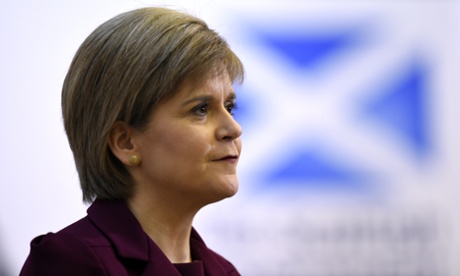
Nicola Sturgeon, Scotland’s first minister, has condemned David Cameron for refusing top take part in multiple TV debates. As SNP leader, she is due to take part in the two multi-party ones planned by the broadcasters.
David Cameron is clearly running scared of having to answer for his government’s record of failure and incompetence - and this arrogance in trying to lay down the law is all about getting out of debates, not taking part.
I will debate him anytime, anywhere, on any number of occasions. However we have accepted the broadcasters’ proposals, and believe we should stick with that, rather than allow a Tory Prime Minister to dictate the terms of debate.
Carwyn Jones, the Labour Welsh first minster, has also condemned Cameron.
Ridiculous that the PM should appear to be running from debate, no matter how badly the broadcasters have handled the issue.
— Carwyn Jones AM/AC (@AMCarwyn) March 5, 2015
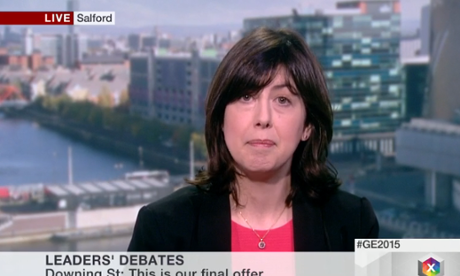
We could be get yet another debate. Lucy Powell, Labour’s vice chair of election strategy, floated the idea of a deputy prime minister’s debate, involving Nick Clegg and Harriet Harman, in an interview just now.
Here are the key points.
-
Powell refused to say whether Ed Miliband would debate head-to-head with Nick Clegg if Clegg were allowed to stand in for Cameron in the final leaders debate. (See 8.54am and 9.40am.) When pressed, she said this was a “ridiculous question”. Miliband would debate with Clegg in the multi-party debates, she said.
Ed Miliband wants to go head to head with David Cameron. He’s going to take part in debate with Nick Clegg and the other party leaders as well.
-
She floated the idea of Clegg debating Harriet Harman. She came out with the idea when pressed about a possible Miliband/Clegg head to head.
[Clegg] can have a debate with Harriet Harman, who’s our deputy leader, about being deputy prime minister.
Powell seemed to be thinking out loud. Miliband has not committed himself to making Harman deputy prime minister if he wins the election.
-
Powell said people were “outraged” about Cameron refusing to take part in multiple debates and that they should put pressure on him to change his mind.
22 million people tuned into those debates at the last election. They brought the campaign alive. They were a really important part of democracy. It shouldn’t be for the prime minister of the day to say, ‘Hang on a minute, I’m dropping out’. There should be ourage about that. We are outraged about that. I think the public are outraged about that. We need to ensure that more pressure is being put on him to take part in those debates.
This reflects the point that Gary Gibbon made in his blog. See 10.11am.
Gary Gibbon, Channel 4 News’s political editor, says in a blog that Labour want more public support for the debates and that the broadcasters may be worried about turning down Downing Street’s offer.
Labour hoped there would be a big head of steam demanding the debates in something like the same shape as in 2010. But the newspapers who so often still shape moments of political pressure are conflicted on this one. They were staggered at how the debates in 2010 diminished their own role and influence. They were not hostile this time round – they, like others, struggle to think how the politicians will fill a six week campaign without debates. But neither were they full-throated in support of the broadcasters’ (mutating) plans. Tory High Command will hope they will now have a bigger role in the election campaign given that the bulk of the papers with big readerships look like backing David Cameron.
One of the broadcasters is saying they will “hold firm.” We shall see. Do they risk looking like they stopped a chance to see the PM amidst the other party leaders, albeit not in the format or at the time they wanted. There are examples – Norway, for instance – of countries where the seven or so party leaders line up but the top two, the candidates for the premiership, get extra time and focus. David Cameron will be hoping that if the debate goes ahead he can stand at one end waving his arm dismissively down the row and saying do you want me and clarity or that lot and chaos
Labour says Miliband will go ahead with all debates without Cameron
This is what a Labour source told me about the Downing Street claim that Labour has dropped its support for the multi-party debates. (See 9.30am.)
That is utter nonsense. We want them both, seven-ways and the two-way. That’s what the British people want, that’s what the broadcasters want and that’s what Cameron said he wanted. There is no reason now not to have those debates.
Downing Street has now agreed to one debate and that shows that they can be dragged kicking, screaming and wriggling into changing their position. Cameron is terrified of going head to head with Ed Miliband because he does not want the British people to decide who would be the best prime minister unmediated by the Daily Mail and everyone else, but he has to come out from behind the sofa and do it.
The source also insisted that, if Cameron refused to turn up for the head-to-head with Miliband, Miliband would take part anyway. “Ed has said he will be there any time, any place, anywhere,” the source said. He said there were plenty of precedents for a “debate” of this kind with just one participant, such as the Question Time election specials with party leaders.
Updated
Clegg accuses Cameron of Downton Abbey 'pomposity' over debates
Here’s more from what Nick Clegg said on LBC about the debates, and is offer to stand in for David Cameron.
Having been in government for five years, I also have this old-fashioned view that I want to defend the record of this government. If David Cameron is too busy or too important to defend the record of this government with Ed Miliband, then I offer myself. I’ll do it instead ...
I just can’t get over the lofty pomposity of the Conservatives that they should now deign to tell us that they’re too busy, too important, to lower themselves to the level of everybody else and actually have a debate with everybody else.
It’s as if they think they are ordering a drink in the drawing room of Downton Abbey and telling everybody else what they should do. It’s not for one party to grandly tell everybody else what’s going to happen.
No 10 claims broadcasters handling of this has been 'absolutely shambolic'
A Number 10 aide has been in touch about the debates. He is making various points.
1 - David Cameron always said he wanted debates to take place outside the short election campaign, the source said. He said this in a press gallery lunch in December 2012.
(This is true, but until yesterday Cameron was not saying that he would refuse categorically to take part in a debate in April. At the press gallery lunch he talked about having “an open mind”.)
2 - The broadcasters refused to change the dates until yesterday, when they abruptly changed their mind, the source said. That is a reference to Sky and Channel 4 offering the move the date of the final debate.
3 - The week beginning 23 March is the only option if the debate is not going to take place during the campaign in April, the source said. Next week would be too soon, and the week after we’ve got the budget.
4 - The source claims that Labour has ditched support for a multi-party debate, and that that is because Ed Miliband does not want to appear alongside Nicola Sturgeon. I’ve just spoken to the Labour party who say that is not true, and that Miliband is still committed to the multi-party debates, as well as to the head-to-head with Cameron.
5 - The source says the broadcasters’ handling of this has been “absolutely shambolic”.
(Craig Oliver has been running this line for some time, because it helps to justify Cameron’s non-participation, and I’m surprised commentators are giving it so much credence, because it’s self-serving spin, rather than a fair assessment. The broadcasters came up with one set of proposals and then, following objections - not least from Cameron - they adapted them. Most observers thought the 7-7-2 format was satisfactory, apart from Cameron, who doesn’t want the debates to go ahead anyway, and the Northern Ireland parties, who are never easy people to please at the best of times. The outcome isn’t perfect. But that does not mean the process “shambolic”.)
Updated
Labour has set up an online petition saying Cameron should not chicken out of the TV debates.
RETWEET: David Cameron is running scared of @Ed_Miliband on the TV debates. Don't let him dodge them → https://t.co/qLtyIdFNtt
— The Labour Party (@UKLabour) March 5, 2015
In his Today interview Lord Ashdown also said that it would be wrong to hold the debates before the publication of the Conservative party manifesto.
Lady Royall, the Labour leader in the Lords, says he’s right.
Paddy Ashdown good point re leaders' debates - PM wants them before the Tory manifesto is published. Not only frit but disingenuous
— Janet Royall (@LabourRoyall) March 5, 2015
Nick Clegg is on LBC now.
He has just confirmed what Lord Ashdown said earlier: that he would be happy to stand in for David Cameron in the final head-to-head debate with Ed Miliband.
If David Cameron is too busy or too important to defend the record of this government with Ed Miliband, then I offer myself, I will do it instead.
He also accused Cameron of “lofty pomposity” over this issue.
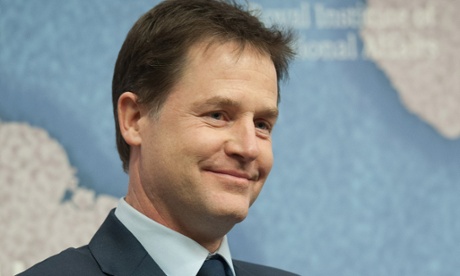
Ashdown says Clegg could stand in for Cameron in head-to-head debate with Miliband
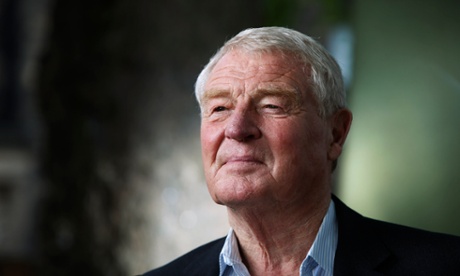
Lord Ashdown, the former Lib Dem leader and his party’s election coordinator, was on the Today programme too, talking about David Cameron’s stance on the debates.
He made two key points.
-
Ashdown said that Nick Clegg was still committed to the debates proposed by the broadcasters, despite Cameron saying only one should go ahead. He said he thought Cameron was hoping Clegg would pull out, meaning they would not go ahead.
I’m told that Downing Street is now depending on the Liberal Democrats to say no. Well, I’ve got bad news for them. We’re not going to.
I hope the broadcasters stand firm, but I need to be very clear that even if it is done in the fashion that the prime minister demands - and why on earth should he be able to veto the democratic debate? - we will still be there.
-
He said that if Cameron did not attend the proposed head-to-head with Miliband, Clegg would be happy to stand in for him to defend the government’s record.
If it is the case that there’s a two-headed debate and Mr Miliband turns up and the prime minister will not defend the record of the Government, then Nick Clegg will be very happy to.
Updated
Harvey Proctor denies attending sex parties or being involved in rent boy ring
The police are searching the home of Harvey Proctor, the former Conservative MP, as part of their investigation into historic allegations of child abuse. This is from the Press Association.
Detectives from the Metropolitan Police’s Operation Midland are carrying out the search of his home, which is within the 16,000-acre grounds of Belvoir Castle, in Leicestershire near Grantham.
Proctor, 68, works for the Duke and Duchess of Rutland, who live on the estate with their five children.
A Met Police spokesman said he “can confirm officers from Operation Midland are carrying out a search of an address in Grantham in connection with their inquiries”.
Operation Midland was launched by the Met last November following allegations that boys were sexually abused by a VIP paedophile ring centred around Westminster more than 30 years ago.
Officers are investigating allegations that three boys linked to the alleged ring were murdered.
Proctor represented Basildon in Essex from 1979 to 1983 and Billericay, also in Essex, from 1983 to 1987.
He has also sat on the executive of the right-wing pressure group the Monday Club.
The operation includes detectives from the child abuse investigation command and the homicide and major crime command.
Proctor has just been on the Today programme. He admitted that he pleaded guilty to gross indecency in the 1980s, but he said that his conduct would not be criminal now because the age of consent for homosexuals has been reduced from 21 to 16. The men involved told him they were over 21 when they weren’t, he said.
He also strongly rejected suggestions that he was involved in any form of Westminster rent boy ring.
I have never attended sex parties at Dolphin Square or anywhere else. I have not been part of any rent boy ring with cabinet ministers, other MPs or generals or the military. I conducted my private life in a discreet manner. It wasn’t I who outed myself, it was the press who did an assortment of things to out me ...
I was regarded in the House of Commons as a very independent MP and a loner. The last thing I would dream of doing was talking to other MPs or ministers or anybody else about my personal life. It wasn’t that I was ashamed of being a homosexual; it was that I didn’t think it mattered a damn to the work I did on behalf of my constituents.
He also said that he was in a “Kafka-esque situation” (ie, facing accusations, but without knowing exactly what they were).
I’ve taken the quotes from PoliticsHome.
Here’s the Green party’s reaction to David Cameron’s debates announcement. It’s from a party spokesman.
This swerve by Cameron will further damage trust in our political system. Not only is Cameron’s announcement cowardly but it also shows his contempt for the electorate. People want to see a set of debates between all major party leaders, yet the prime minister is clearly scared of scrutiny.
Natalie [Bennett, the Green party leader] is very much looking forward to debating with the other 6 party leaders. David Cameron must not be allowed to scupper these plans.
At Coffee House Isabel Hardman has written a blog accusing David Cameron of “running chicken” from the debates. Here’s an extract.
The prime minister is indeed running chicken from televised debates because he does not believe he will benefit from them. From a campaigning point of view, that is perhaps fair enough, but it is not a fair enough reason for scuppering debates that you once insisted were important for engaging voters and were here to stay.
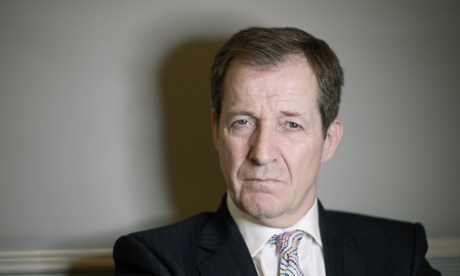
Alastair Campbell accuses Cameron of moral cowardice
Alastair Campbell, Tony Blair’s communications chief, was on the Today programme a few minutes ago criticising David Cameron for his stance on the debates. He has also set out his views in a blog. Here’s an extract.
So as [Cameron] pops up today to explain his latest wriggle just ask yourself this …
If Ed Miliband is as hopeless as Cameron and his press poodles say he is, why is the Tory leader so scared of going head to head over an extended period live on TV? He can’t claim to be a presidential figure whose prime ministerial qualities will inevitably shine through the electoral fog if he is cowering behind the sofa at the prospect of facing Miliband – unmediated by the press – in a live head-to-head encounter.
Because, to repeat, he has no record worth the name, and no plan for the future. Also, having been involved in the debate preparations on Labour’s side, I can see why one on one, policy v policy, plan v plan, he might want to duck this. But it is morally cowardly and democratically wrong.
Campbell tweeted about this last night, and he received a reply from Tim Montgomerie, the Times columnist and ConservativeHome founder.
Head to head TV debate could be game-changing moment when @Ed_Miliband breaks through prism of biased media. Hence @David_Cameron bottling
— Alastair Campbell (@campbellclaret) March 4, 2015
So, so partisan: @campbellclaret - who did not let Blair debate - attacks Cameron for not debating! https://t.co/jaDgyxvtlX
— Tim Montgomerie ن (@montie) March 4, 2015
In his blog, Campbell addresses this criticism.
It is true that I was sceptical almost 20 years ago, not least because I worried the media would make the campaign all about themselves, not about the issues at the heart of the campaign. But Cameron was and is in a different position. He is on record many times before and after the first debates saying how vital they are to democracy. And also, the precedent of the debates having been set, any analysis of this has changed fundamentally since 1997. The processology is only dominating the pre campaign because he has chosen that to be so.
On the Today programme Campbell said he did not know if Ed Miliband would agree to go ahead with the debates without Cameron. Norman Smith said earlier that he thought Miliband would (see 6.51am), but James Naughtie said Labour had not put up a frontbench spokesman to appear on the programme, suggesting that perhaps the party is still keeping its options open. (A frontbench spokesman would be expected to give a categorical answer to that question.)
Updated
And here’s Ukip’s response. It’s from a party spokesman.
After praising what a good thing debates were for democracy as late as 2014, why is David Cameron now acting chicken and running as far away from them as possible?
Labour accuses Cameron of 'outrageous' attempt to bully broadcasters
Here’s Labour’s response to the Number 10 letter. It’s from Douglas Alexander, the party’s general election strategy chair.
We continue to support the broadcasters’ proposals, including for seven-way debates alongside a two-way debate.
But this is an outrageous attempt from the prime minister to bully the broadcasters into dropping their proposals for a head-to-head debate between David Cameron and Ed Miliband.
That it comes only hours after Ed Miliband called David Cameron’s bluff and said he would debate him any time, any place, shows the lengths David Cameron will go to run scared of a debate with Ed Miliband.
Number 10's letter to the broadcasters
Here’s the letter to the broadcasters from Number 10 setting out David Cameron’s offer. It’s from Craig Oliver, Cameron’s director of communications, to Sue Inglish, chair of the broadcasters’ leaders debates committee.
Dear Sue,
I am writing to you in your capacity as chair of the broadcasters’ “leaders’ debates” committee.
As you know, I have had serious concerns about the way in which this has been handled from the start.
Despite the prime minister having been clear about his concern around holding debates in the short campaign, you did not consult us before issuing a press release last October outlining your plans for three debates during that period.
Had you consulted us, we could have also told you that we also did not think it was appropriate to exclude the Green party from the process.
Despite all of this, we then entered into negotiations in good faith, during which I made the case for a more representative debates structure, including the Greens. It is fair to say that the desire to exclude the Greens was clear from all other parties present.
Three months later – and again without consultation – you surprised us again by proposing a new seven-party structure, this time not only inviting the Greens, but Plaid Cymru and the SNP as well. Again, this was a flawed proposal – that has resulted in the DUP initiating what appears to be legitimate legal action.
Since this proposal has been suggested, there has been chaos. In recent weeks, you have avoided letting the parties sit in a room to hammer out proposals, making progress impossible.
In order to cut through this chaotic situation I am willing to make the following proposal:
There should be one 90-minute debate between seven party leaders before the short campaign. As well as the prime minister, the leaders of the Green party, Labour, Liberal Democrats, Plaid Cymru, SNP and Ukip should invited. The leader of the DUP should be allowed to make his case for why he should be involved. If the broadcasters cannot agree amongst themselves who hosts the debate, lots should be drawn, though the debate should be freely available to whoever wants to broadcast it. In order for it to be organised in time, the debate should take place during the week beginning the 23rd March. I will make myself available to negotiate the details. Having been the editor of numerous broadcast news and current affairs programmes, I know this is ample time to organise a programme.
This is our final offer, and to be clear, given the fact this has been a deeply unsatisfactory process and we are within a month of the short campaign, the prime minister will not be participating in more than one debate.
Yours sincerely,
Craig Oliver
Prime minister’s director of communications
After weeks of prevaricating, David Cameron has finally made his move to try to derail the proposed televised leaders’ debates. He has said he will refuse to take part in the three debates proposed, including the head-to-head with just Ed Miliband, and that he will only attend one 90-minute debate, with at least six other leaders, later this month. Downing Street will be very happy if this never actually takes place and, even if it does, it thinks the event will be so short and chaotic that it won’t do Cameron any harm.
My colleague Nicholas Watt has written up the story here.
I’ll be covering reaction to this as the day goes on. The BBC’s Norman Smith told the Today programme about half an hour ago that he thought the broadcasters were minded to stick to their original plans (two seven-party debates, and one with just Cameron and Miliband, all during April), and that they would empty chair Cameron if he refused to attend. This means the final debate would involve Miliband on his own being grilled by Jeremy Paxman, but Smith said he thought Labour would be happy for this to go ahead.
Here’s the agenda for the day.
9am: Nick Clegg hosts his Call Clegg phone-in.
9.30am: The Office for National Statistics publishes figures on inequality and life expectancy at birth.
10.30am: The intelligence and security committee publishes a report on gender diversity in the intelligence community.
Morning: David Cameron makes a campaign visit.
As usual, I will be also covering all the breaking political news from Westminster, as well as bringing you the most interesting political comment and analysis from the web and from Twitter. I will post a summary at lunchtime and another in the afternoon.
If you want to follow me on Twitter, I’m on @AndrewSparrow.
Updated











Dear Andrew, do you have any idea what DC and the Tories hope to gain with their vacillation over the TV debates? Do they hope to please some sector of the electorate to gain an advantage? Or are they just scared of loosing advantage (to UKIP)? It makes no sense ( to someone who is never going to vote Tory or UKIP)...Peter